Impact of Digital Misinformation on Political Awareness in Pakistan: The Role of Social Media Usage, Media Literacy, and Political Interest
DOI:
https://doi.org/10.63056/lsjmiss.2.1.2026.159Keywords:
Digital misinformation, political awareness, use of social media, media literacy, political interest, Pakistan, Lahore, survey, research, misinformation exposureAbstract
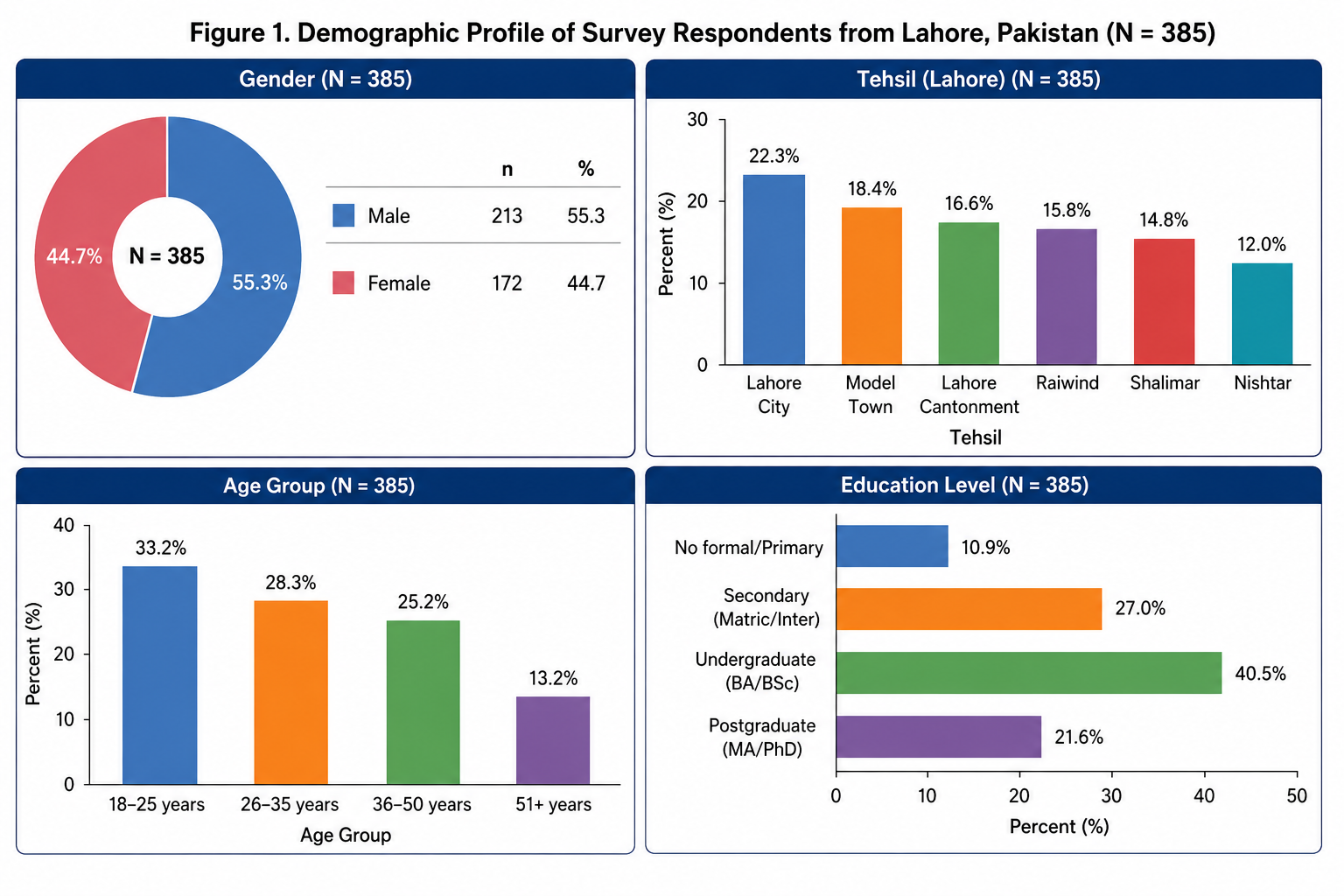
The spread of online fake news in social media has become a major danger to political awareness and participation in democracy in developing countries. This paper will analyze how the exposure of digital misinformation, social media pattern use, media literacy and political interest interact to influence the political awareness of citizens in Lahore, Pakistan. The quantitative cross-sectional survey design was utilized to collect the data of 385 adult respondents who were sampled using stratified random sampling through six tehsils of Lahore. The exposure to misinformation (Digital Misinformation Exposure Scale, DMES), the use of social media (Social Media Intensity Scale, SMIS), media literacy (Media Literacy Assessment Tool, MLAT), political interest (Political Interest Scale, PIS), and political awareness (Political Awareness Index, PAI) were evaluated by means of validated instruments. The multi-regression analysis, Pearson correlations, and moderated mediation modeling with the Hayes PROCESS macro showed that the exposure to digital misinformation had a significant and negative impact on political awareness (beta = -.46, p =.001). The use of social media acted as a buffer to this relationship, making the adverse effect of misinformation stronger at the high usage levels. Media literacy became one of the protective moderators that played a crucial role in reducing the level of misinformation-awareness gap in the respondents who were highly literate. Political interest was a positive predictor of political awareness (beta =.38, p <.001) and mediated the effects of misinformation on the awareness. The entire model described 61 percent of variations in political awareness. The direct implications of these findings to the digital literacy policy, media regulation, and civic education in Pakistan and other similar developing democracies are: Government, civil society and media organizations are discussed in terms of recommendations.
Downloads
Published
How to Cite
Issue
Section
License
Copyright (c) 2026 Iram Naeem, Ali Abbas

This work is licensed under a Creative Commons Attribution 4.0 International License.