Does Green Energy Mitigate the Environmental Impact of Industrialization and FDI while Promoting Economic Growth in OIC Countries?
DOI:
https://doi.org/10.63056/lsjmiss.2.1.2026.174Keywords:
Green Energy, CO₂ Emissions, Industrialization, FDI, Economic Growth, Financial Development, AMG, CCEMG, DH Causality, EKC, OIC CountriesAbstract
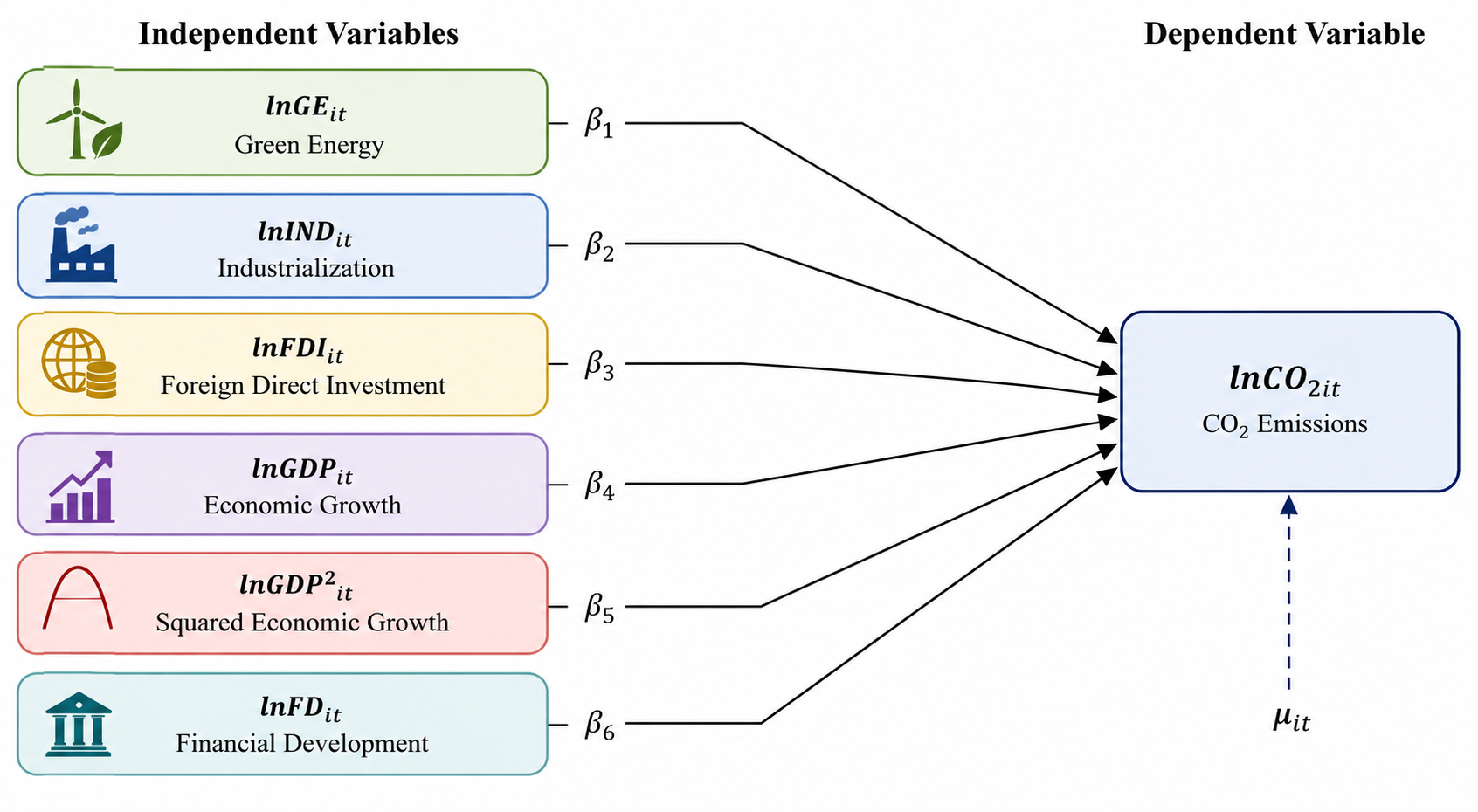
This study investigates whether the adoption of green energy mitigates the environmental impacts of industrialization and foreign direct investment (FDI) inflows in the Organisation of Islamic Cooperation (OIC) countries during the period 2003–2024. The empirical analysis employs Pesaran’s (2004) cross-sectional dependence test, second-generation CIPS and CADF panel unit root tests, Westerlund’s (2007) panel cointegration test, the Augmented Mean Group (AMG) estimator, the Common Correlated Effects Mean Group (CCEMG) estimator, and the Dumitrescu–Hurlin (DH) panel causality test. The cross-sectional dependence test confirms that common global shocks exert simultaneous effects across all OIC member countries. The stationarity analysis indicates that all variables are integrated of order one, I(1), while the Westerlund cointegration test reveals a stable long-run relationship among the variables. The findings provide support for the Pollution Haven Hypothesis (PHH) and indicate that fossil-fuel-based industrialization contributes significantly to environmental degradation. Green energy consumption is found to reduce CO₂ emissions, whereas industrialization and FDI inflows are positively associated with emissions. Furthermore, the results reveal an inverted U-shaped relationship between economic growth and environmental degradation, supporting the Environmental Kuznets Curve (EKC) hypothesis for OIC countries. The causality analysis indicates bidirectional causality between green energy consumption and CO₂ emissions, while economic growth and industrialization exhibit unidirectional causality toward emissions. These findings offer important policy implications for strengthening OIC energy cooperation, promoting green industrialization strategies, and implementing climate-friendly FDI screening mechanisms.
Downloads
Published
How to Cite
Issue
Section
License
Copyright (c) 2026 Muhammad Zubair Ashraf, Tanzeela Shams, Muhammad Ali

This work is licensed under a Creative Commons Attribution 4.0 International License.