Competitive Intelligence in China–ASEAN Relations: Enhancing Strategic Cooperation in Southeast Asia
DOI:
https://doi.org/10.63056/lsjmiss.2.1.2026.175Keywords:
Competitive Intelligence; China–ASEAN Relations; Strategic Cooperation; Southeast Asia; Public Diplomacy; Chinese Development Finance; Belt and Road Initiative; Regional InterdependenceAbstract
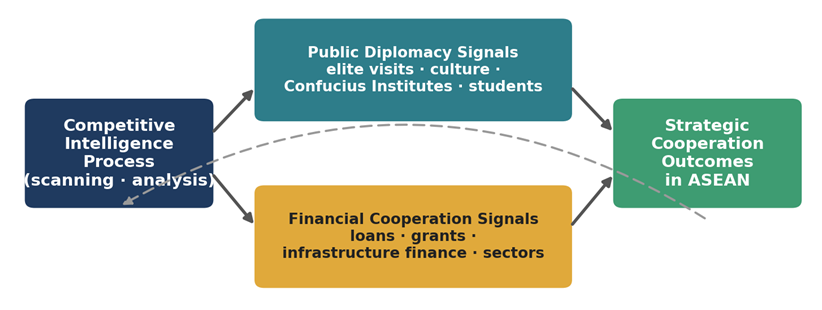
Purpose: The objective of the current research is to look at the applicability of competitive intelligence (CI) as a methodology for understanding the relationship between China and ASEAN and for fostering strategic cooperation in the region. China’s public diplomacy and development aid are viewed as information-based signals for engagement with ASEAN members.
Methodology/Approach: A quantitative, data-driven, observational design is applied to two authentic, publicly available, non-synthetic AidData resources: China’s Public Diplomacy in East Asia and the Pacific and China’s Global Loans and Grants Dataset, both constructed through the Tracking Underreported Financial Flows (TUFF) methodology (Custer et al., 2023; Goodman et al., 2024). The data are filtered to ASEAN recipients and analysed using descriptive statistics, country-level comparison, trend analysis, Pearson correlation, regression/panel-style estimation, and the construction of composite engagement indicators.
Findings: For the years 2000-2023, the finance data set reflects around USD 196.4 billion in Chinese engagements to ASEAN recipients analyzed, with a growth rate of 13.6% per year, and the commercial engagements (OOFs) forming 63.8% of the total engagements. Financial and cultural tools of diplomacy show no correlation between each other, with a correlation coefficient of r=0.42 between the loans and financial public diplomacy, suggesting a conscious diversification of influence strategies, while an engagement index helps identify a distinct group of priority countries that consist of Thailand, Indonesia, and Vietnam, respectively.
Originality/Relevance: In other words, it brings together the concepts of competitive intelligence with public diplomacy, soft power, regional interdependence, and development finance in an empirical model for China-ASEAN strategic cooperation based on real country-level data rather than anecdotal evidence or examples.
Downloads
Published
How to Cite
Issue
Section
License
Copyright (c) 2026 Sujie Liu

This work is licensed under a Creative Commons Attribution 4.0 International License.