The impact of Emotional Intelligence of Employees Behavior on Flight Safety: A study of Pakistan’s Aviation sector
DOI:
https://doi.org/10.63056/lsjmiss.2.2.2026.179Keywords:
Emotional Intelligence; Employee Behavior; Flight Safety; Aviation Sector; Crew Resource ManagementAbstract
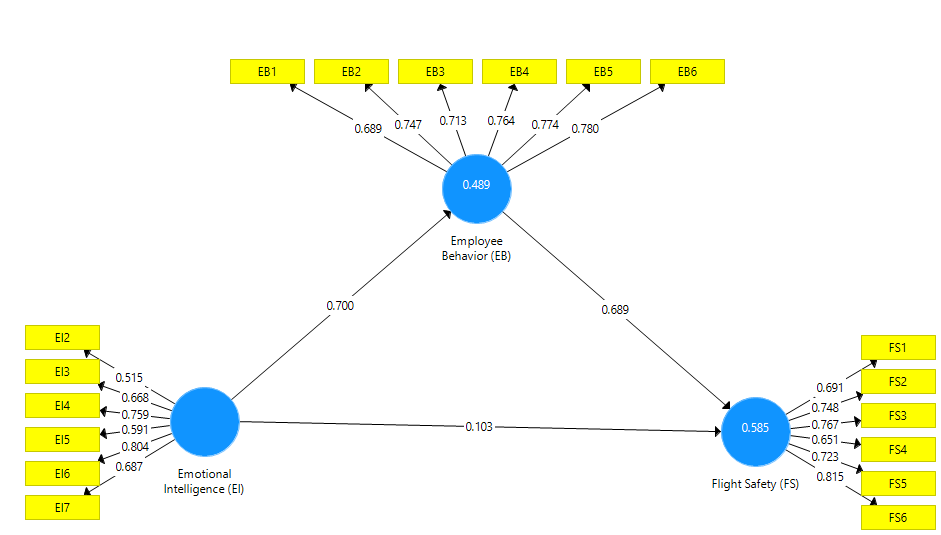
The aim of this study is to investigate the relationship between Emotional Intelligence (EI), Employee Behavior (EB) and Flight Safety (FS) in aviation industry and the role of employee behavior as the mediating variable in the relation. The study is based on Emotional Intelligence Theory, Human Factors Theory and Crew Resource Management (CRM) and suggests that emotional competencies would have a significant influence on the safety-related outcomes through behavioural mechanisms. A quantitative research design (cross section) was used and data were gathered from 230 aviation professionals including those working in the airlines, ground handling agencies, civil aviation authority and general aviation organizations in Pakistan. The data were analyzed descriptively, reliability and validity test, normality data test, and structural equation modeling. The results show that there is a positive significant relation between Emotional Intelligence and Employee Behavior and Flight Safety. Furthermore, Employee Behavior plays a key role in Flight Safety, suggesting its importance in operational safety performance. The findings also support the partial mediation of the relationship between Emotional Intelligence and Flight Safety by Employee Behavior, indicating that the relationship between Emotional Intelligence and Flight Safety is mediated not only directly, but also indirectly through the Employee Behavior. The descriptive results also show that the respondent's perceptions of their Emotional Intelligence were at the moderate level and their perceptions of their Employee Behaviour and Flight Safety were at the high level. The results indicate that the use of emotional intelligence training for employees in aviation should be integrated into recruitment, selection and professional development programs to improve employee behavior and therefore the overall safety of flight.
Downloads
Published
How to Cite
Issue
Section
License
Copyright (c) 2026 Alisha Bukhari, Arbab Abdul Shakoor, Shahid Mahmood

This work is licensed under a Creative Commons Attribution 4.0 International License.