Institutional Contexts for Youth Participation and Cultural Identity in Ethnic-Minority Oral Narratives: An Archival Study of Intangible Cultural Heritage in Jilin, Northeast China
DOI:
https://doi.org/10.63056/lsjmiss.2.2.2026.182Keywords:
youth participation, cultural identity, intangible cultural heritage, oral narratives, ethnic minorities, Jilin Province, intergenerational transmissionAbstract
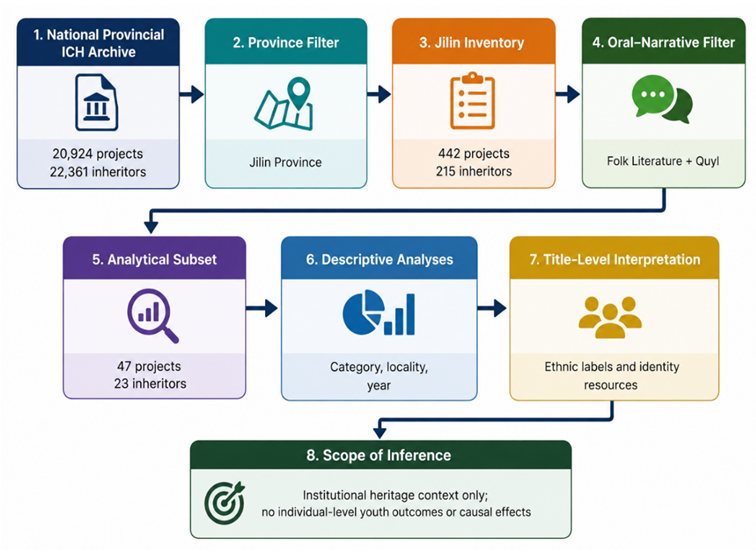
This archival study maps the institutional heritage environment within which youth participation and cultural-identity processes may be investigated in the ethnic-minority oral traditions of Jilin Province, Northeast China. The analysis used the Spatial Distribution Dataset of Provincial Intangible Cultural Heritage Projects and Inheritors in China (2005–2024), comprising 20,924 project records and 22,361 representative-inheritor records. Filtering for Jilin Province identified 442 projects and 215 inheritors. Folk Literature and Quyi were treated as the principal oral-narrative categories, yielding 47 projects and 23 associated inheritors. Descriptive analysis examined category composition, municipal distribution, and administrative recognition year; a conservative title-level review identified explicitly named Korean, Manchu, and Mongolian traditions and recurrent identity resources. Traditional Skills was the largest provincial category, whereas Folk Literature and Quyi together represented 10.63% of Jilin’s inventory. Oral-narrative projects were concentrated in Jilin City, Songyuan, Changchun, and Yanbian, and 61.70% were recognized in the 2009–2011 rounds. Fourteen project titles explicitly referenced Korean, Manchu, or Mongolian traditions. Place, ancestry, heroic memory, ritual knowledge, language, moral instruction, and performed narration emerged as recurrent identity resources. The study establishes a reproducible regional sampling frame for youth-centered heritage research; however, the archive contains no individual measures of age, participation, language proficiency, or cultural identity. Accordingly, no individual-level or causal claims are made. Future research should test active performance, intergenerational learning, minority-language use, and community-governed digital participation through survey, interview, participatory, and longitudinal designs.
Downloads
Published
How to Cite
Issue
Section
License
Copyright (c) 2026 Yao Chen, Xiangyuan Jin

This work is licensed under a Creative Commons Attribution 4.0 International License.