Integrating 20th-Century Chinese Socially Engaged Music into University Aesthetic Education: A Multi-Source Analysis of Humanistic Literacy
DOI:
https://doi.org/10.63056/lsjmiss.2.2.2026.184Keywords:
aesthetic education; Chinese music; humanistic literacy; cultural openness; music information retrieval; multi-source triangulation; higher educationAbstract
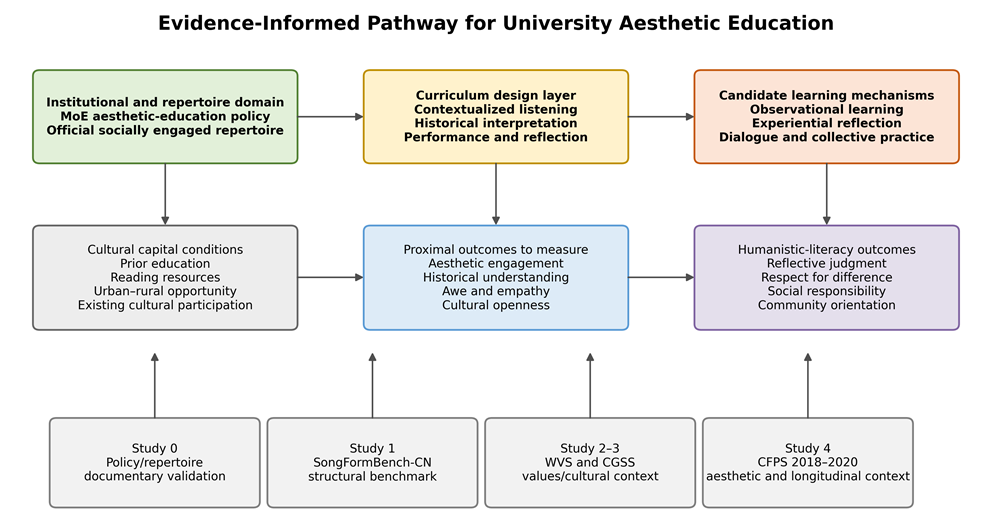
This study develops an evidence-informed pathway for incorporating twentieth-century Chinese socially engaged music into university aesthetic education while testing the empirical boundaries of claims about humanistic literacy. Research gap: Existing scholarship often discusses music, national culture, aesthetic education, and student development within separate literatures; it rarely distinguishes direct curricular evidence from structural benchmarks and population-level contextual indicators. A convergent multi-source design combines directed analysis of Chinese aesthetic-education policies and an officially recommended patriotic-song repertoire; structural analysis of 100 Chinese songs in SongFormBench; weighted regression using World Values Survey China data (analytic n = 2,917); province-fixed-effects models using the Chinese General Social Survey 2006 (model n = 8,041–9,096); and weighted cross-sectional and lagged models using China Family Panel Studies 2018–2020 (cross-sectional n = 26,022; panel n = 15,984–16,076). The datasets were analyzed separately and integrated through a joint display. The documentary layer directly supports the relevance of historically and socially situated repertoire to Chinese university aesthetic education. SongFormBench shows a chorus- and verse-centered contemporary structural benchmark with four modestly differentiated structural clusters. In WVS China, education and cross-group trust have small positive associations with an additive humanistic-orientation proxy. In CGSS, music/opera engagement is positively associated with cultural openness, but not with civic orientation, national solidarity, or life satisfaction. In CFPS, education and book engagement predict aesthetic orientation cross-sectionally, whereas aesthetic orientation does not predict later trust, life satisfaction, or happiness after baseline adjustment. The analysis separates what is documented, what is statistically associated, and what remains untested. Practical relevance: Universities can use historically contextualized listening, comparative structural analysis, discussion, performance, and reflection as a curriculum sequence, but should evaluate humanistic outcomes prospectively rather than infer them from general cultural participation.
Downloads
Published
How to Cite
Issue
Section
License
Copyright (c) 2026 Zheng Wang

This work is licensed under a Creative Commons Attribution 4.0 International License.