Knowledge, Attitude, and Practice of Local Residents towards Solid Waste Management in Taluka Shahdadkot, Sindh, Pakistan: A Cross-Sectional Study
DOI:
https://doi.org/10.63056/lsjmiss.2.3.2026.246Keywords:
solid waste management; knowledge attitude practice (KAP); Shahdadkot; Sindh; PakistanAbstract
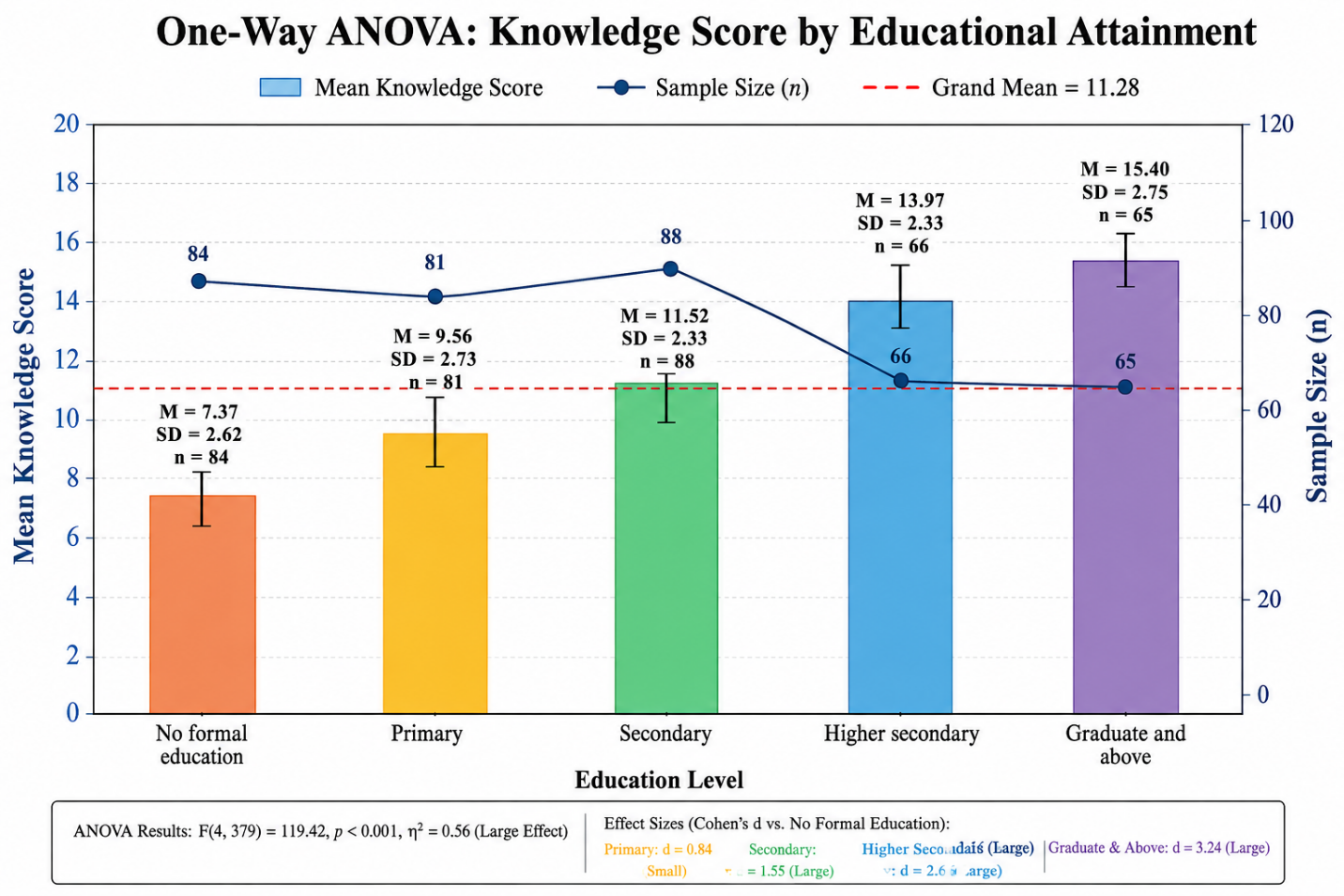
Rapid urbanization and population growth in secondary towns of Sindh, Pakistan has placed increasing pressure on the capacities of these municipalities in terms of solid waste management (SWM); the consequent environmental and public-health impacts at the household and community level have been highly damaging. Community knowledge, attitude and practices (KAP) are known as the immediate cause of the outcomes of SWM, but there is limited empirical evidence in smaller taluka like Shahdadkot. The objective of this study was to assess the knowledge, attitude and practices of local residents of Taluka Shahdadkot in relation to SWM and testing the demographic, knowledge and attitudinal correlates of waste-management practice. Cross sectional survey design was used. A pre-validated and structured KAP questionnaire (Cronbach's α = 0.81 for Knowledge, 0.78 for Attitude and 0.83 for Practice) was used to gather information from 384 household heads who were randomly selected from urban and rural union councils of taluka. Descriptive statistics, Pearson correlation, one-way analysis of variance (ANOVA), analysis of covariance (ANCOVA) and multiple linear regression were used for data analysis. The outcomes show that overall respondents' level of knowledge about SWM was moderate (M = 11.28 SD = 3.82 out of 20), their attitude was moderately favorable (M = 16.60 SD = 3.30 out of 25) and their level of practice was moderate (M = 14.98 SD = 3.53 out of 25) about SWM. Knowledge differed significantly across educational strata, F(4, 379) = 119.42, p < .001, η² = .56. The practice scores were significantly higher for urban compared with rural respondents, F(1, 382) = 44.16, p < .001. Attitude scores were still significantly higher for residents of urban localities than for rural residents after adjusting for household income (ANCOVA, F(1,381) = 5.15, p < .001). In a multiple regression model, knowledge, attitude, monthly household income and being urban-dwelling were significant positive predictors of waste-management practice (R² = .62, adjusted R² = .61, F(5, 378) = 121.88, p < .001), with attitude being the strongest predictor (β = 0.42). The local population of Shahdadkot has moderate level of knowledge and practice attitude gap in SWM. There is a need to build the momentum by facilitating targeted education-related awareness-raising campaigns and upgrading waste collection waste infrastructure, including in rural union councils, in order to ensure that positive attitudes are followed by consistent practice.
Downloads
Published
How to Cite
Issue
Section
License
Copyright (c) 2026 Muhammad Ayoub Khoso, Mariam Abbasi, Muhammad Asif Rao

This work is licensed under a Creative Commons Attribution 4.0 International License.