Green Finance, Digitalization, and Sustainable Economic Growth Nexus: A Case Study of Pakistan
DOI:
https://doi.org/10.63056/lsjmiss.1.4.2025.134Keywords:
Green finance, Digitalization, Sustainable economic growth, Time series analysis, ARDL model, Pakistan, Environmental sustainability, Financial developmentAbstract
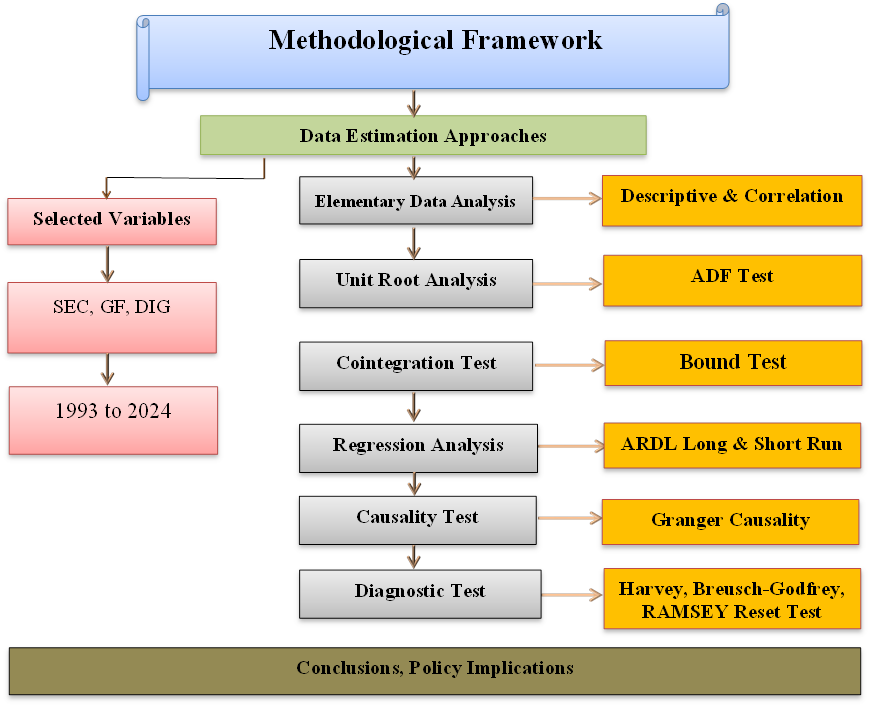
This study examines the relationship between green finance, digitalization, and sustainable economic growth in Pakistan using annual time-series data from 1993 to 2024. The study aims to explore how financial innovation and technological transformation contribute to environmentally sustainable economic development. The Autoregressive Distributed Lag (ARDL) bounds testing approach is employed to analyze both the short-run and long-run dynamics among the variables. The empirical findings confirm the existence of a long-run cointegrating relationship between green finance, digitalization, and sustainable economic growth. The long-run results indicate that green finance significantly promotes sustainable economic growth by encouraging environmentally responsible investments and improving resource efficiency. Similarly, digitalization demonstrates a strong positive impact by enhancing productivity, financial inclusion, and technological innovation. The short-run dynamics also support these results, while the error correction term confirms a stable adjustment toward long-run equilibrium. Diagnostic tests verify the robustness and stability of the estimated model. The findings suggest that strengthening green financial systems and expanding digital infrastructure can play a crucial role in achieving sustainable economic growth in Pakistan.
Downloads
Published
How to Cite
Issue
Section
License
Copyright (c) 2025 Muhammad Ahsan Bhutta, Rana Zafar Hayat, Nadia Ameer

This work is licensed under a Creative Commons Attribution 4.0 International License.