The Invisible Tragedy: Exploring Slow Violence in Thomas Hardy’s Tess of the D’Urbervilles
DOI:
https://doi.org/10.63056/jllsa.2.1.2026.129Keywords:
Slow Violence, Feminism, Tess of the D’Urbervilles, Victorian Novel, Rob NixonAbstract
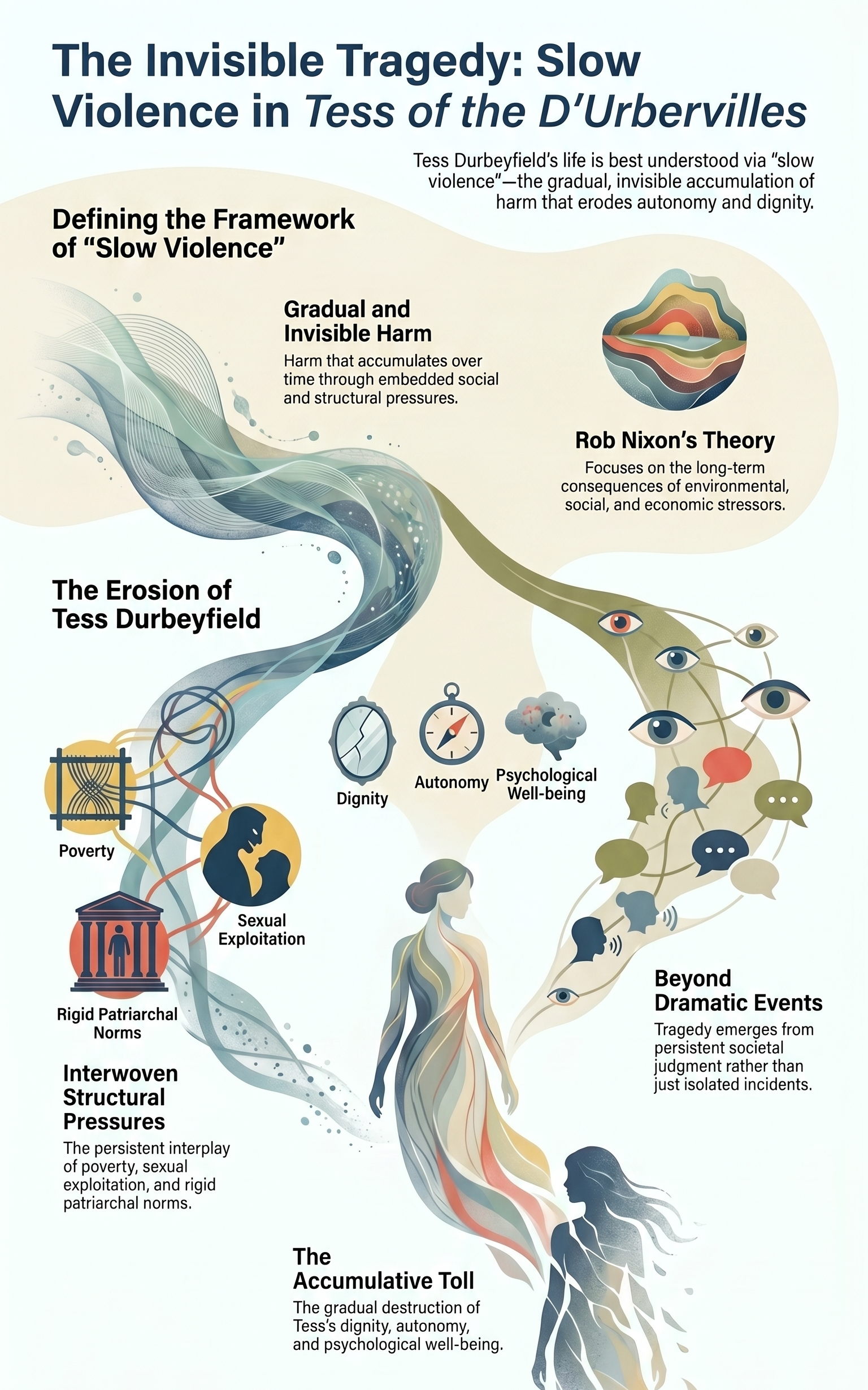
Slow violence is a critical concept that examines the gradual, often invisible forms of harm that accumulate over time, affecting individuals and communities in ways that are structurally embedded and socially reinforced. Within this framework, Rob Nixon’s theory of slow violence emphasizes how long-term environmental, social, and economic pressures produce profound consequences that are frequently overlooked. Although scholars have explored Tess of the D’Urbervilles in relation to Victorian morality, gender, and class, there is a noticeable gap in research applying Nixon’s concept of slow violence to Hardy’s novel. This study addresses that gap by employing a qualitative textual analysis to examine the cumulative effects of social, economic, moral, and environmental pressures on Tess Durbeyfield. The analysis reveals that Tess’s tragedy is not the result of isolated or dramatic events but emerges from the persistent interplay of poverty, sexual exploitation, patriarchal norms, and societal judgment. These interwoven pressures produce psychological and emotional trauma, constrain Tess’s autonomy, and gradually erode her dignity and sense of self. By demonstrating how slow violence operates both structurally and internally within Tess’s life, the study highlights the novel’s critique of Victorian society and underscores the relevance of Nixon’s framework in literary analysis. This research thus affirms the utility of slow violence as a lens for understanding the invisible, accumulative forces that shape human experience and narrative tragedy.
Downloads
Published
How to Cite
Issue
Section
License
Copyright (c) 2026 Sawera Tanveer, Malik Umer Ajmal, Tayyaba Qadeer, Anosha Sheikh

This work is licensed under a Creative Commons Attribution 4.0 International License.