Thread, Pin, and Sacred Geometry: Aisha Khalid's Spatial Installations and the Politics of Feminine Heritage
DOI:
https://doi.org/10.63056/jllsa.2.7.2026.191Keywords:
metamodernism, Postmodernism, Oscillation, Contemporary art, ReflexivityAbstract
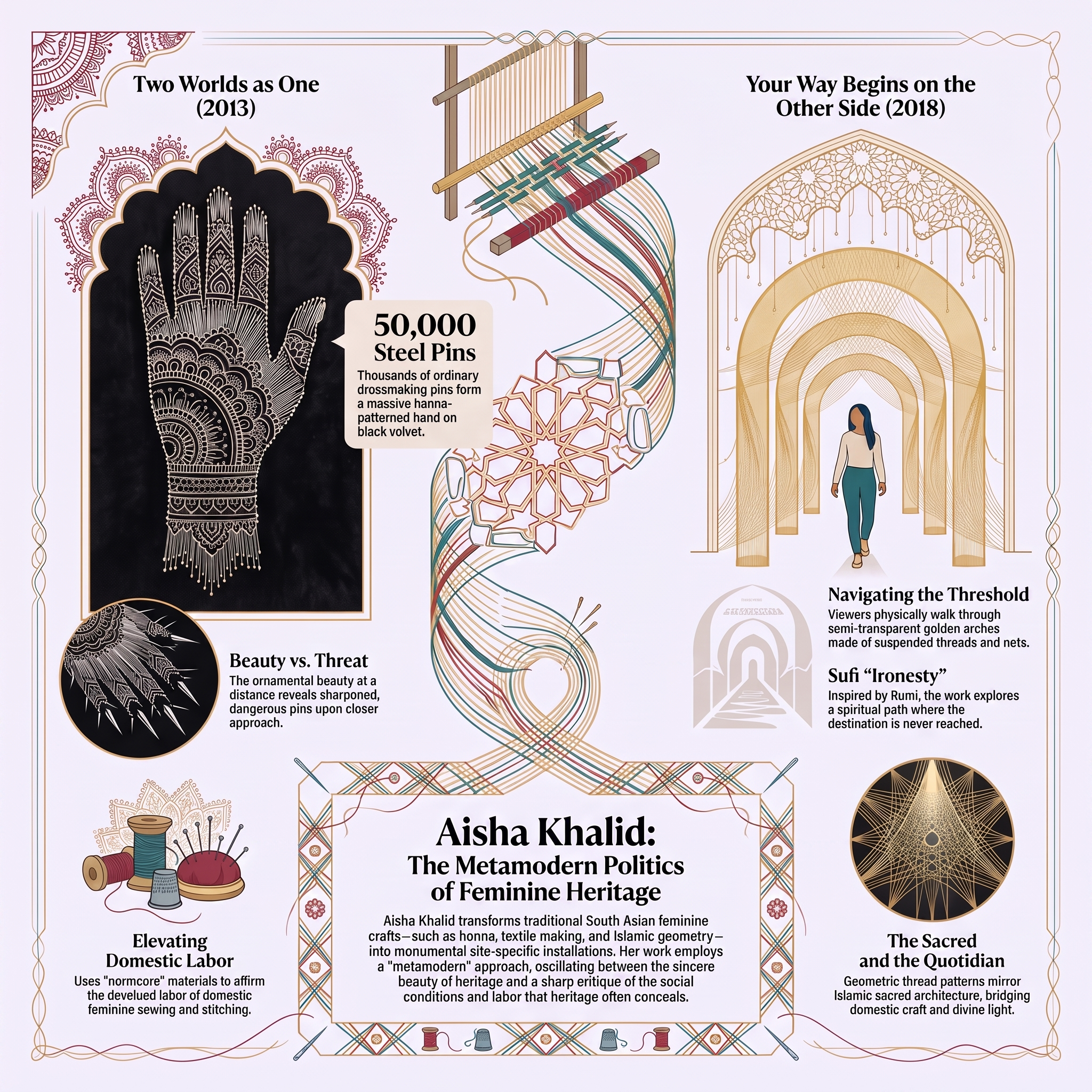
Pakistan-based artist Aisha Khalid is a National College of Arts (NCA) Lahore-trained professional miniature painter․ For over two decades‚ she has developed a unique practice‚ moving between the scale of miniature painting and the scale of large site-specific pin‚ thread and velvet installations․ Through the lens of the art-historical categories of metamodernism and feminist art history‚ the paper seeks to explore Khalid's two large‚ contemporary site-specific art installations: Two Worlds as One (2013) and Your Way Begins on the Other Side (2018)․ The paper argues that Khalid's installations constitute a form of metamodern constructive pastiche in which South Asian feminine craft traditions such as henna ornamentation‚ domestic textile making and Islamic sacred geometry are assembled into new architectural configurations that celebrate the correspondences‚ ambiguities and complexities of South Asian feminine cultural heritage but also render visible the material conditions - restraint‚ labor‚ potential harm - that that heritage conceals․ Drawing on Vermeulen and van den Akker's (2010) notion of metamodern oscillation‚ Gibbons' (2017) notion of metamodern affect‚ and feminist scholarship on craft‚ labor and spatial experience‚ the paper argues that Khalid's work represents a meaningful but underexplored contribution to both feminist spatial art and to the study of metamodernism in non-Western contexts․ It allows for a close reading of the treatment of normcore‚ the meta-cute‚ reflexivity‚ the double frame narrative and maximalism as metamodern aesthetics that has not yet been systematically brought to bear on the artist's practice‚ and‚ in particular‚ the comparative reading of I Am and I Am Not within the wider evolution of Khalid's metamodern aesthetic practice․
Downloads
Published
How to Cite
Issue
Section
License
Copyright (c) 2026 Durdana Naseer, Dr. Sumera Jawad

This work is licensed under a Creative Commons Attribution 4.0 International License.