Dynamics of Refusal Strategies with Reference to Class and Gender: A Study of Jane Austen’s Mansfield Park
DOI:
https://doi.org/10.63056/jllsa.2.6.2026.193Keywords:
gender differences, refusal strategies, speech acts, Mansfield Park, Jane AustenAbstract
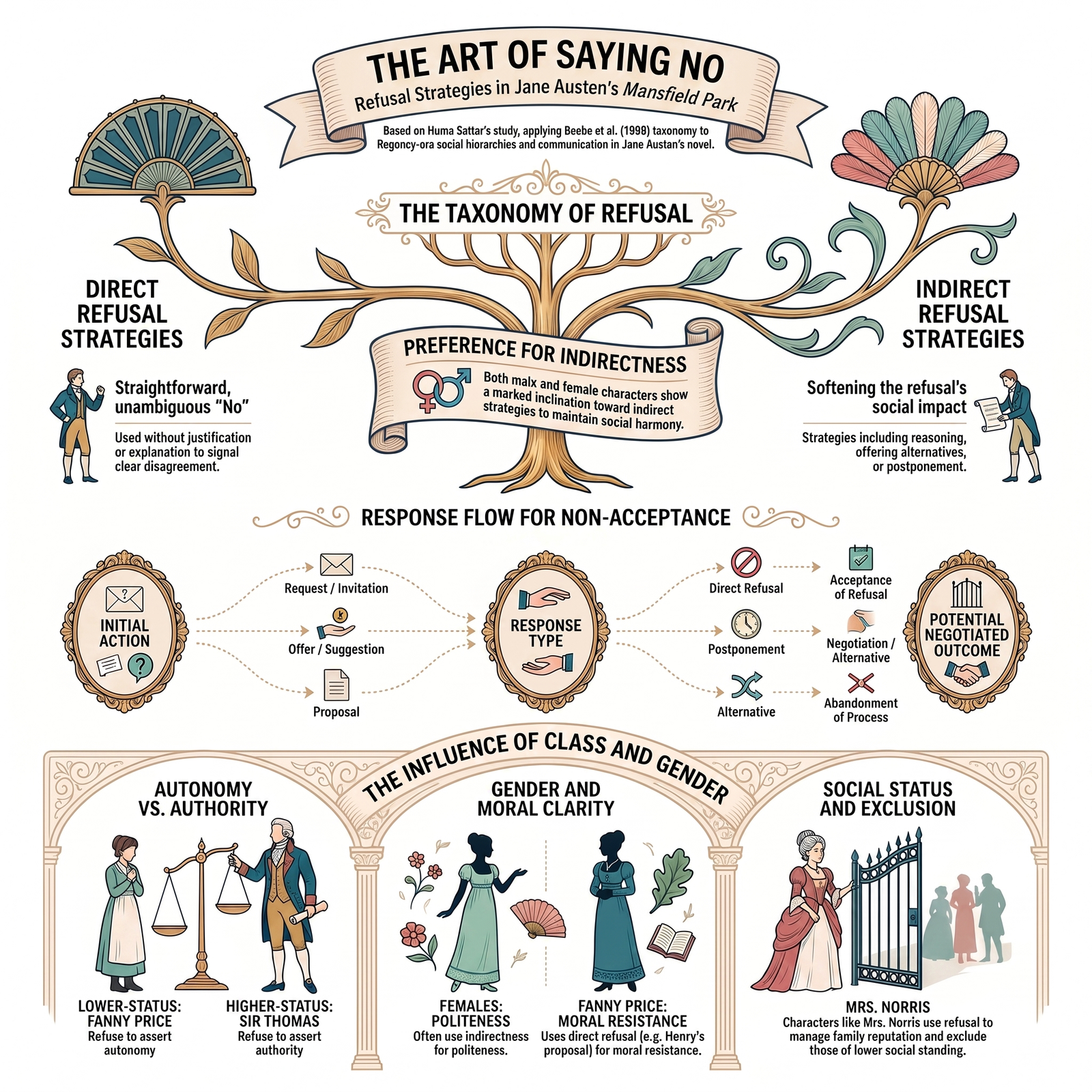
This study deals with the investigation of various strategies of refusal used by both male and female characters of the novel Mansfield Park. The study also explores how gender differences and social class influence the employment of refusal strategies by both the male and female characters in the novel. To achieve the goals, the study applied taxonomy of refusal strategies given by Beebe, Takahashi, and Uliss-Weltz (1990). In refusals, individuals decline invitations, offers, suggestions and requests. Refusals are categorized into two categories: semantic formulas and adjuncts. Semantic formulas are categorized into two subtypes: direct refusal strategies and indirect refusal strategies. Research reveals that the main distinction in refusal strategies between males and females lies in their tendency to use direct or indirect refusals. The findings of the research show that both male and female characters employed both the direct refusals and indirect refusals, but their inclination is more towards the indirect refusals. The study also highlights that refusals of interlocutors of lower status (Fanny) assert their autonomy while that of higher status employed refusals to ensure their authority. The study has contributions to the study of speech acts.
Downloads
Published
How to Cite
Issue
Section
License
Copyright (c) 2026 Huma Sattar, Liaqat Iqbal

This work is licensed under a Creative Commons Attribution 4.0 International License.