Who Gets Heard? Money and Voice in Everyday Discourse
DOI:
https://doi.org/10.63056/jllsa.2.2.2026.198Keywords:
voice, economic inequality, communication, discourse, communicative justice, public sphere, symbolic power, digital mediaAbstract
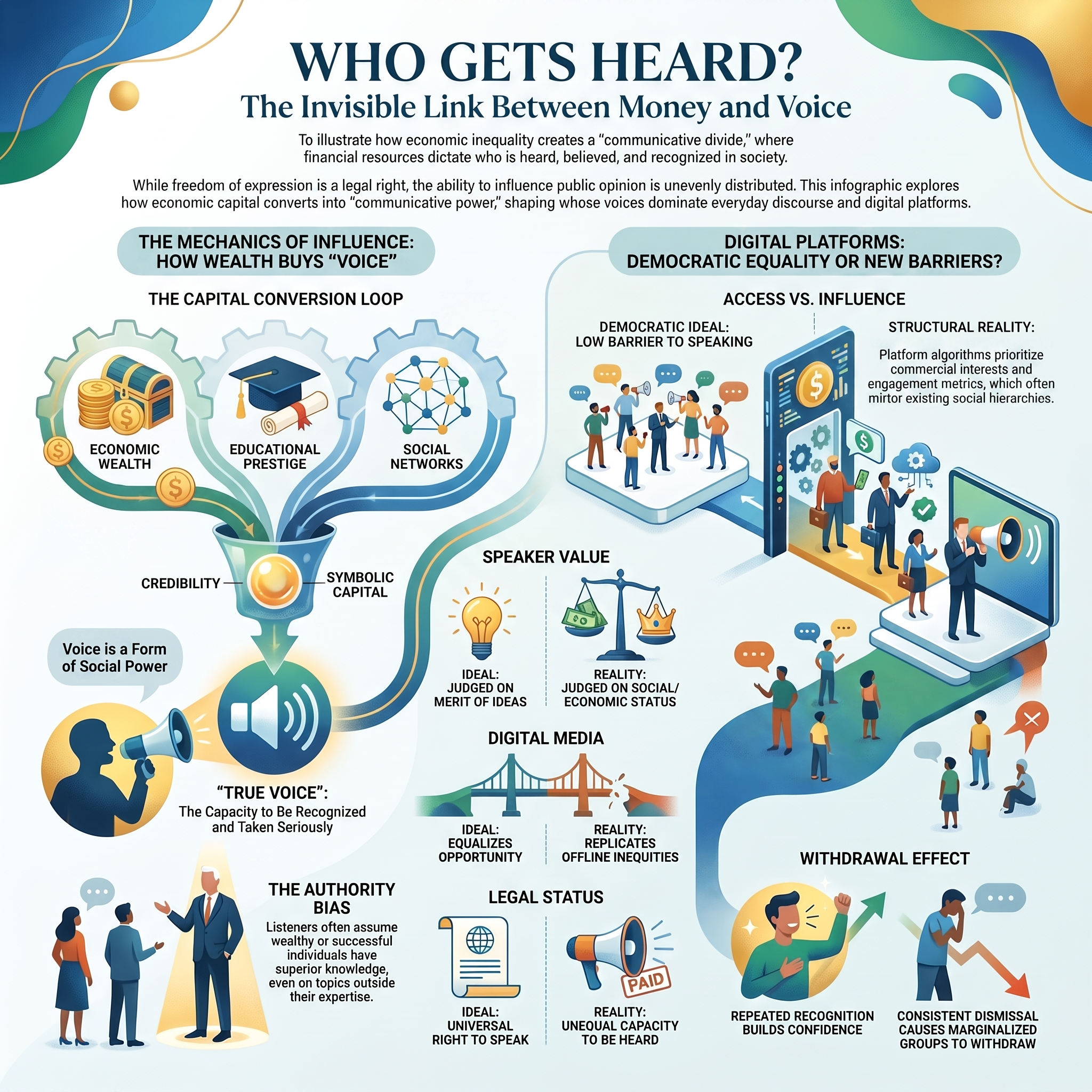
In an era of growing economic inequalities and fast changing communications technology, the topic of who gets to speak in ordinary discourse is more relevant than ever. Countries may espouse freedom of expression as a basic right but the ability to influence discussion, shape public opinion and participate effectively in social and political life is not even distributed. This article analyzes the link between money and speech, researching how economic resources structure communicative power in interpersonal, institutional and digital contexts. The study is looking for a conceptual and analytical method, combines scholarship from language, communication studies, sociology, political theory and media studies to explore processes of conversion of economic capital into credibility, visibility and influence. The theoretical work of Pierre Bourdieu, Jürgen Habermas, Nancy Fraser, Michel Foucault and Nick Couldry, the paper argues that voice should be viewed not only as the ability to speak but the socially mediated capacity to be heard, recognized and taken seriously. That economic inequality extends beyond the material divide to influence access to means of communication, institutional legitimacy, social networks, and public attention and influence the contours of whose voices dominate ordinary talk. Digital media have created new possibilities for involvement, while replicating existing inequities through algorithmic prominence, commercialization, and unequal access to technological resources. The study argues that real communicative inclusions entails going beyond formal rights of free speech to include the structural constraints that determine whose voices matter. The variety of theoretical approaches, this paper contributes to continuing discussions of democratic participation, communicative justice, and social inequality by giving a conceptual framework for theorizing voice as a key dimension of power in modern contexts.
Downloads
Published
How to Cite
Issue
Section
License
Copyright (c) 2026 Monday Emmanuel Pereowei

This work is licensed under a Creative Commons Attribution 4.0 International License.