Linguistic Complexity and Readability in Corporate Privacy Policies: A Corpus-Based Comparison of Apple and Samsung
DOI:
https://doi.org/10.63056/jllsa.2.7.2026.221Keywords:
privacy policy, corpus linguistics, readability analysis, lexical density, digital discourse, Apple, SamsungAbstract
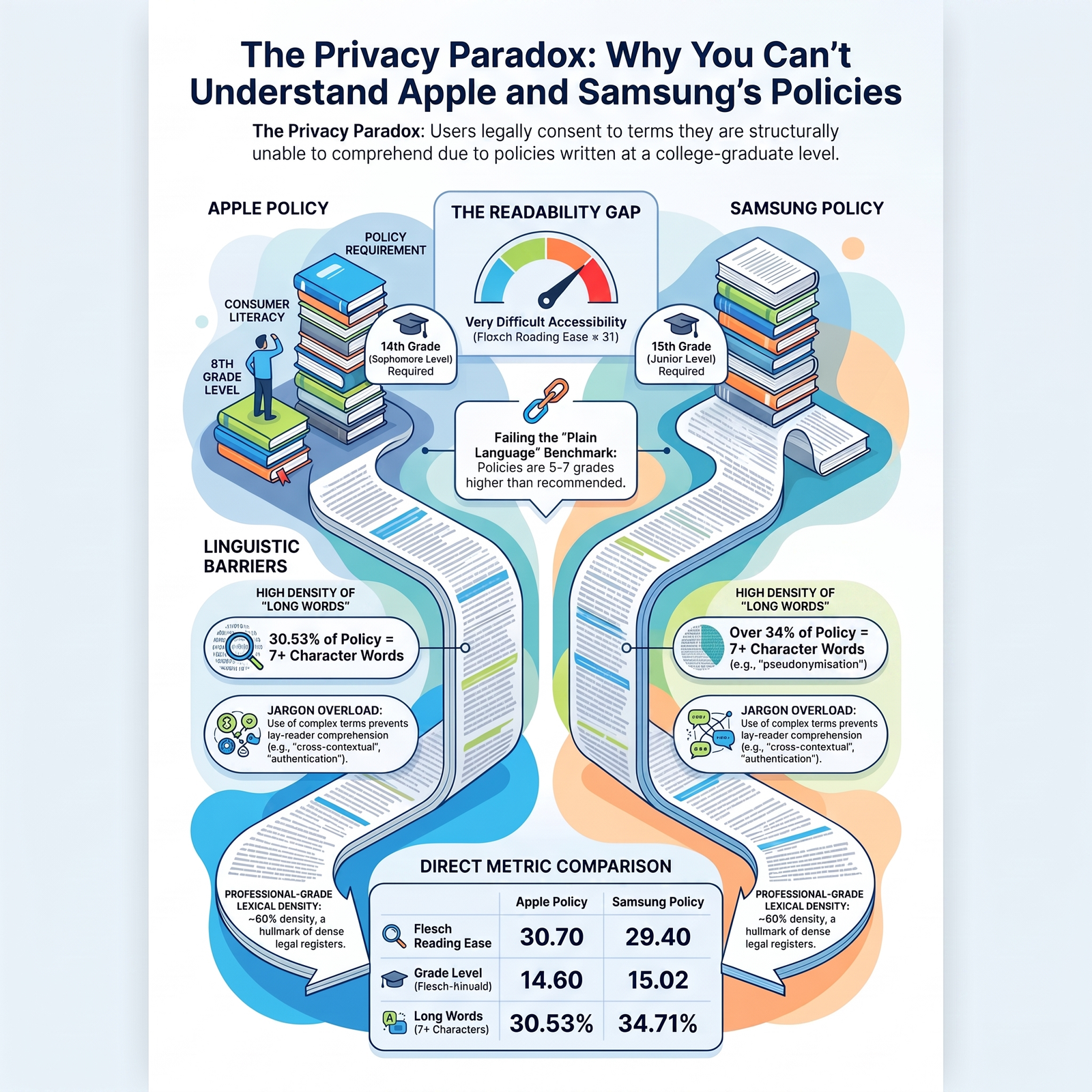
Corporate privacy policies are legally binding documents that govern how technology companies collect, process, and share user data. Despite their legal significance, these documents are frequently characterised by dense, inaccessible language that hinders consumer comprehension. This study employs a corpus-based approach to conduct a comparative readability and lexical analysis of the official privacy policies of two leading global technology corporations, Apple Inc. and Samsung Electronics Co., Ltd. The corpus consists of two authentic policy texts extracted from their respective official websites. Thirteen readability indices were computed using automated computational tools, including the Flesch Reading Ease score, the Flesch–Kincaid Grade Level, the Gunning Fog Index, the SMOG Index, the Coleman–Liau Index, the Automated Readability Index (ARI), the Dale–Chall Score, and the Linsear Write Formula, alongside lexical measures including lexical density, type–token ratio, and long-word frequency. Findings reveal that both policies operate at a college-graduate reading level, substantially exceeding the eighth-grade plain-language benchmark recommended for consumer documents. Samsung exhibits consistently greater linguistic complexity across all indices, with a higher proportion of polysyllabic words compared to Apple. The study concludes that both corporations employ language of considerable complexity that effectively limits lay-reader comprehension, with implications for digital privacy literacy, informed consent, and regulatory policy in the context of global data governance.
Downloads
Published
How to Cite
Issue
Section
License
Copyright (c) 2026 Zainab Shakoor, Fariha Yasmeen, Syed Shafqat Hussain Zaidi

This work is licensed under a Creative Commons Attribution 4.0 International License.