The Chorus as the Voice of the Demos: Proto-Democratic Expression in Sophocles’ Oedipus Rex
DOI:
https://doi.org/10.63056/jllsa.2.7.2026.223Keywords:
Oedipus Rex, Chorus, proto-democracy, civic consciousness, Greek tragedy, ethical mediationAbstract
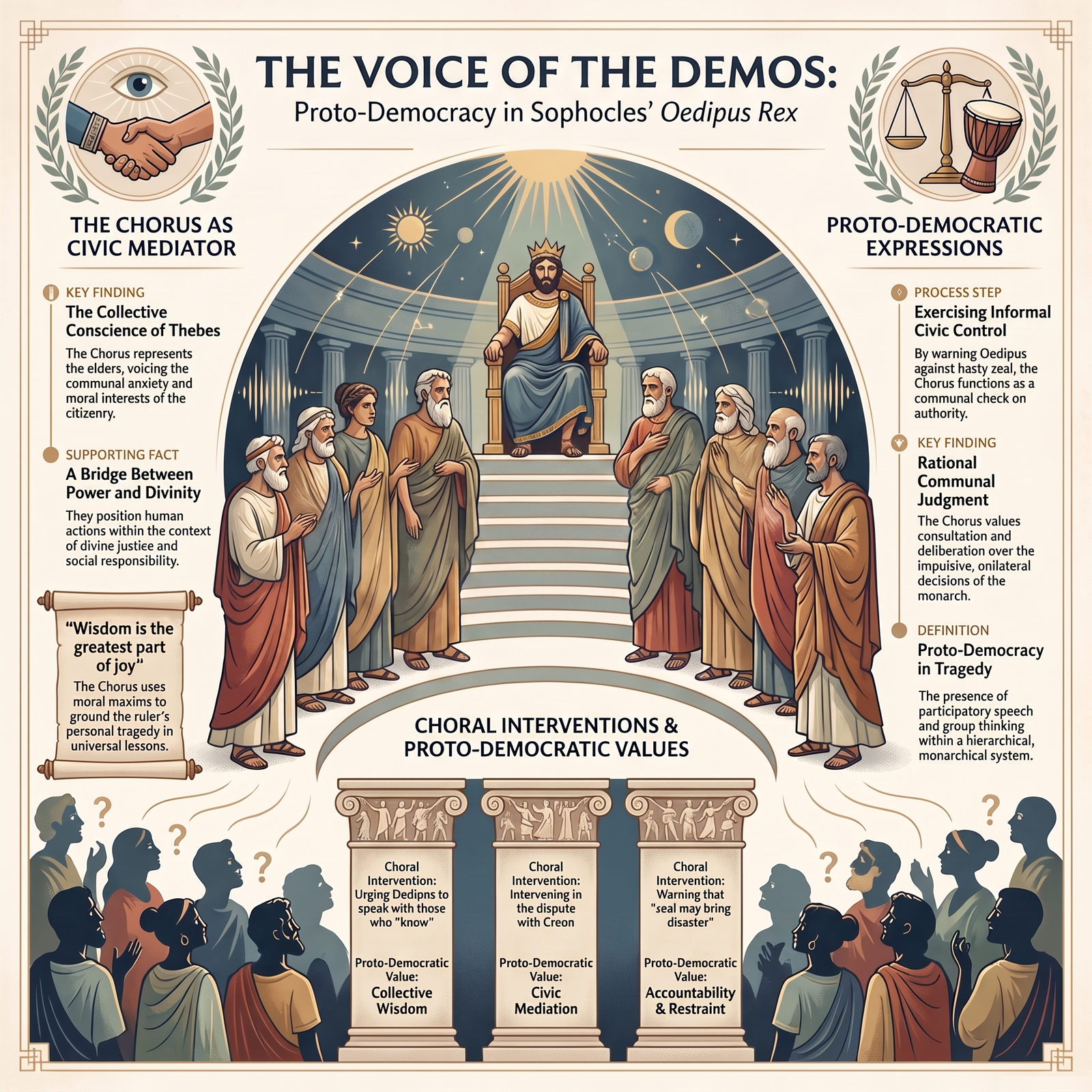
In this paper, the function of Chorus in Oedipus Rex is discussed as the voice of the demos in general, and the covert expression of proto-democratic voice in the middle of a monarchic story. Though the traditional interpretation has focused on the themes of fate, tragic irony and personal misfortune of Oedipus, the emphasis in this study has been on the civic and moral dimension of the Chorus as a mediator between the ruler, the citizenry of the people and God. Qualitative analysis of the Chorus in the context of close reading and reference to context highlights six key interventions and how the Chorus embodies communal anxiety, provides moral guidance, challenges authority, and considers ethically and civically. The theoretical framework incorporates Aristotle moral conception of a tragedy, the concept of Chorus by Goldhill to be the mediator of the city, the concept of rational communal judgment put forward by Dodds and the concept of collective consciousness put forward by Vernant and Vidal-Naquet. The findings have confirmed that the Chorus is always a voice of the majority will, an intermediary in the process of decision-making, and a voice of the moral consciousness, which are a part of the elements of proto-democracy—responsibility, consultation, civic control. This paper comes to the conclusion that Sophocles is strategic in the way he instills the early ideas of democracy in the Chorus and that Oedipus Rex is not only a tragedy of the individual, but a tragedy that is used to show the dynamics between authority and the civic voice.
Downloads
Published
How to Cite
Issue
Section
License
Copyright (c) 2026 Aziz ur Rehman, Humaira Masud, Muhammad Hamza Zahid

This work is licensed under a Creative Commons Attribution 4.0 International License.