Pakistan's Strategic Hedging Between the United States and China: Balancing Great-Power Competition in the Emerging Multipolar International Order
DOI:
https://doi.org/10.63056/jllsa.2.5.2026.225Keywords:
strategic hedging, Pakistan, United States, China, multipolarity, strategic autonomy, great-power competition, neoclassical realismAbstract
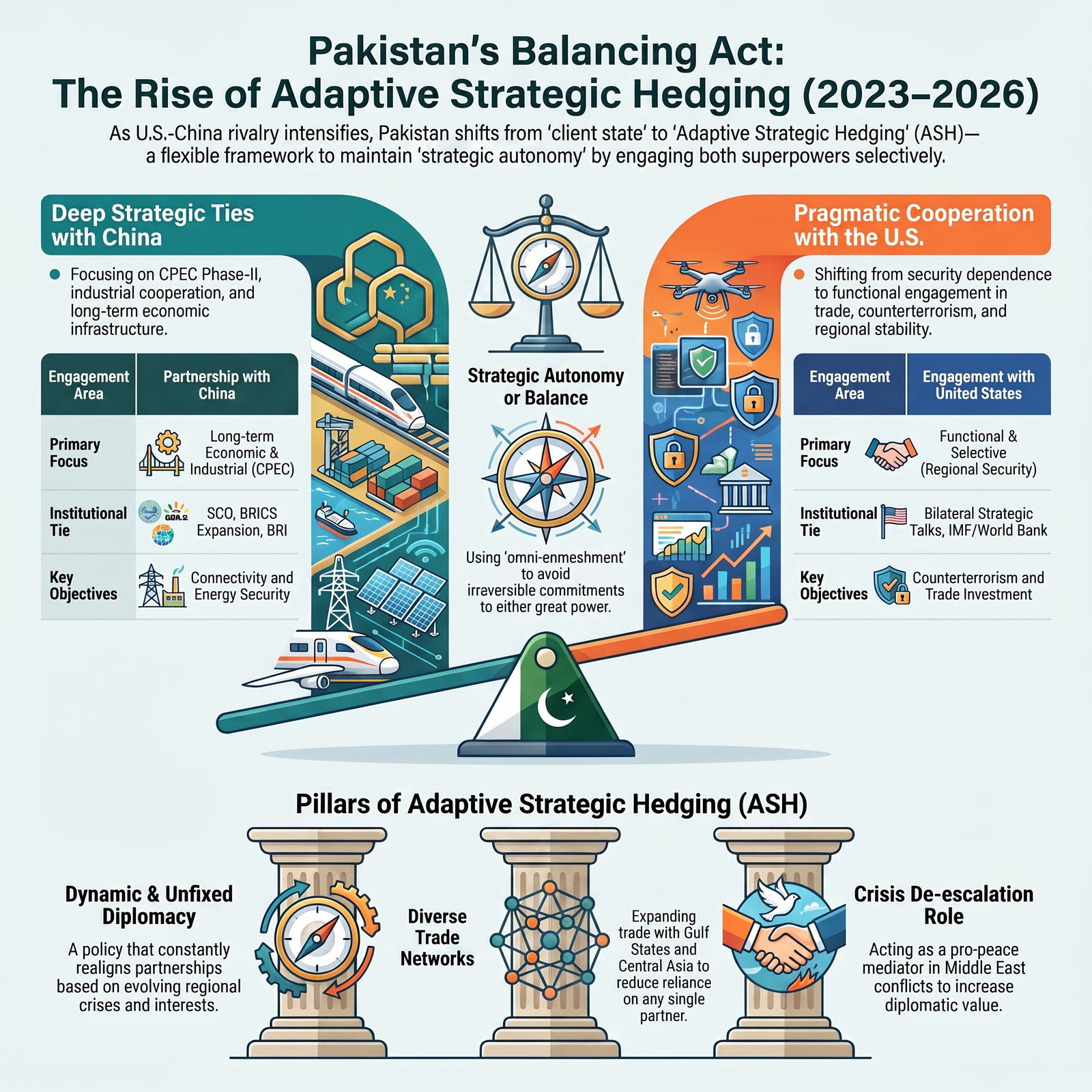
The rivalry between the U.S. and China is intensifying and has created a new security environment in the Indo-Pacific, compelling middle powers to shift their foreign policies. Pakistan lies at the junctures of South Asia, Central Asia, and the Middle East and has adopted a multi-alignment approach more in line with strategy than alliance politics. Scholarship is limited to Pakistan's alliance dependence or its strategic alignment with China, while few efforts have examined how Pakistan has actually engaged in strategic hedging. This article scrutinizes Pakistan's foreign policy in the period of 2023-2026, using qualitative case study research to apply theories of Neoclassical Realism, Strategic Hedging Theory, and Constructivism. It analyzes policy documents, government statements, and scholarly studies on Pakistan's stance against China while, to some extent, aligning with the USA. In addition, the scope of the study reflects the reality of a new regional security environment due to the Israel-Hamas war, the upcoming confrontation between Iran and Israel, the US military presence, and the new significance of energy security and crisis diplomacy in the region. These developments have boosted Pakistan's strategic, economic, and diplomatic value for Washington and deepened its relations with Beijing in all three fields accordingly. The article argues that Pakistan's foreign policy could be interpreted as adaptive strategic hedging (ASH), which is a method of foreign policy with an unfixed approach to security, economic, and diplomatic interests to achieve strategic autonomy for Pakistan. The study helps advance current discussions on middle-power agency, strategic autonomy, and hedging in an increasingly multipolar world.
Downloads
Published
How to Cite
Issue
Section
License
Copyright (c) 2026 Fahad Yaqoob Awan, Dr. Muhammad Munir

This work is licensed under a Creative Commons Attribution 4.0 International License.