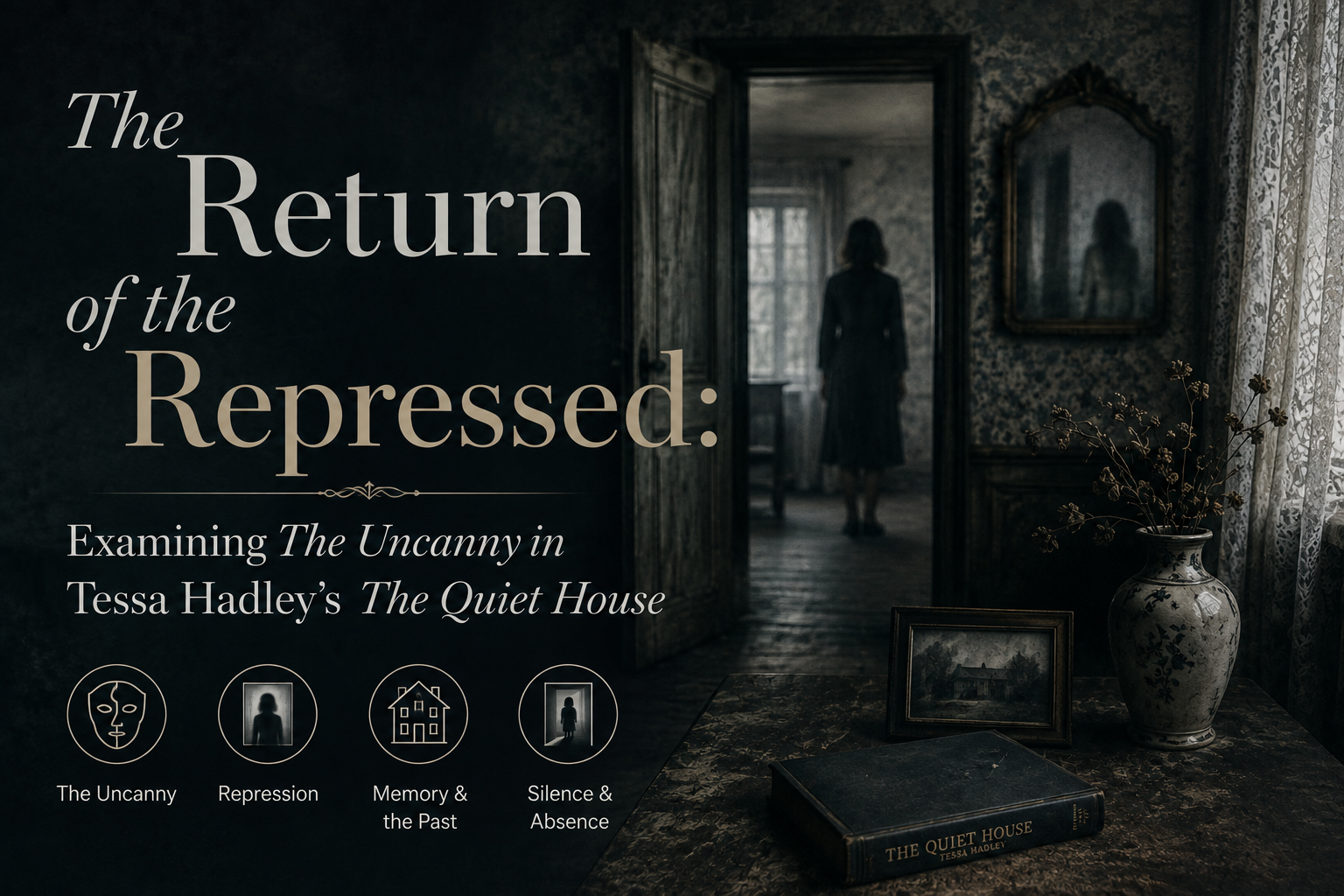
The Return of the Repressed: Examining The Uncanny in Tessa Hadley’s The Quiet House
DOI:
https://doi.org/10.63056/jllsa.2.7.2026.228Keywords:
Tessa Hadley, Freud, Das Unheimliche, Psychoanalytic Literary Criticism, Temporal DisruptionAbstract
This paper adopts Sigmund Freud's (1919) psychoanalytical theory on The Uncanny (das Unheimliche) to analyse Tessa Hadley's short story The Quiet House (2026). It explores how it is a psychological exploration of aging, memory and repressed emotions and thoughts coming to the surface. The study is based on two questions. Firstly, it looks at the representation of Freud's notion of the uncanny (the repressed) in the protagonist Geraldine through her dream encounters with her long deceased friend Mattie Szymanski. Second, it examines the uncanny effects created by Hadley's narrative strategies – such as the disruption of the time sequences and the structural ambiguity – which destabilize the boundaries between past and present, between life and death and between familiarity and strangeness. The paper uses eight central ideas of Freud’s (1919) essay, The Uncanny: the paradox of the familiar and unfamiliar, the return of the repressed, animism and the power of thoughts, involuntary repetition, the return of the dead, the double, the difference between the uncanny in fiction and in reality, and intellectual uncertainty. Research indicates that Mattie represents Geraldine's own suppressed qualities of youth: emotional intensity, intellectual passion, idealized authority and physical vitality. The Quiet House, a symbol of order, is the peaceful, ordered life that Geraldine's return to dreams upsets. The paper argues that ageing in the story is a repressive process because the responsibilities of adulthood require the repression of previous impulses and energies. The fragmentation of memory in old age is manifested in Hadley's flexible use of time, the use of free indirect speech and in the lack of resolution. In general, the study demonstrates how the Freudian theory is significant in the interpretation of modern fiction and how older women are a complex character always relating to the past.
Downloads
Published
How to Cite
Issue
Section
License
Copyright (c) 2026 Syed Atta Ullah Bacha, Aamir Sohail Khan, Dr. Shaukat Ali

This work is licensed under a Creative Commons Attribution 4.0 International License.