Reflection of Environmental Changes in the Discourse and Ecological Vocabulary of Shina Speakers in Roundu: An Ecolinguistic Perspective
DOI:
https://doi.org/10.63056/jllsa.2.3.2026.230Keywords:
ecolinguistics, shina language, environmental change, indigenous knowledge, linguistic vulnerability, cultural erosion, language and ecologyAbstract
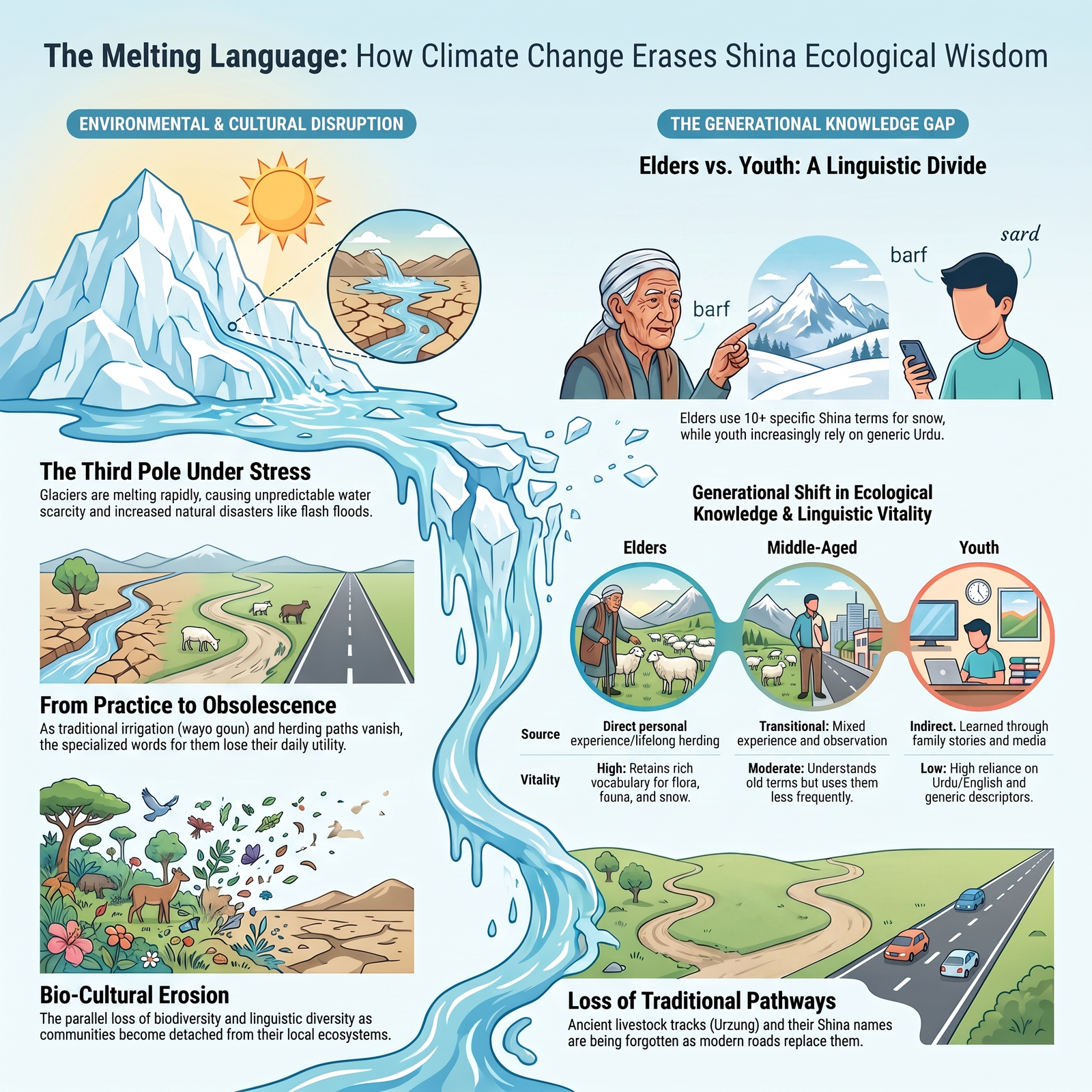
This study examines the relationship between environmental change, and the language practices of Shina speakers in the Roundu region of Gilgit-Baltistan. Using a qualitative research design, data were collected through semi-structured interviews with three generational groups: elders, middle-aged adults, and youth. An ecolinguistic approach was used to explore how environmental changes, including glacier retreat, irregular rainfall, changing agricultural practices, and resource scarcity, influence language and ecological knowledge. The findings reveal a strong link between environmental change and language use. Elders retain extensive ecological vocabulary and traditional knowledge, while younger speakers show a decline in indigenous ecological terms and oral traditions. The study concludes that environmental and socio-cultural changes are accelerating the erosion of ecological knowledge and linguistic heritage. It highlights the need to document and revitalize indigenous knowledge to support the preservation of the Shina language and culture.
Downloads
Published
How to Cite
Issue
Section
License
Copyright (c) 2026 Muhammad Asif Javaid, Zahra Batool, Abdul Rehman Mir, Altaf Hussain

This work is licensed under a Creative Commons Attribution 4.0 International License.