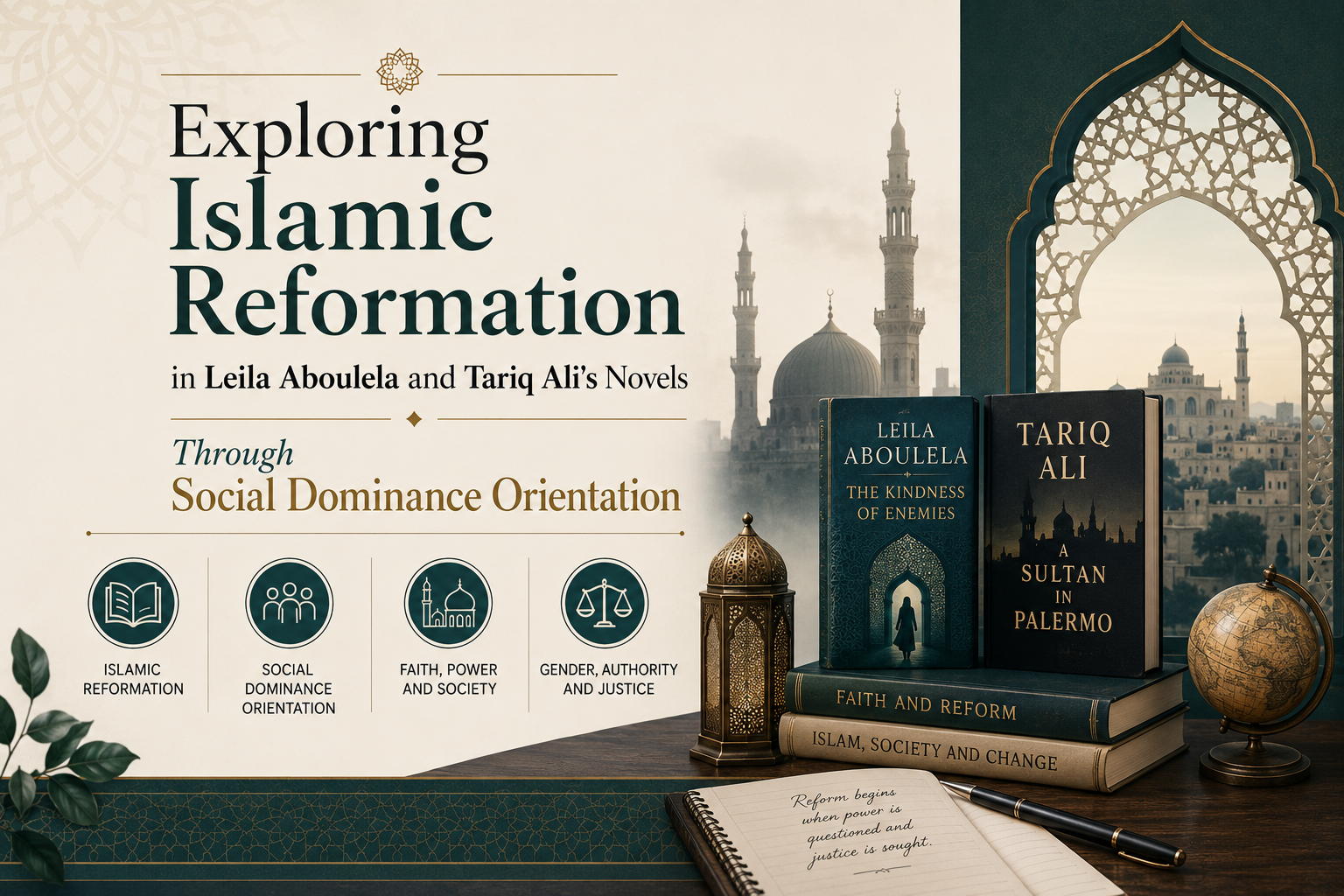
Exploring Islamic Reformation in Leila Aboulela and Tariq Ali's Novels Through Social Dominance Orientation
DOI:
https://doi.org/10.63056/jllsa.2.7.2026.233Keywords:
Islamic reformation, negative perceptions, reinterpretation, religious radicalism, stereotypesAbstract
This research aims to explore how Islamic reformation can eradicate extremism and social dominance. For this purpose, it focuses on Leila Aboulela’s Minaret and Tariq Ali’s Night of the Golden Butterfly. The objective of this research is to inspect as to how the Muslims living under unequivocal influences of socio-cultural paradigms develop different strategies to unite conventional Islamic values with the contemporary world hence instigating Islamic reformation. Thus, it intends to defy negative discourse against Islam and Muslims. This study fills the gap in research on Islamic reformation using the social dominance orientation. This research adheres to the framework of social dominance orientation used as a tool to counteract the stereotypical perceptions about Islam as a bigoted and violent religion. Thus, the data used highlights the significance of fiction in providing a better understanding of how the repositioning and reinterpretation of Islamic values plays a positive role in Muslims’ lives. Future researchers can explore various dimensions of Islamic reformation to break the old perceptions about Islam through the works of different writers.
Downloads
Published
How to Cite
Issue
Section
License
Copyright (c) 2026 Samra Abdul Rehman, Maleeha Zahid, Aimen Munir

This work is licensed under a Creative Commons Attribution 4.0 International License.