Subjective and Objective Variation in Human Translation in English to Urdu of Religious Discourse
DOI:
https://doi.org/10.63056/jllsa.2.8.2026.243Keywords:
Translation Strategies, Formal Equivalence, Dynamic Equivalence, Subjectivity and Objectivity in Religious Translation, Human Translation, Religious TranslationAbstract
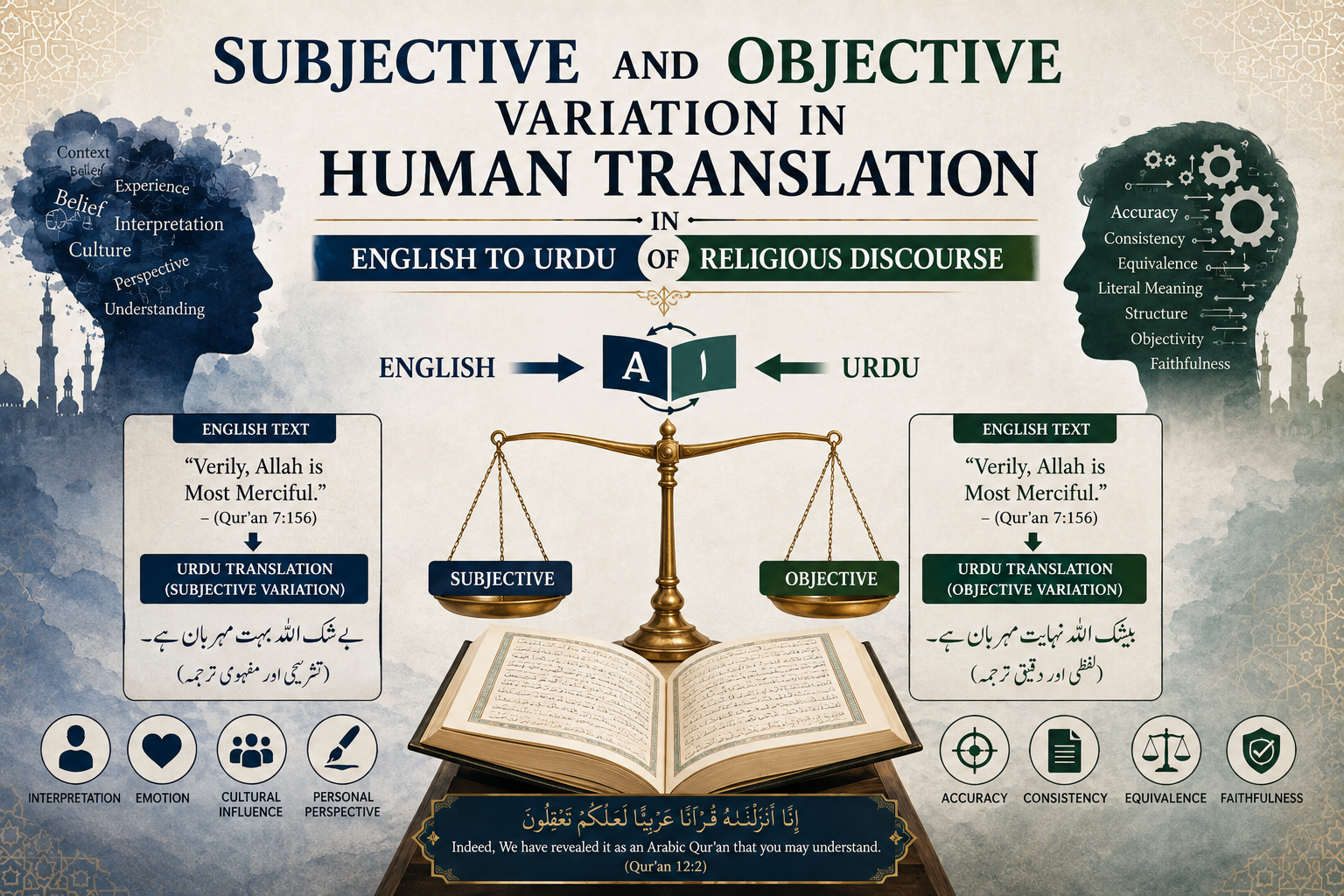
This paper investigates subjectivity and objectivity in the selected translated book of Dr Zakir Naik, Answers to Non-Muslims’ Common Questions about Islam, by Professor Muhammad Raza. The paper analyses the translated version of English through the use of Eugene Nida’s Theory of Equivalence. The study found that subjectivity appeared in the translated text in the form of adaptation and explanation. The translator has explained the difficult religious terms and adapted the translated text according to the needs of the target readers. The translator has made the use of formal equivalence for the translation of the verses of the Holy Quran and dynamic equivalence for the translation of the source text without the distortion of the original message. The study proposed a balance between formal and dynamic equivalence for accurate translation.
Downloads
Published
How to Cite
Issue
Section
License
Copyright (c) 2026 Muhammad Alamgir, Dr. Muhammad Abdullah Baig

This work is licensed under a Creative Commons Attribution 4.0 International License.