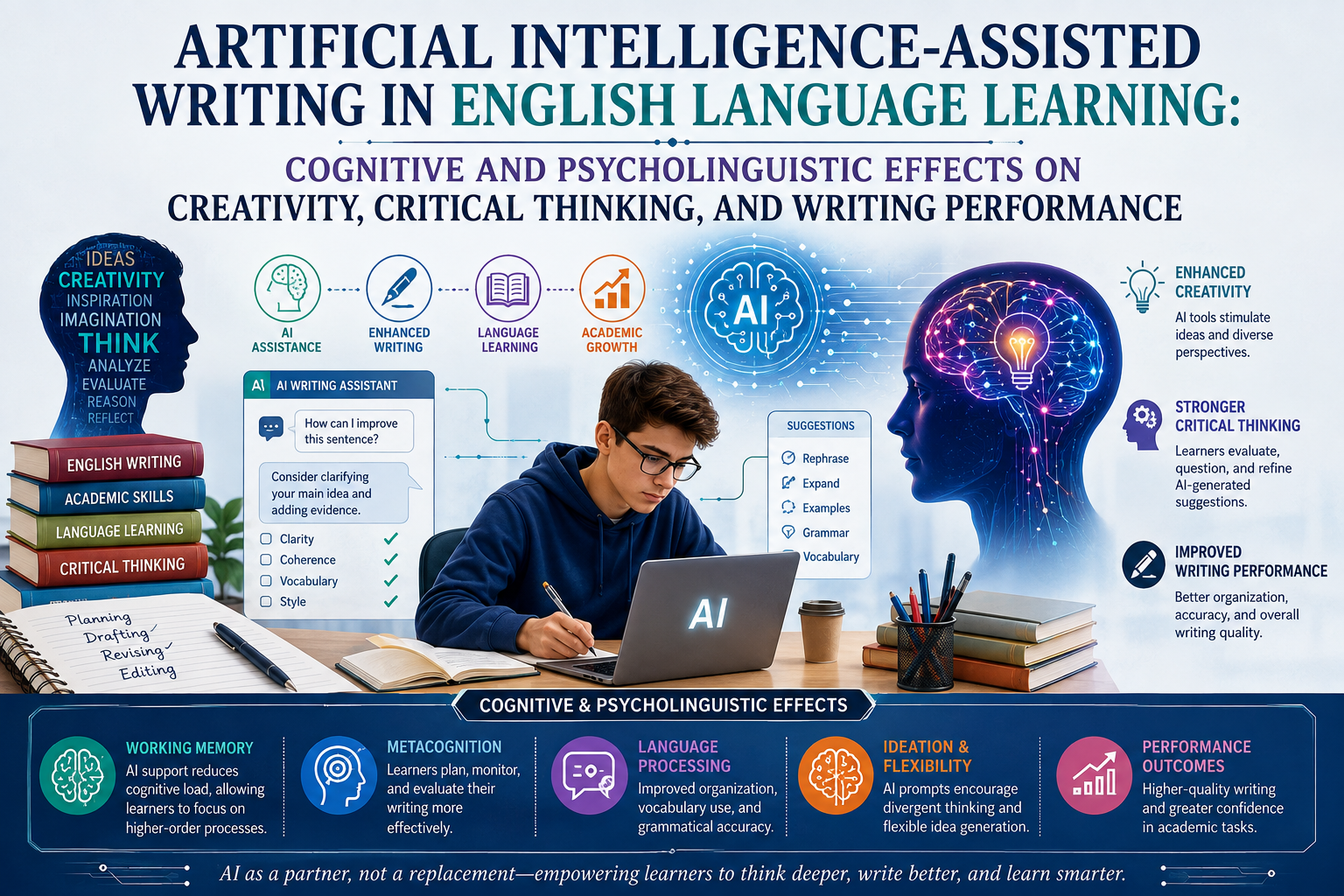
Artificial Intelligence-Assisted Writing in English Language Learning: Cognitive and Psycholinguistic Effects on Creativity, Critical Thinking, and Writing Performance
DOI:
https://doi.org/10.63056/jllsa.2.6.2026.244Keywords:
AI-Assisted Writing, English Language Learning, Creativity, Critical Thinking, Cognitive Processes, Psycholinguistic Processes, Writing Performance, Artificial IntelligenceAbstract
The relationships among AI-assisted writing, creativity, critical thinking, cognitive and psycholinguistic processes, and English writing performance were explored in the context of university learners. A quantitative cross sectional correlational research design was used and the subjects were 300 undergraduate students who were randomly drawn from public and private universities of Karachi, stratified sampling. The data was collected by using structured questionnaire and analyzed by descriptive statistics, Cronbach's alpha, Pearson correlation and regression analysis. All reliability coefficients were within the range of .82 to .91 which suggested good to excellent internal consistency. Creativity (r = .58, p < .01) and critical thinking (r = .55, p < .01), cognitive processes (r = .67, p < .01), psycholinguistic processes (r = .60, p< .01), and writing performance (r = .65, p < .01) were significantly associated with AI-assisted writing. The results of regression analysis indicated that the AI-assisted writing could account for 33.6%, 30.3%, 42.3%, and 44.9% of the variance in creativity, critical thinking, writing performance, and cognitive processes, respectively. The psycholinguistic processes accounted for 53.3% of the variance in writing performance, and the cognitive processes accounted for 47.6% of the variance. The results underline the importance of balanced AI interfacing that allows for higher-order thinking, language processes and writing development without compromising autonomy of the learner.
Downloads
Published
How to Cite
Issue
Section
License
Copyright (c) 2026 Dr. Tahira Adeel Zaman, Nida Shabbir, Ishtiaq Ahmed Kolachi

This work is licensed under a Creative Commons Attribution 4.0 International License.