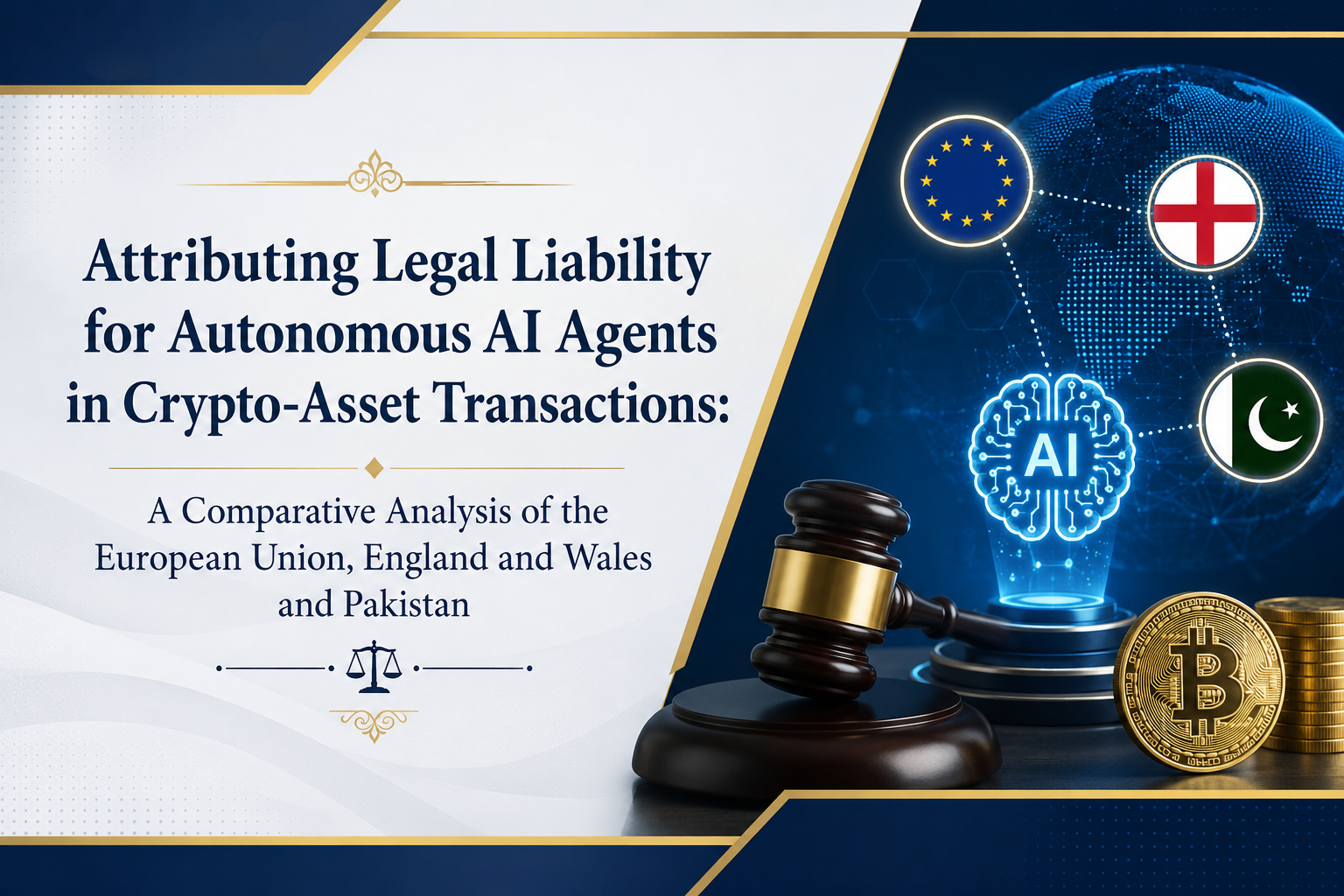
Attributing Legal Liability for Autonomous AI Agents in Crypto-Asset Transactions: A Comparative Analysis of the European Union, England and Wales and Pakistan
DOI:
https://doi.org/10.63056/jllsa.2.8.2026.249Keywords:
artificial intelligence, crypto-assets, liability, autonomous agents, comparative law, European Union, England and Wales, PakistanAbstract
Autonomous artificial intelligence agents in the crypto-asset markets present a distinct attribution of legal liability issue. An autonomous agent can approve, arrange and conduct transactions without special user case consent and the relevant legal relationship is spread among various participants such as developers, AI providers, deployers, users, custodians, crypto-asset service providers and other infrastructure operators. Traditional legal systems usually do not recognize autonomous AI agents as independent legal entities and traditional private-law rules and specialized regimes do not offer a consistent process for determining the legal subject who is held liable for financial damage resulting from autonomous execution. This article has made a comparison of European Union with England and Wales and Pakistan. It takes into account the EU AI Act, Markets in Crypto-Assets Regulation, revised Product Liability Directive, and the proposed AI Liability Directive, as well as the Property ( Digital Assets etc) Act 2025, the Financial Services and Markets Act 2000 (Crypto assets) Regulations 2026 in England and Wales and the National AI Policy 2025, the Regulation of Artificial Intelligence Bill 2024 and the Virtual Assets Act 2026 in Pakistan. The analysis shows that every jurisdiction has rules that potentially apply to AI governance, crypto-asset activity, custody, product liability and property rights/institutional responsibility, but no rules providing a methodology to assign legal responsibility when autonomous agents operate across various technical and institutional layers. The article is not a substantive cause of action but a normative attribution model that is the Control-Authorization-Duty-Causation-Rule framework. The framework provides guidance to adjudicators with respect to: determination of the technically and operationally competent actors; scope of authorization; identification of duties; breach or defect and causation; selection and application of the governing liability rule, including allocation of liability among multiple actors and available remedies. The framework distinguishes technical autonomy from legal responsibility: autonomy alone does not create or end liability and the AI system does not need to have legal personality for responsibility to be attributed to an existing legal person. The analysis also identifies “double opacity” – the interaction of algorithmic opacity and transactional opacity – as a distinctive evidentiary problem in autonomous crypto-asset disputes. A worked hypothetical illustrates the framework thru VASP-mediated self-custodied hybrid DeFi and institutional multi-agent architectures. The article argues that reforms to targeted attribution, evidence preservation and risk allocation are preferable to granting autonomous AI agents independent legal personality.
Downloads
Published
How to Cite
Issue
Section
License
Copyright (c) 2026 Shahzeb Murad

This work is licensed under a Creative Commons Attribution 4.0 International License.