Error Patterns in Undergraduate English Writing: A Comparative Analysis of Learner Corpora
DOI:
https://doi.org/10.63056/jllsa.2.5.2026.250Keywords:
error analysis, learner corpus, undergraduate ESL writing, subject–verb agreement, interlanguage, L1 transfer, intralingual errors, academic writingAbstract
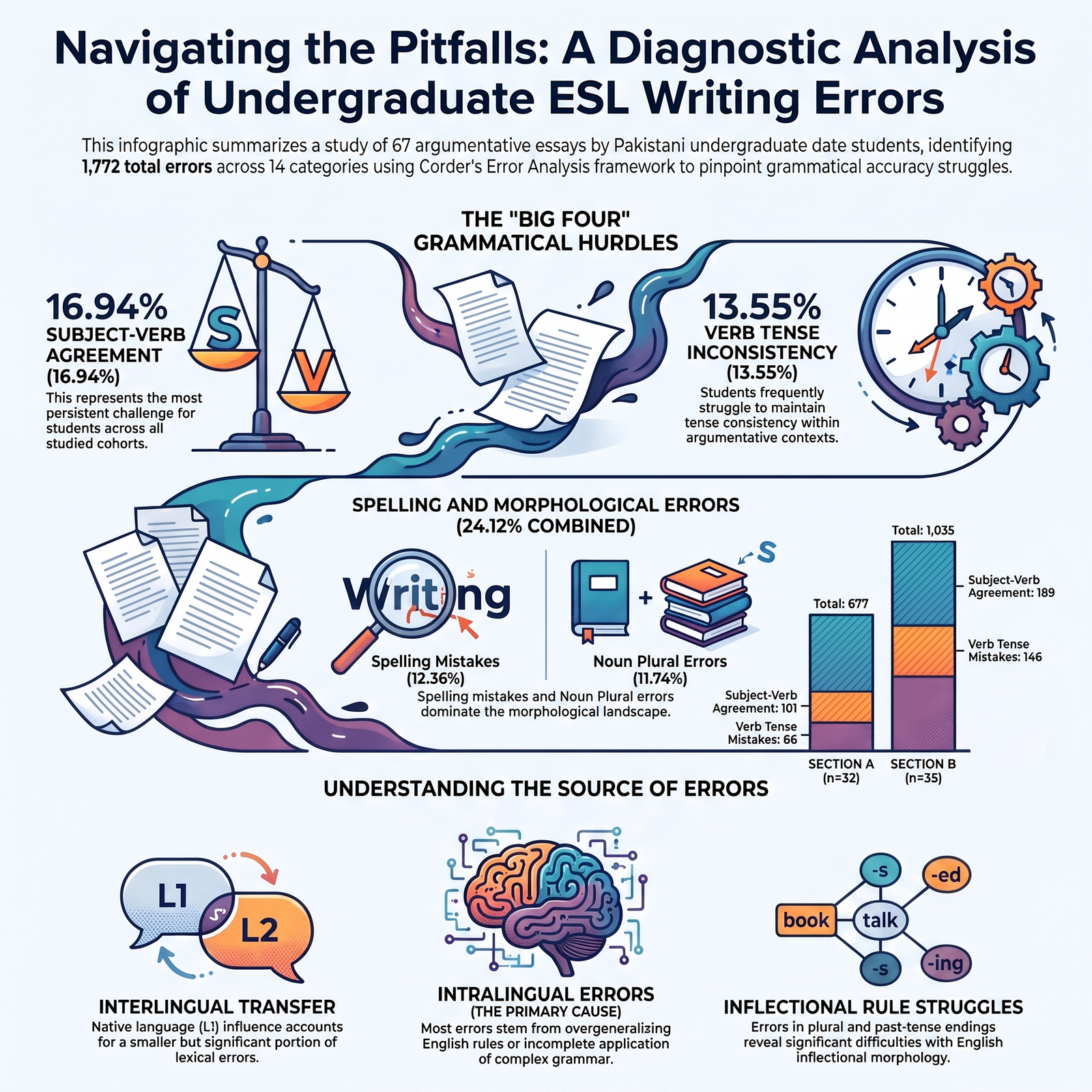
This research examines the error patterns in the argumentative writing of undergraduate ESL learners through a comparative analysis of two intact student sections at a public-sector university in Pakistan. The learner corpus analyzed in this study was made up of 67 argumentative essays produced by a group of students comprising Section A (n = 32) and Section B (n = 35). Corder’s Error Analysis framework is employed in this study and the error diagnosis is done by identifying, classifying, quantifying and explaining the errors based on error analysis rubric involving a set of fourteen error classes. The total number of the errors identified in the corpus is 1712; Section A students made 677 errors while Section B students incorporated 1035 errors. The most frequent types of errors made by the students in the corpus are Subject-Verb Agreement error (290; 16.94 % error), Verb Tense error (232; 13.55% error), Spelling error (212; 12.38% error), and Noun Plural Endings (-s/-es) (201; 11.74%). The findings reveal that undergraduate ESL learners continue having difficulties in grammatical accuracy, and morphology, to which interlingual transfer and intralingual learning processes contribute. Overall, the findings highlight the value of systematic error analysis for diagnosing recurrent difficulties in undergraduate ESL writing and for informing areas requiring focused writing instruction and practice in the Pakistani university context.
Author Biographies
Ambreen Sattar, PhD Scholar, Department of STEM Education, Lahore College for Women University, Lahore, Punjab, Pakistan
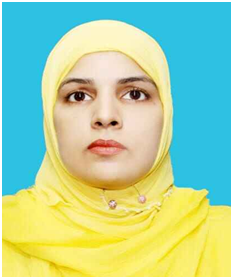
Ms. Ambreen Sattar, is a PhD scholar in the Department of STEM Education, Faculty of Education, Lahore College for Women University, Lahore, Pakistan. She has more than seven years of experience in teaching. Her research interests include English Language Teaching (ELT), Applied Linguistics, Error Analysis, and Curriculum Development.
Corresponding Author
AMBREEN SATTAR, PhD Scholar, Department of STEM Education, Lahore College for Women University, Lahore, Punjab, Pakistan.
Email: ambreensattar28@gmail.com
Sadaf Jabeen, Assistant Professor, Department of STEM Education, Lahore College for Women University, Lahore, Punjab, Pakistan

Dr. SADAF JABEEN
Dr. Jabeen is an Assistant professor in the Department of STEM Education, Faculty of Education, Lahore College for Women University, Lahore (LCWU), as well as Coordinator of BS Ed. Program. She has more than 10 years experience of Teaching and Research at tertiary level. She has started BS Ed. Program and developed ten new courses for Bachelor level students. Her scholastic research interests lie in Teacher Education, Educational Psychology, Curriculum Development, Educational Administration, Decision making in Higher Education, Teacher embodied learning environment, STEM education and so on. She has more than 30 international publications and book chapters to her credit.
Downloads
Published
How to Cite
Issue
Section
License
Copyright (c) 2026 Ambreen Sattar, Sadaf Jabeen

This work is licensed under a Creative Commons Attribution 4.0 International License.