Sustainable Agriculture and Water Scarcity in the Indo-Pak Indus Basin: Diplomatic Approaches to Boost Productivity
DOI:
https://doi.org/10.63056/jllsa.2.3.2026.255Keywords:
sustainable agriculture, water scarcity, hydro-politics, climate change, Food-Water-Energy Nexus, Indo-Pak relations, water diplomacy, systematic review, Indus Waters TreatyAbstract
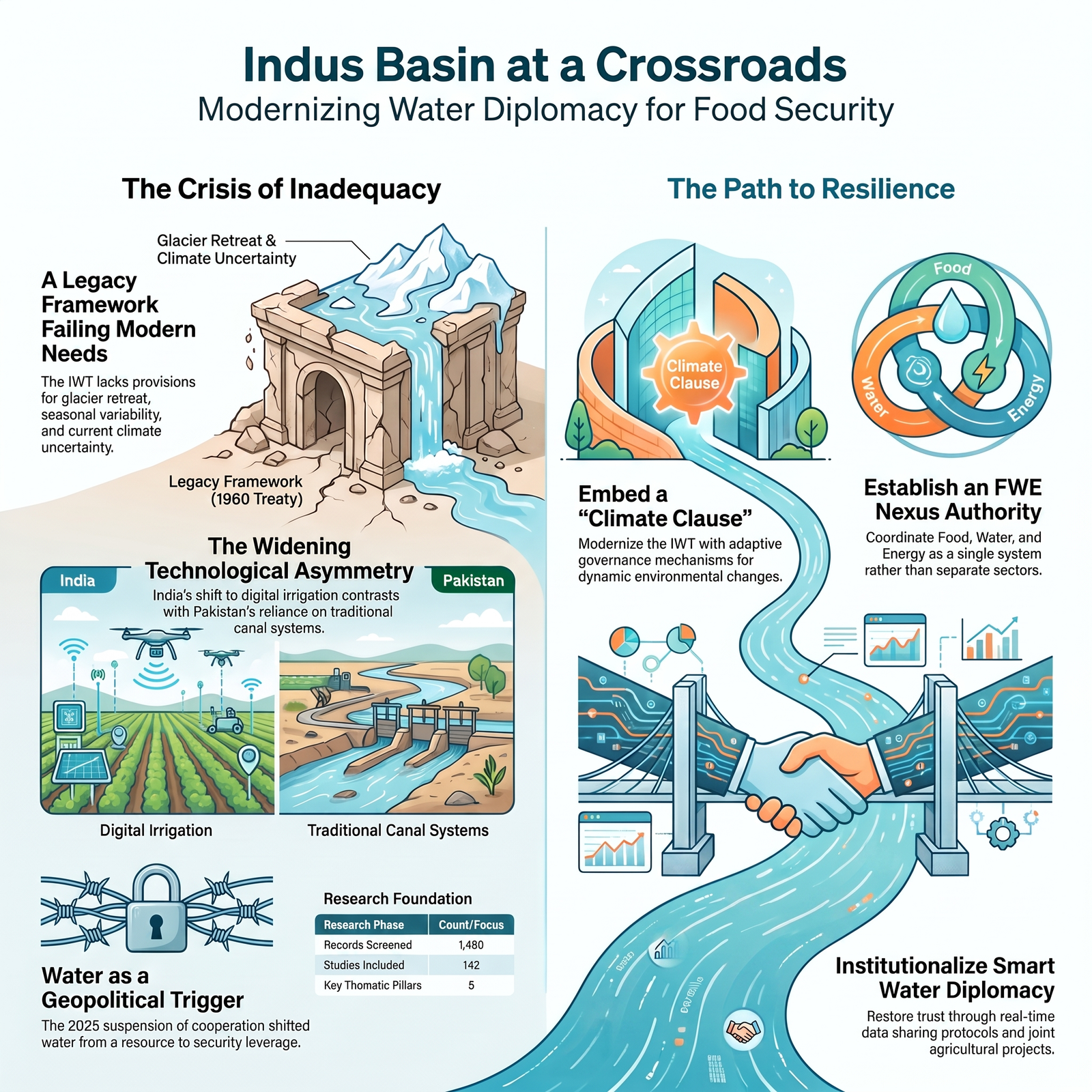
The Indus Waters Treaty (IWT), signed in 1960, was designed to prevent water conflict between India and Pakistan. Seven decades later, glacier retreat, erratic monsoons, unilateral hydropower development, and the 2025 political suspension of treaty cooperation have exposed its structural inadequacy. This rapid systematic literature review examines how diplomatic stagnation and environmental change interact to undermine sustainable agriculture in the Indo-Pak Indus Basin. Following PRISMA 2020 guidelines, 1,450 records were screened; 142 studies met inclusion criteria after quality appraisal using the Mixed Methods Appraisal Tool. Five themes emerged: IWT fragility under climate stress, the weaponisation of water as diplomatic leverage, a widening technological gap between Indian and Pakistani irrigation systems, institutional collapse at the Permanent Indus Commission, and cascading socio-economic impacts on farming communities. The synthesis finds that agricultural vulnerability in the basin is primarily driven by institutional failure and political mistrust rather than by absolute water scarcity. Cooperative mechanisms have stalled while unilateral upstream infrastructure decisions deepen downstream insecurity. Policy recommendations include embedding a Climate Clause in a revised IWT, establishing a Food-Water-Energy Nexus governance authority, and institutionalizing data-sharing protocols between riparian states.
Downloads
Published
How to Cite
Issue
Section
License
Copyright (c) 2026 Prof. Dr. Muhammad Munir, Muhammad Rehan, Irfan Maqbool

This work is licensed under a Creative Commons Attribution 4.0 International License.