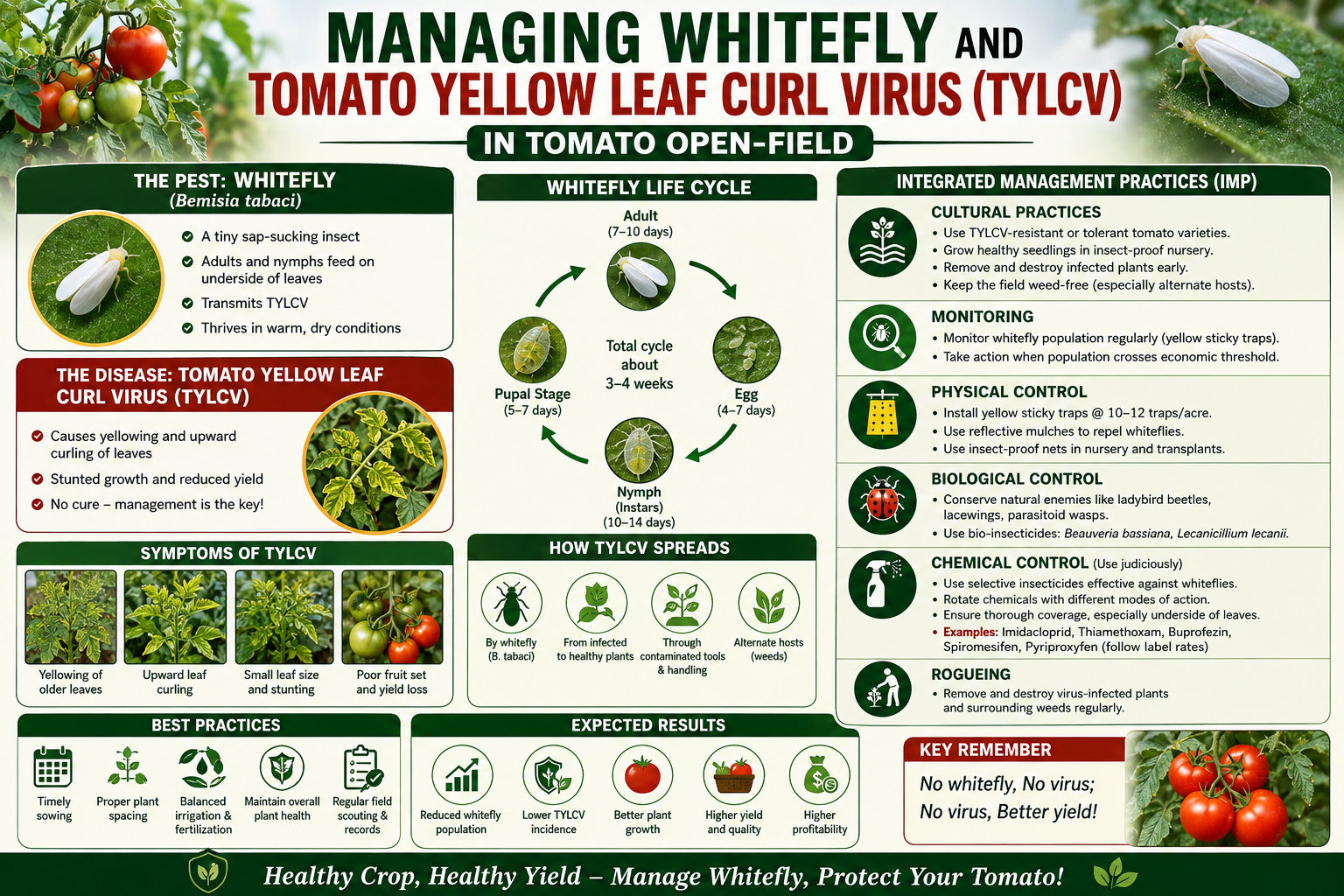
Managing Whitefly and Tomato Yellow Leaf Curl Virus (TYLCV) in Tomato Open-Field
DOI:
https://doi.org/10.63056/jllsa.2.4.2026.256Keywords:
Bemisia tabaci, tomato yellow leaf curl virus, reflective mulch, conservation biological control, Eretmocerus, Encarsia, buprofezin, spiromesifen, resistance managementAbstract
A field-scale integrated pest management (IPM) programme combining pre-plant soil solarization, reflective mulch, weekly pest and parasitoid monitoring, a parasitoid-informed action threshold, and selective insecticides was compared with a conventional chemical-intensive programme for management of Bemisia tabaci and Tomato yellow leaf curl virus (TYLCV) in open-field tomato. The study was conducted at CCRI Pirsabak during the 2024–2025 season using a randomized complete block design with four replicate 0.5-ha plots per system. Adult whiteflies were monitored weekly using sticky traps and direct leaf counts; immature stages were quantified from standardized leaf samples; and parasitoid emergence (Eretmocerus and Encarsia) was assessed after leaf incubation. Selective applications of buprofezin or spiromesifen were triggered when adult abundance exceeded five per leaf and the parasitoid-to-whitefly ratio fell below 1:10. At 60 days after transplanting, adult whitefly density averaged 4.8 per leaf under IPM compared with 9.2 under conventional management—a 47.8% reduction. Total parasitism increased from 12.6% to 56.6%, a 44.0 percentage-point gain. Seasonal insecticide applications declined from 11.0 to 5.2 (52.7% reduction), while active-ingredient use decreased by 62.9%. Marketable yield was 31.8 t ha⁻¹ under IPM and 28.6 t ha⁻¹ conventionally; the difference was not statistically resolved. TYLCV incidence declined by 52.0%, from 34.2% to 16.4%. Despite higher upfront costs for solarization and reflective mulch, absolute net return increased by PKR 92,000 ha⁻¹. These findings support a decision-based IPM programme that integrates prevention, biological conservation, and selective intervention. However, verification of block-level observations, diagnostic records, cost invoices, and original statistical outputs is essential before final adoption recommendations are made.
Downloads
Published
How to Cite
Issue
Section
License
Copyright (c) 2026 Muhammad Tariq Khan, Mujahid Khan, Madieha Ambreen, Samina Yasmin, Akhtar Hussain

This work is licensed under a Creative Commons Attribution 4.0 International License.