Institutional and Policy-Level Barriers Shaping the Learning Experiences of Undergraduate Students with Visual Impairments in Natural Sciences and Quantitative Reasoning Courses
DOI:
https://doi.org/10.63056/jllsa.2.8.2026.259Keywords:
visual impairment, inclusive education, higher education, Natural Sciences, Quantitative Reasoning, accessibility barriers, institutional policyAbstract
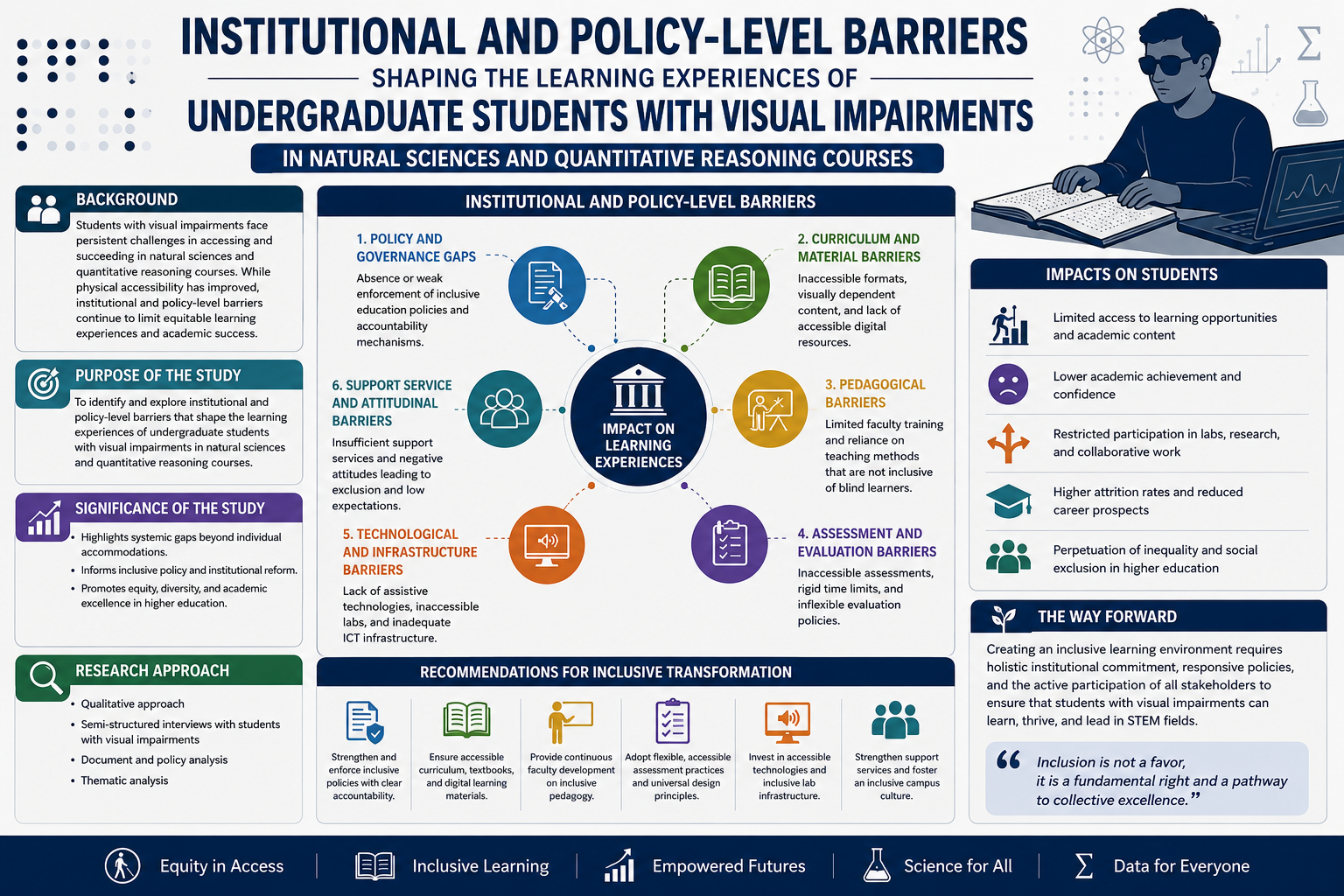
Students with visual impairments often have difficulties accessing general education courses, especially courses in Natural Sciences (NS) and Quantitative Reasoning (QR) that are heavily reliant on visual information like that found in diagrams, graphs and tables. In this qualitative study, institutional and policy level obstacles faced by students with visual impairment in Natural Sciences and QR courses in the University of Lahore, Lahore, Pakistan, while taking undergraduate courses were explored. The study was designed to examine the gaps of institutional and policy level support such as HEC Undergraduate Policy and to understand students' experiences and perceptions related to their learning needs, academic participation and performance. Purposive sampling was employed for the interview and the interview was semi-structured until data saturation was reached and themed-analyzed. The results showed that there were seven main themes: university support, barriers and challenges, positive experiences, learning needs, participation and performance, policy and institutional support, and improvement suggestions. The results showed that institutional support was still largely inconsistent, and that it was still dependent on individual teachers, not on systematic implementation of the policy. Issues that prevented access to the visual materials within the lessons were identified as teacher-centeredness and lack of student involvement in practical activities, whereas teacher–student collaboration and peer collaboration were identified as factors that facilitated a more positive experience. The need for easily accessible learning materials, teacher training, curriculum adaptations, assistive technology, and effective policy monitoring mechanisms was noted. The study finds that a single individualized accommodation for a visually impaired student is not sufficient to meet their educational needs; rather, universities should take a systemic approach that puts accessibility at the core of our policy, curriculum, and teaching practice to guarantee equitable learning opportunities in science and quantitative reasoning courses.
Downloads
Published
How to Cite
Issue
Section
License
Copyright (c) 2026 Neza Naseer, Syeda Beenish Batool, Saiqa Khalid

This work is licensed under a Creative Commons Attribution 4.0 International License.