Unrealistic Media Standards and Social Comparison as Predictors of Body Image Satisfaction among Female Students in Higher Education
DOI:
https://doi.org/10.63056/jllsa.2.6.2026.264Keywords:
Unrealistic Media Standards, Social Comparison, Body Image Satisfaction, Female StudentsAbstract
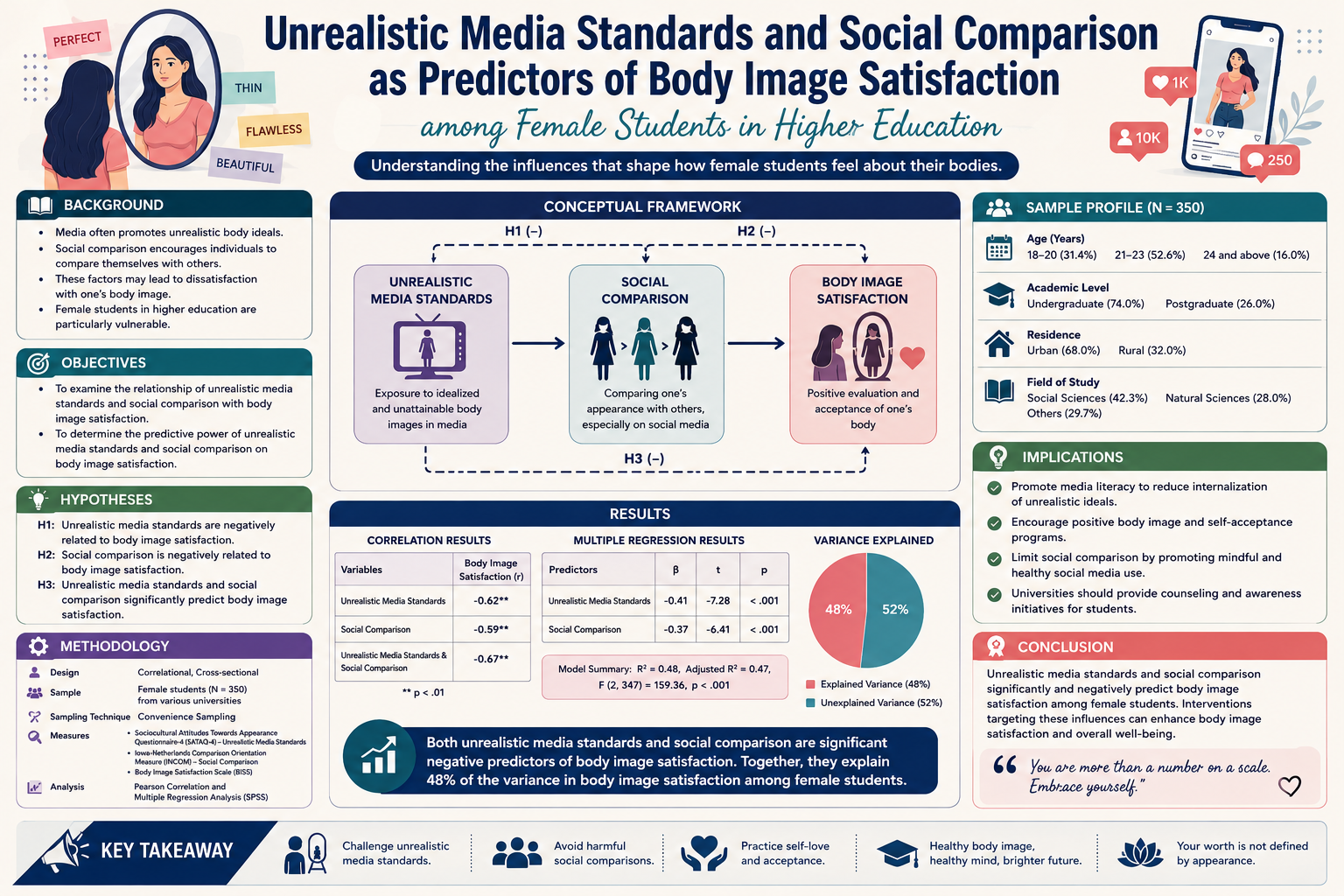
The digital landscape promotes narrow beauty standards and unrealistic ideals for women, exacerbating social comparison and creating a filtered perception of reality. Digital platforms can reinforce unrealistic notions of beauty and encourage users to compare themselves to others through celebrities, influencers, and photoshopped images. The purpose of this study is to investigate unrealistic media standards and social comparison as predictors of body image satisfaction among female university students. In this study, the researcher used a quantitative approach with an exploration of the key variables among female students at the University. Data were collected via a structured questionnaire from 300 participants in a correlational study based on Social Gratification and Social Comparison theories. The results showed that unrealistic media standards and social comparison have a positive and significant correlation (r=0.309, p < .01), and unrealistic media standards also have a significant positive correlation with body image satisfaction (r = 0.287, p < .01). Social comparison and body image satisfaction have a statistically significant and strong association (r = 0.702, p < .01) among female students. The regression model showed that unrealistic media standards and social comparison significantly predicted body image satisfaction, jointly explaining 53.6% of its variance (β = 0.637, R2 =.536). The results indicate that females who are more exposed to a digital environment and social comparison have a substantial effect on their self-perception, physical appearance, and body image satisfaction. This study demonstrates the urgent need to teach students to view digital beauty standards critically and to support realistic media content. Institutions must intervene with educational and mental health support because unrealistic media standards and ongoing social comparisons have a significant impact on how female college students perceive their bodies. There should be resources that support positive body image to assist young women in navigating digital environments without undermining their self-perception and physical appearance.
Downloads
Published
How to Cite
Issue
Section
License
Copyright (c) 2026 Anila Iram, Umme Zainub, Sonia, Arooj Sikandar

This work is licensed under a Creative Commons Attribution 4.0 International License.