Household Economic Burden of Pollution Around the Nandipur Power Plant, Pakistan
DOI:
https://doi.org/10.63056/jllsa.2.3.2026.266Keywords:
Nandipur Power Plant, household economic burden, pollution, health impact, migration pressure, environmental governance, PakistanAbstract
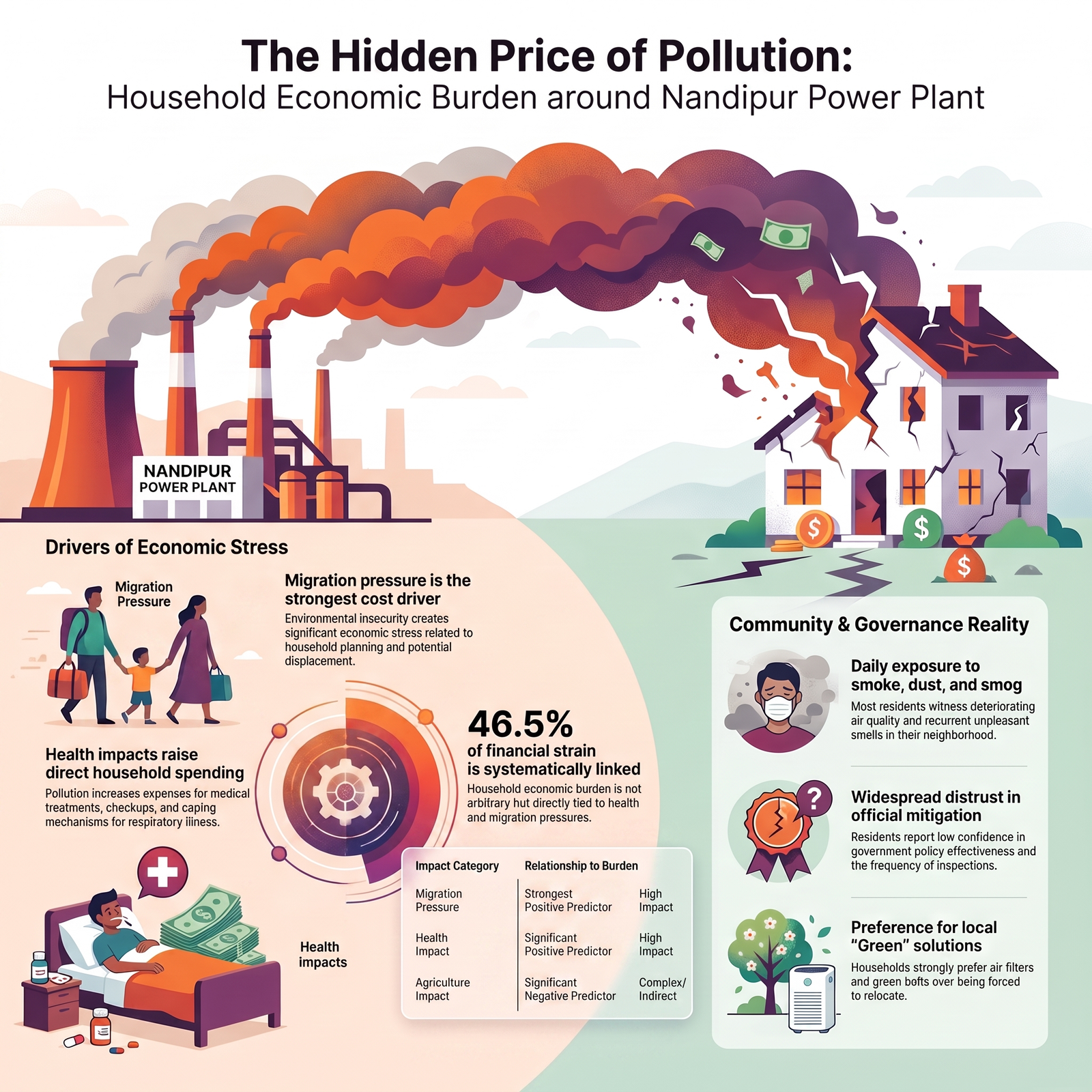
The system of thermal power generation continues to play the center stage in the electricity production sector of Pakistan, but its local social and economic implications remain under-studied. The article is a research on the economic cost of the household in terms of pollution surrounding the Nandipur Power Plant in Gujranwala, Pakistan. The study based on the cross-sectional survey of 100 respondents in the assessment of the translation of the pollution-related stress into the household cost is examined along three lines of explanations: health impact, migration pressure, and agriculture-related impact. Total Economic Burden (TEB) is used as the dependent variable. The results indicate that the regression model is statistically significant and it explains 46.5% of the variation in TEB. Household burden is positively and significantly related to health impact whereas migration pressure is the strongest predictor in the model. Impact associated with agriculture is also significant; however, it carries a negative value, indicating more complicated relationship to consider. Descriptive results also indicate that there is a general understanding of an increasing smoke, dust, and deteriorating air quality and that there is a strong degree of dissatisfaction with the official attempts to control pollution. Practical mitigation measures such as air filters and green belts are greatly preferred by respondents to relocation. The study reaches a conclusion that pollution surrounding the Nandipur Power Plant is not just an environmental problem but also a problem in the household welfare and governance. It thus requires more vigorous scrutiny, more plausible local mitigation and policy responses that directly alleviate the load on the communities at risk.
Downloads
Published
How to Cite
Issue
Section
License
Copyright (c) 2026 Laiba Sarwar, Dr. Muhammad Abdul Rahman

This work is licensed under a Creative Commons Attribution 4.0 International License.