Socioeconomic Disparities and Terrorism in Pakistan: A Fractionalized Macroeconomic Analysis
DOI:
https://doi.org/10.63056/jllsa.2.2.2026.269Keywords:
terrorism, food inflation, non-food inflation, youth unemployment, income inequality, ARDL, PakistanAbstract
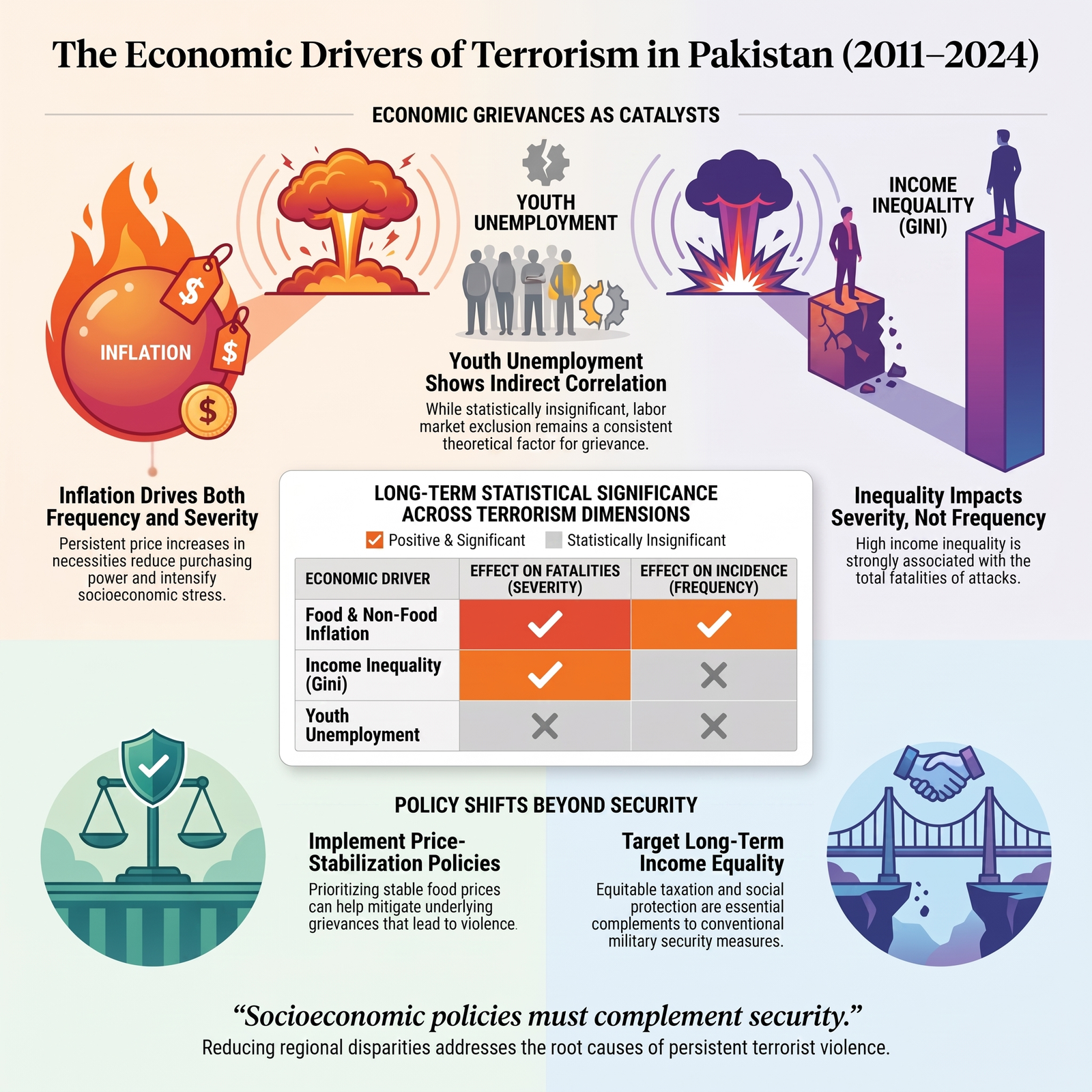
Terrorism in Pakistan has substantial socioeconomic consequences, yet much of the existing empirical literature relies on aggregate macroeconomic indicators that can conceal important differences across economic components. This study examines whether fractionalized macroeconomic indicators food inflation, non-food inflation, youth unemployment, and income inequality are associated with terrorism in Pakistan. The analysis uses annual time-series data for 2011–2024 and considers two dimensions of terrorism: fatalities and incidence. Because the variables exhibit a mixture of I(0) and I(1) integration orders and the sample is small, the Autoregressive Distributed Lag (ARDL) bounds-testing framework is employed to distinguish short-run dynamics from long-run relationships. The bounds tests indicate cointegration in both the fatalities and incidence models. In the fatalities model, food inflation and non-food inflation have positive and statistically significant long-run effects, while the Gini index is also positive and significant. Youth unemployment is positive but statistically insignificant in the long run. In the short run, current and lagged food inflation and lagged non-food inflation are positive and significant, whereas youth unemployment is insignificant; lagged income inequality is positive and significant. For terrorism incidence, lagged food inflation and non-food inflation are positive and significant in the short run, while current and lagged youth unemployment are insignificant. In the long run, food and non-food inflation are positive and significant, whereas youth unemployment and the Gini index are statistically insignificant. Diagnostic and stability tests indicate no evidence of serial correlation or Heteroskedasticity and support model stability. The findings suggest that price stability and policies aimed at reducing persistent income inequality should complement conventional security measures in Pakistan.
Downloads
Published
How to Cite
Issue
Section
License
Copyright (c) 2026 Wajeeha Arshad, Dr. Muhammad Abdul Rahman

This work is licensed under a Creative Commons Attribution 4.0 International License.