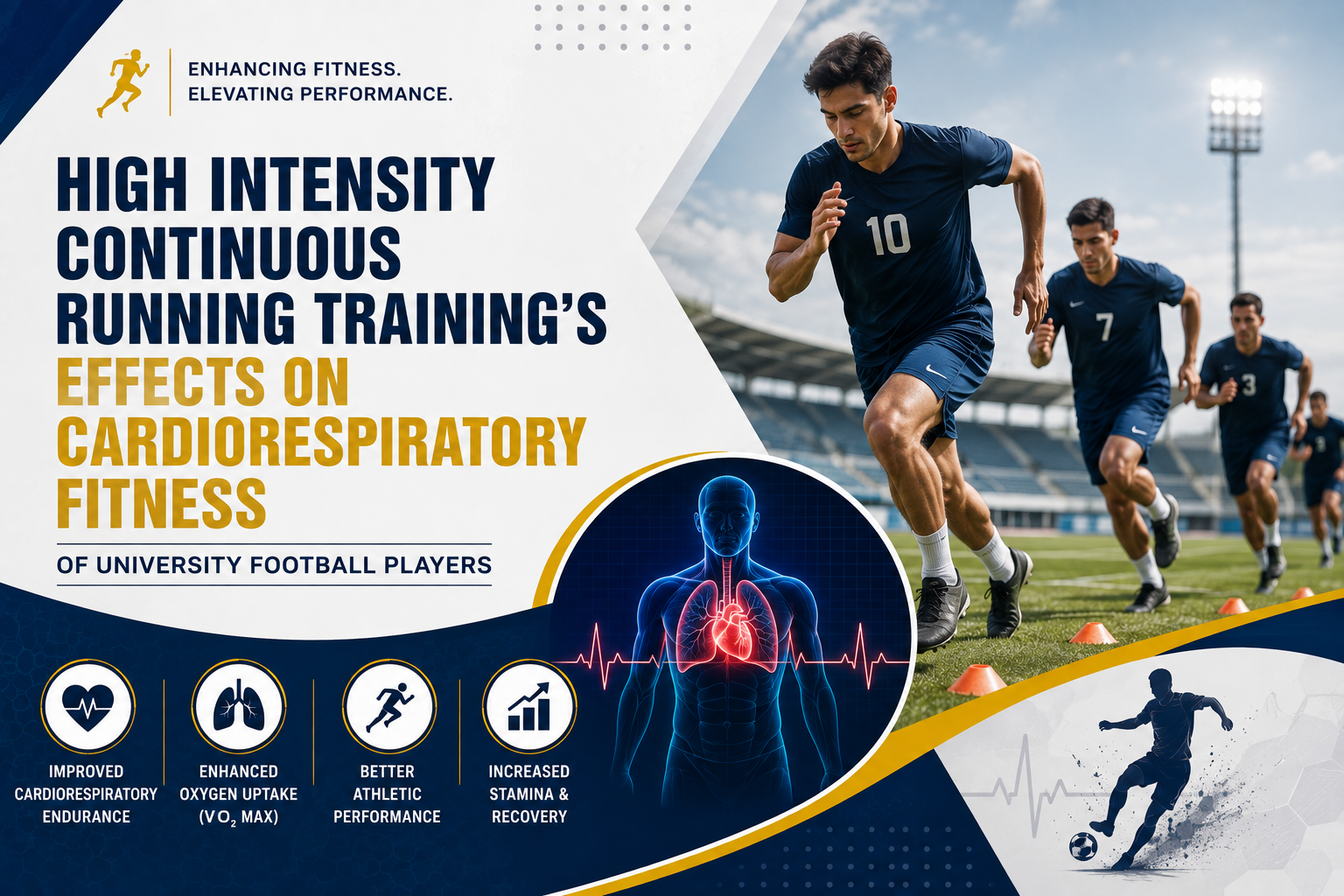
High Intensity Continuous Running Training’s Effects on Cardiorespiratory Fitness of University Football Players
DOI:
https://doi.org/10.63056/jllsa.2.8.2026.274Keywords:
Cardiorespiratory, Fitness, Endurance, Athlete, TrainingAbstract
Cardiorespiratory fitness is essential for football performance, influencing aerobic capacity, recovery, and respiratory efficiency during prolonged, intermittent high-intensity match play. Aims of the Study: This study examined the effects of an 8-week HICRT program on Maximum Oxygen Uptake (VO₂max), Heart Rate Recovery (HRR), Forced Vital Capacity (FVC), and Forced Expiratory Volume in one second (FEV1) among university football players. Methodology: Forty healthy male players from The University of Kamalia, District Toba Tek Singh, were randomly assigned to a Control Group (n=20) and an Experimental Group (n=20). Pre- and post-test measurements were recorded for both groups under standardized conditions. The Experimental Group completed a supervised 8-week HICRT program comprising three sessions per week at 75-90% of maximal heart rate with progressive intensity, while the Control Group maintained regular training and daily activities. Results: Significant improvements were observed in the Experimental Group for VO₂max (40.05±1.66 to 46.65±2.36 ml/kg/min, p<.001), HRR (25.75±1.25 to 19.25±1.44 beats/min, p<.01), FVC (3.81±0.12 to 4.41±0.14 L, p<.01), and FEV1 (3.12±0.15 to 3.79±0.15 L, p<.01), whereas the Control Group showed no significant changes. Post-test comparisons also significantly favored the Experimental Group across all variables (p<.05). Conclusion: The findings indicate that HICRT is an effective, time-efficient strategy to enhance cardiorespiratory fitness, aerobic power, and pulmonary function in university football players, providing valuable implications for coaches and conditioning specialists.
Downloads
Published
How to Cite
Issue
Section
License
Copyright (c) 2026 Ghulam Majeed, Mohibullah Khan Marwat, Muhammad Tahir Bashir

This work is licensed under a Creative Commons Attribution 4.0 International License.