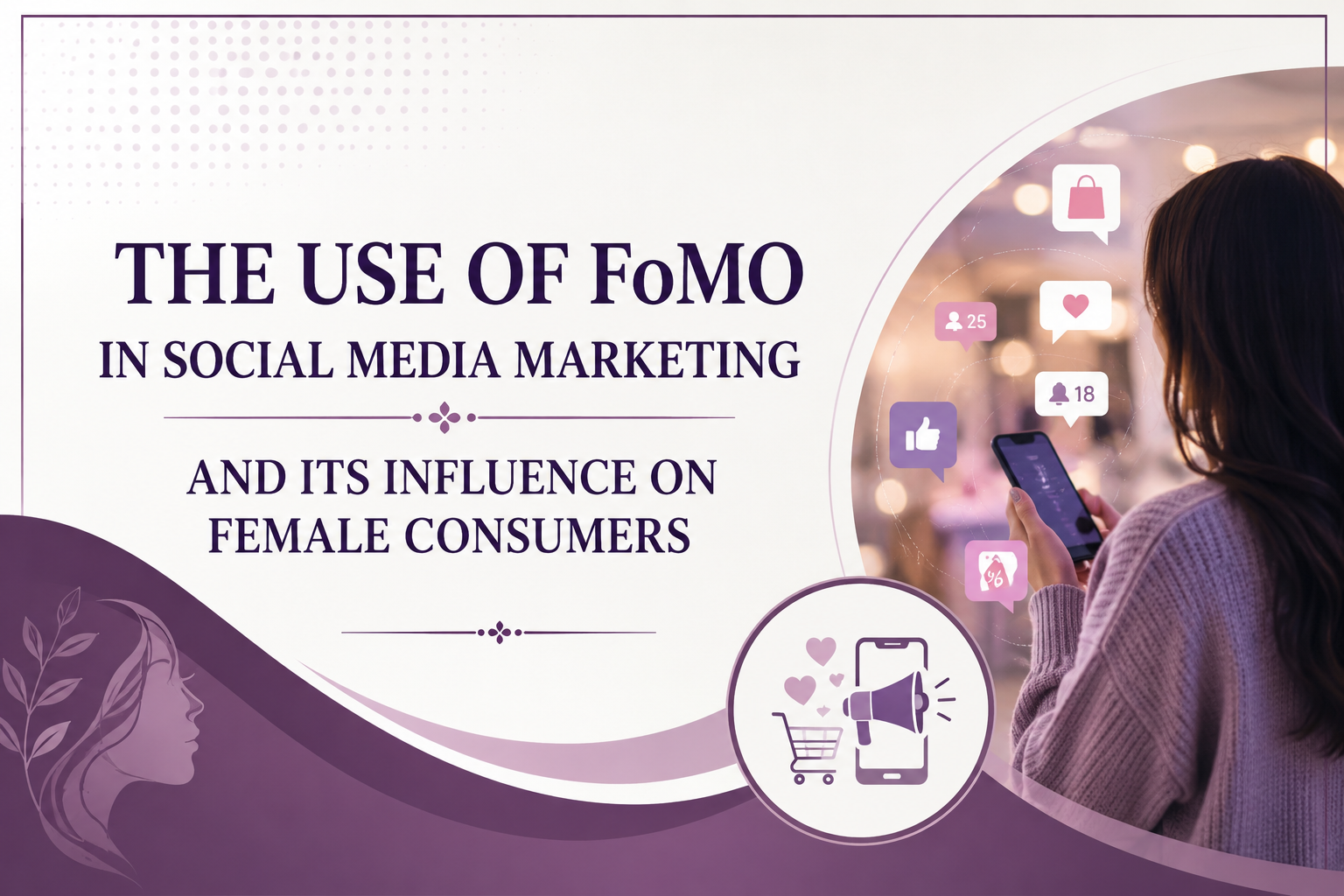
The Use of FoMO in Social Media Marketing and Its Influence on Female Consumers
DOI:
https://doi.org/10.63056/jllsa.2.8.2026.277Keywords:
Fear of Missing Out (FoMO), social media marketing, female consumers, impulsive buying, mediation analysisAbstract
This study examines how Fear of Missing Out (FoMO) is used as a psychological lever in social media marketing and how it shapes the purchasing behavior of female consumers. As platforms such as Instagram and TikTok have grown more central to everyday life, marketers increasingly rely on urgency- and scarcity-based tactics—limited-time offers, countdown timers, influencer endorsements, and visible peer participation—to prompt rapid purchasing decisions. Using a quantitative, cross-sectional survey design, data were collected from 302 female respondents aged 18–35 through an online questionnaire distributed via WhatsApp, Facebook, and Instagram. Responses were analyzed using descriptive statistics, reliability testing, Pearson correlation, and regression analysis in SPSS. Results show that exposure to FoMO-based marketing strategies is significantly and positively associated with feelings of FoMO (r = 0.56, p < .001), which in turn is strongly associated with impulsive consumer behavior (r = 0.61, p < .001). Regression analysis confirmed that FoMO fully mediates the relationship between marketing exposure and purchase behavior, meaning marketing exposure influences buying decisions primarily by activating emotional discomfort rather than through direct persuasion. All three hypotheses were supported. The findings extend Self-Determination Theory, Social Comparison Theory, Uses and Gratifications Theory, and the Elaboration Likelihood Model into the domain of digital consumer psychology and suggest that FoMO functions as a situationally induced emotional state rather than a fixed personality trait. The study concludes with implications for ethical marketing practice, consumer media literacy, and directions for future longitudinal and experimental research.
Downloads
Published
How to Cite
Issue
Section
License
Copyright (c) 2026 Dr. Zaeem Yasin, Ruby Murtaza, Shamail Zehra

This work is licensed under a Creative Commons Attribution 4.0 International License.