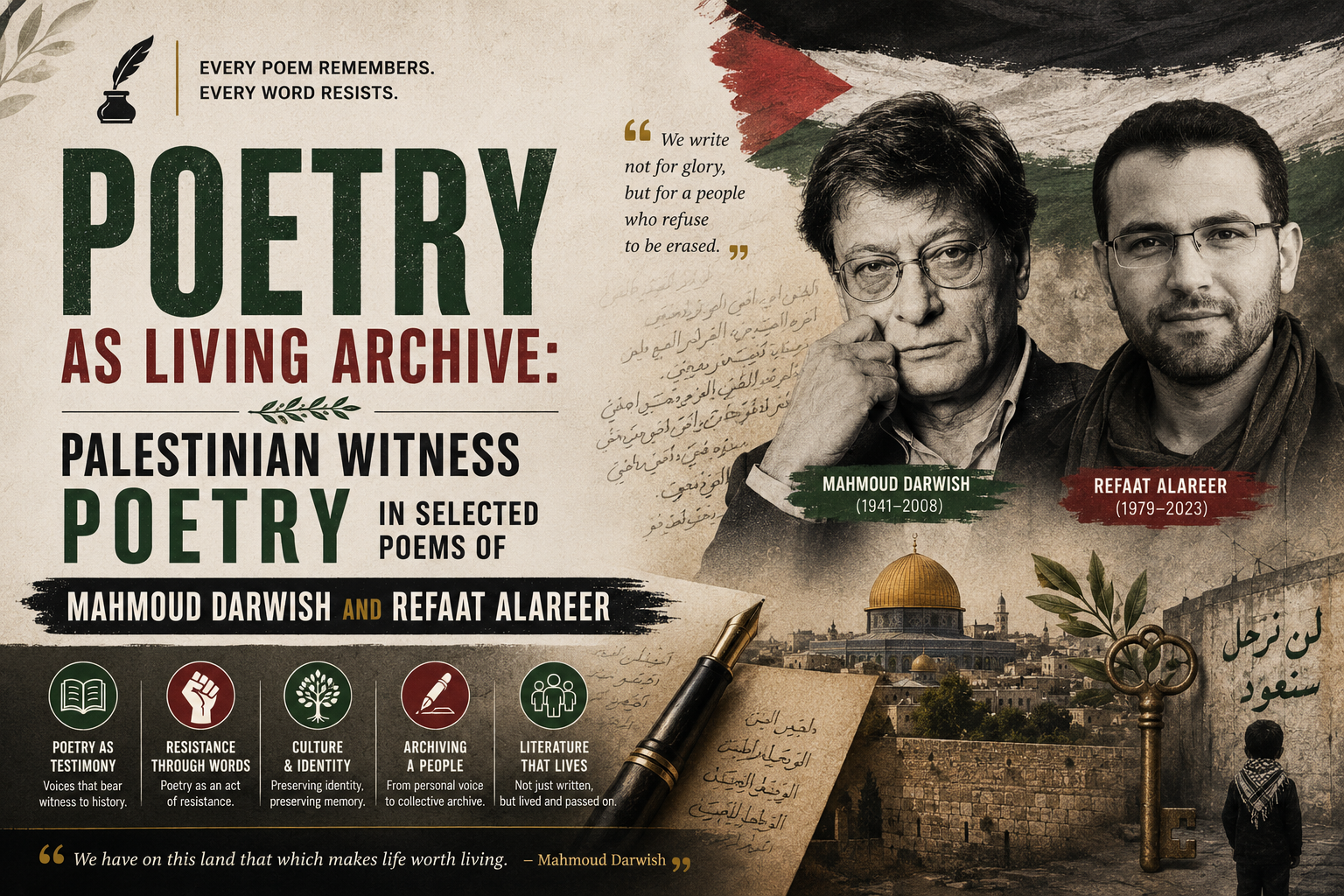
Poetry as Living Archive: Palestinian Witness Poetry in selected poems of Mahmoud Darwish and Refaat Alareer
DOI:
https://doi.org/10.63056/jllsa.2.8.2026.285Keywords:
Palestinian poetry, Witness poetry, Living archive, Carolyn Forché, Mahmoud Darwish, Refaat Alareer, Palestinian literatureAbstract
Palestinian literature has long been studied as resistance writing; however, no existing study systematically examines what specific role this poetry plays during active atrocities, or how that role shifts across different historical eras of violence. This study analyses the selected poems of Palestinian poets Mahmoud Darwish and Refaat Alareer in order to understand the role of poetry during wartime and how that role adapts when the nature of violence changes, given that Darwish's era is defined by displacement, land dispossession, and the bureaucratic erasure of Palestinian identity, whereas Alareer's era is defined by aerial bombardment and siege. By employing Carolyn Forché's poetry of witness as its theoretical framework, this study demonstrates that the selected poems preserve evidentiary traces of suffering, act as poetic memorials against enforced forgetting, restore the individual humanity of those whom violence reduces to statistics, construct a habitable world under conditions of destruction, and create communal urgency that binds writer and reader in shared ethical responsibility. Although both poets perform these same functions, the historical era shapes how each function is performed, such that where Darwish's poems preserve evidence of a people whose existence is officially denied, Alareer's poems transform a genocide that the world watches in real time but fails to act upon into language that demands ethical response, and together these functions transform the poems into what Forché calls a living archive, a text that continues to mark and move its readers across generations. This study concludes that although poetry may not stop war, it ensures that the world does not forget.
Downloads
Published
How to Cite
Issue
Section
License
Copyright (c) 2026 Asma Maqsood, Amina Abbas, Numra Arif

This work is licensed under a Creative Commons Attribution 4.0 International License.