AI Literacy and its Perceived Effect on the Learning Process of the Students at Higher Education in Lahore
DOI:
https://doi.org/10.63056/jllsa.2.8.2026.291Keywords:
Artificial Intelligence (AI), AI literacy, learning process, higher education, affective learning, LahoreAbstract
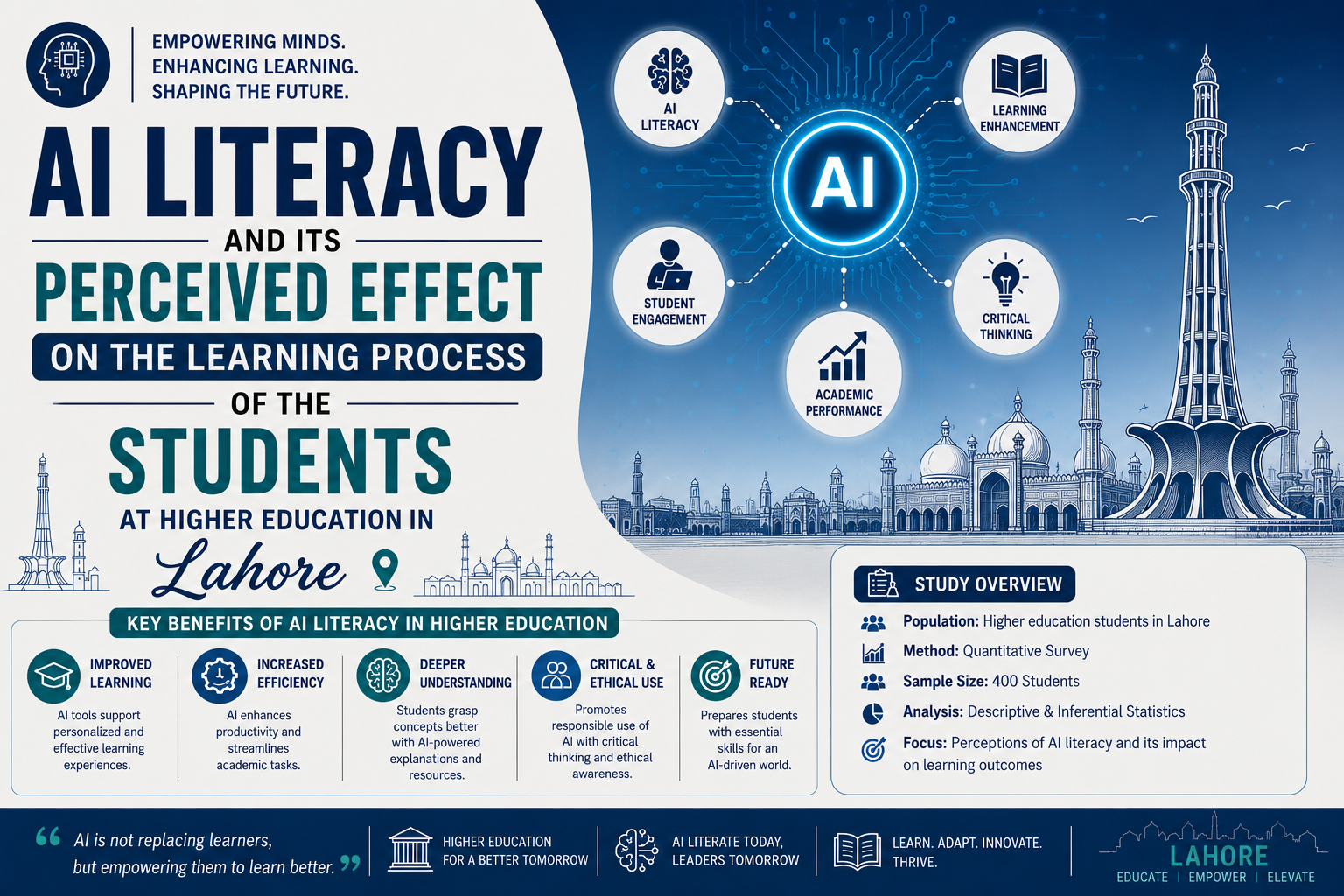
The rapid integration of Artificial Intelligence (AI) into educational contexts has significantly transformed the way students learn, interact, and engage with academic content. The nature of this study was quantitative. The research methodology employed in this study was the positivist research paradigm. In this study, the causal-comparative research design was used. All the undergraduate students of HEC recognized public and private universities of the district Lahore were the targeted population of this study. Multistage random sampling technique was used to select the sample size. A total of 388 students were selected from public and private universities. In this study, two structured questionnaires were used to gather relevant data from students. The first questionnaire was designed to measure the AI literacy of students. This questionnaire included items related to affective, cognitive, and ethical learning of students. The second questionnaire was used to measure the students’ learning process. This questionnaire included items related to learning readiness, learning support, and motivational interaction. Both questionnaires were adapted from existing, well-established studies to ensure relevance and accuracy. After adaptation, the instruments were carefully reviewed to match the objectives of the current study and the context of higher education in Lahore. The findings of the study revealed that there was a strong and statistically significant positive relationship between AI literacy and the learning process, indicating that higher levels of AI literacy are associated with more effective learning experiences. Regression analysis confirmed that AI literacy is a strong predictor of the learning process, explaining a substantial proportion of variance in students’ learning outcomes.
Downloads
Published
How to Cite
Issue
Section
License
Copyright (c) 2026 Syeda Shanza Batool Zaidi, Dr. Muhammad Islam, Ahmad Ali

This work is licensed under a Creative Commons Attribution 4.0 International License.