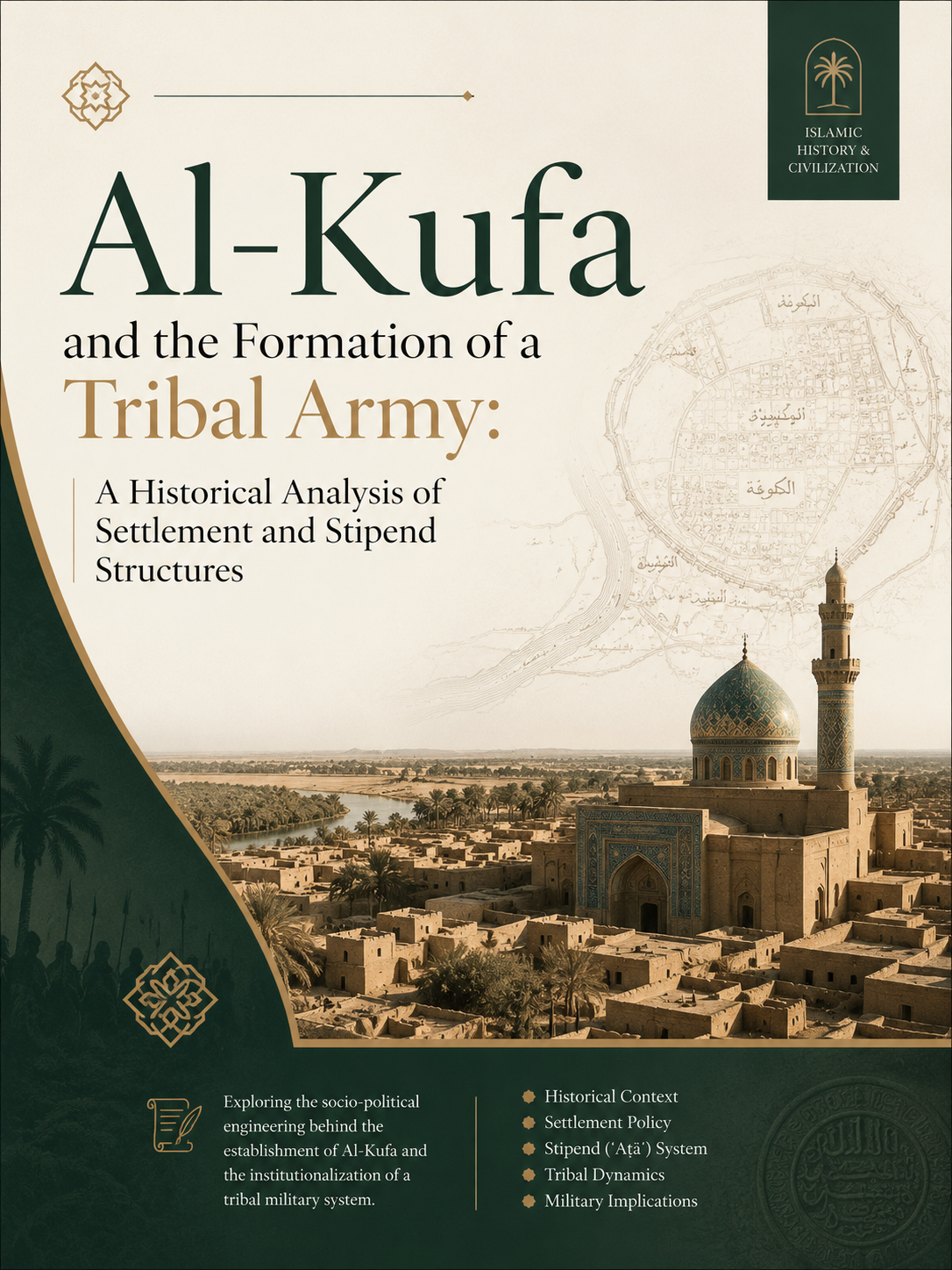
Al-Kufa and the Formation of a Tribal Army: A Historical Analysis of Settlement and Stipend Structures
DOI:
https://doi.org/10.63056/jllsa.2.8.2026.300Keywords:
Muslim army, army of al-Kufa, , Structure and Formation, Composition of armyAbstract
Army is one of the significant institutions of a state. The importance of the army for the security of a state is like that of a blood for the body. The duty of army is not only to protect the boundaries of a state but also to play a key role in its progress. The early Muslim state was also well aware of this fact that an adoptable army was necessary in order to sustain its well-being and growth. For this purpose, caliph ʻUmar b. al-Khaṭṭāb[1] (RA) introduced the institution of regional armies with suitable organization after the conquest of some of the places of foreign domain. Muslims started the conquest of Persian Empire with the conquest of al-Hīra which led to a series of conquests. After several stages of conquests and re-conquests, the whole of Iraq was conquered by the Muslims. In order to maintain control on conquered places, ʻUmar (R.A) decided to establish garrison cities at Iraq. After initially settling at several smaller garrisons, armies settled at the garrison cities namely al-Kūfa and al-Baṣra. This study is an effort to analyze the structure and formation of Kūfan army. In order to create aunthentic narrative and genuine picture of study different versions an event from primary sources are being compared and cross cheched to avoid misinterpretation.
[1] Caliph ʻUmar Ibn al-Khaṭṭāb was the second rightly guided caliph of Islam. He was born in a Quraysh tribe of Banū Adī and he ruled from 13/23-634/644 AH/AD.
Downloads
Published
How to Cite
Issue
Section
License
Copyright (c) 2026 Saima Talib

This work is licensed under a Creative Commons Attribution 4.0 International License.