AI and Pakistani Literary Voice: A Computational Phonetic and Stylistic Analysis
DOI:
https://doi.org/10.63056/jllsa.2.9.2026.304Keywords:
Generative AI, Pakistani English, phonetics, literary voice, computational linguistics, stylistics, code-switching, stylometry, accent bias, artificial intelligenceAbstract
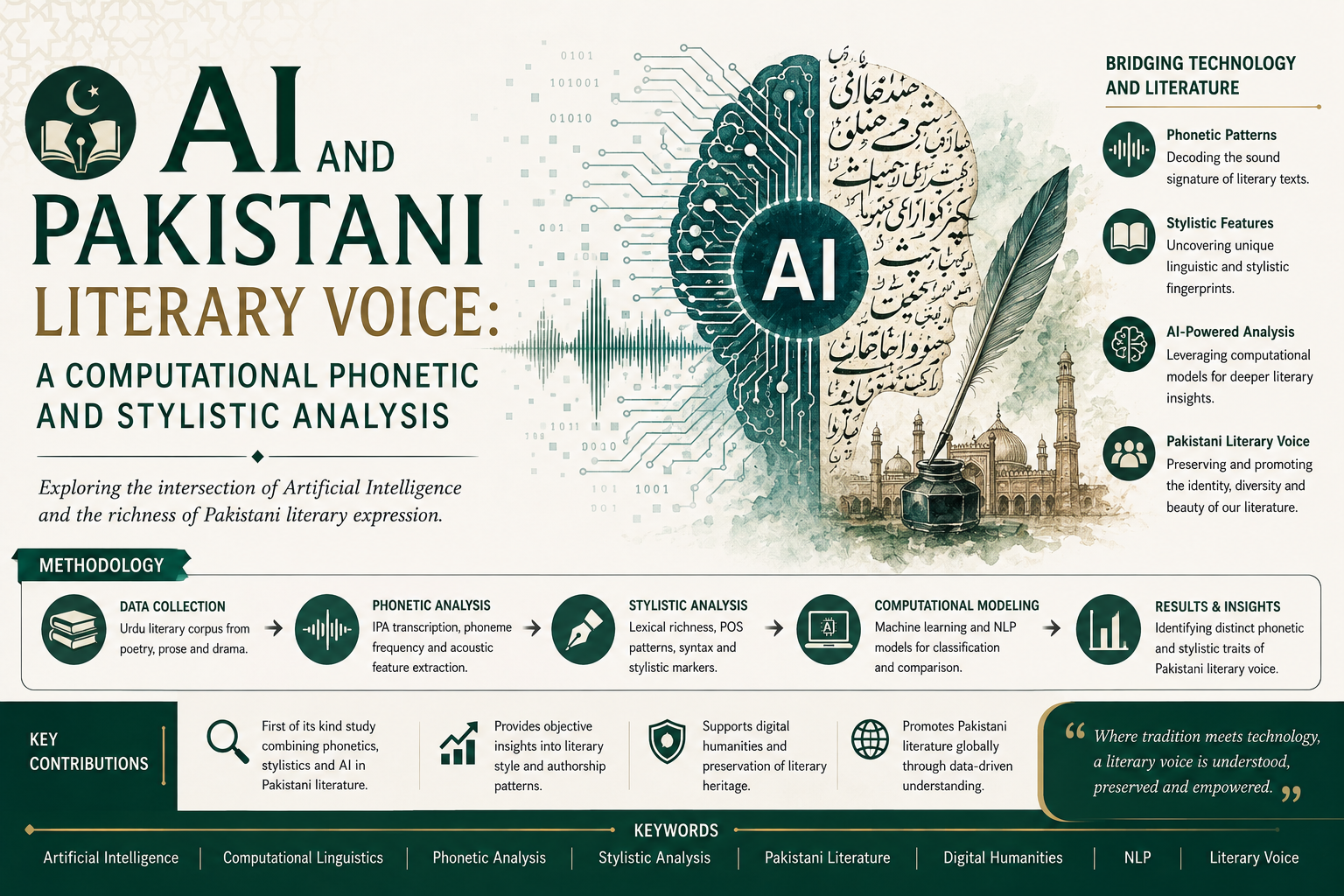
Generative artificial intelligence has brought novel opportunities to literary creation, modelling linguistics, and speech generation. The degree to which AI systems replicate the regional linguistic identities is not well explored. A definite test case of this question is Pakistani English. The present paper suggests a combined computational apparatus to study the Pakistani literary voice on three levels, phonetic, linguistic and literary-stylistic. The framework is an amalgamation of acoustic phonetic examination of vowel formants, vowel duration, fundamental frequency as well as articulation rate. It fuses this with lexical diversity corpus analysis, code switching analysis, and the analysis of culturally-specific vocabulary. It is also a hybrid of computational stylistic analysis of narrative voice, characterisation and positioning in the culture. The entire study plan will involve three datasets. It consists of twenty Pakistani English literature, eighty AI-written texts of fiction with four huge language models, and speech recordings of thirty Pakistani English speakers. Collection and acoustic analysis of these datasets were not complete at the time of writing. In this paper, the suggested analytical pipeline is thus illustrated with the help of illustrative data. The values are realistic trends based on the concepts of the World Englishes, sociophonetic and AI ethics literature. They are not values of datasets above, nor they should be interpreted as empirical findings. They are aimed at demonstrating how the framework would reflect the findings when actual data collection is done. The experiment exhibits the tendency which is in line with the hypothesis guiding the study. The use of human speech and literary data differs more than the corresponding AI-generated counterparts in this example, and the material created by humans features more common culturally embedded use of language. Since the patterns are derived, not measured, data, they are here to be used as a demonstration of the usefulness of the analytical pipeline, but not to confirm the performance of AI. The article provides a methodology that can be followed to assess the interaction between generative AI and a particular variety of English, contextualises the approach to the current body of literature around AI-based stylistic homogenisation, stylometric detection and synthetic-voice accent bias, and outlines what data is needed to transition between demonstration and empirical research.
Downloads
Published
How to Cite
Issue
Section
License
Copyright (c) 2026 Memoona Fida, Dr. Afsheen Kashifa, Jannat Fatima

This work is licensed under a Creative Commons Attribution 4.0 International License.