Creativity as Ideology: A Dual-Framework CDA Analysis of Pakistani English Literary Fiction
DOI:
https://doi.org/10.63056/jllsa.2.9.2026.305Keywords:
Critical Discourse Analysis, linguistic creativity, Fairclough (1992), Carter (2004), Pakistani English fiction, ideology, postcolonial literary discourseAbstract
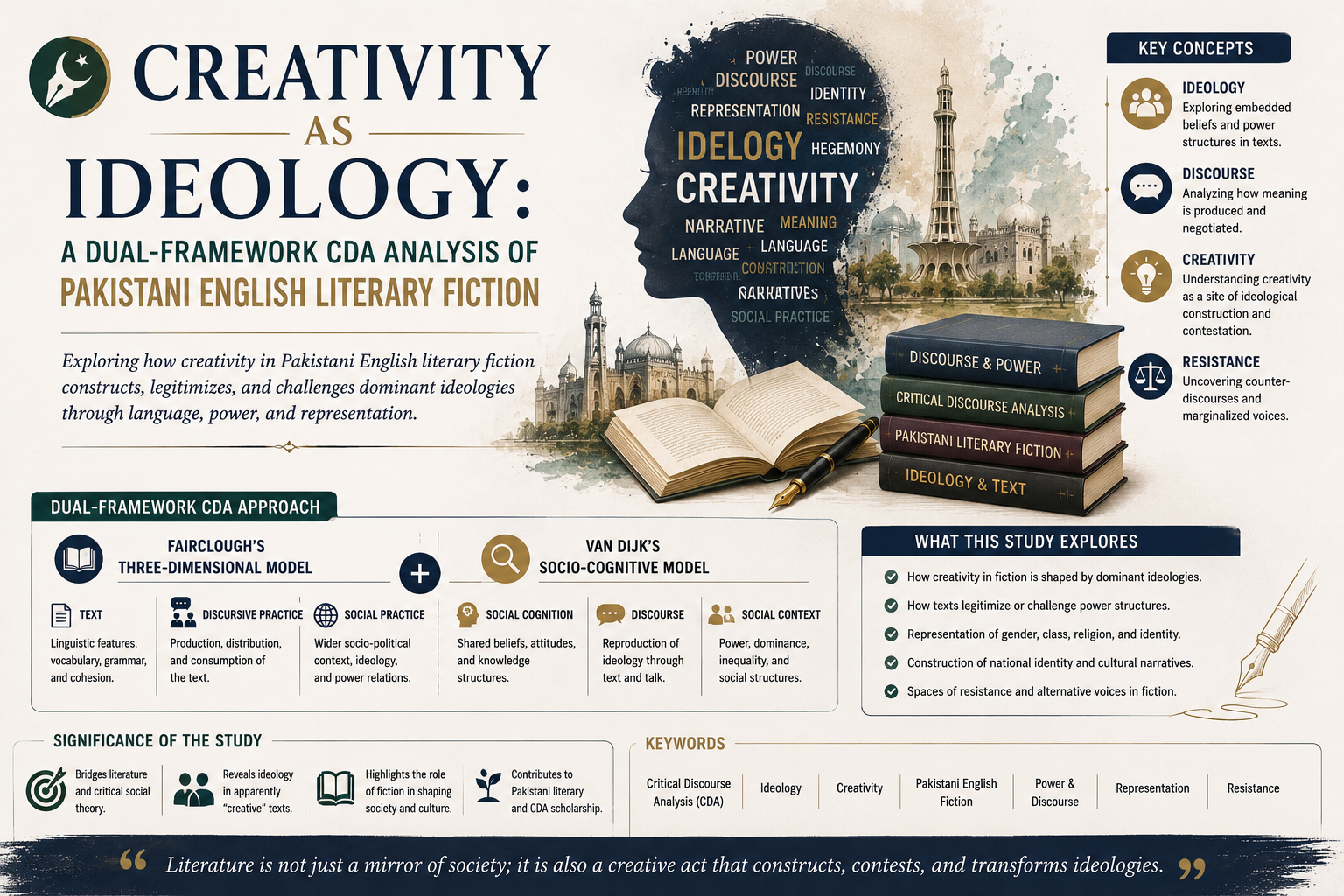
This paper investigates the relationship between linguistic creativity and ideological discourse in Pakistani English literary fiction, applying a dual-framework integration of Carter's (2004) creativity taxonomy and Fairclough's (1992) three-dimensional Critical Discourse Analysis (CDA) model to a purposively sampled analytical dataset of 935 extracts from four novels. Three analytically distinct gains are identified and empirically demonstrated. Gain 1: Carter's taxonomy provides the principled selection criterion for Fairclough's Dimension 1 textual analysis, resolving the feature-selection problem inherent in corpus-scale CDA. Gain 2: Fairclough's Dimension 3 social practice analysis reveals the ideological significance of creativity events that formal analysis alone cannot determine. Gain 3 — the study's central contribution: in the most analytically significant extracts, the Carter creativity event and the Fairclough Dimension 1 feature are formally identical — the same textual choice simultaneously constituting the aesthetic achievement and the discursive-ideological intervention. This formal inseparability is demonstrated across gender, class, and cultural identity ideological fields. The study establishes that creativity in postcolonial Pakistani English fiction is not a formal property deployed in the service of ideology but is found to be both simultaneously.
Downloads
Published
How to Cite
Issue
Section
License
Copyright (c) 2026 Nelofir Shaber, Dr. Syed Kazim Shah

This work is licensed under a Creative Commons Attribution 4.0 International License.