Investigating ESL Teachers’ Textbook Use, Adaptation, and Pedagogical Practices in Teaching Writing Skills
DOI:
https://doi.org/10.63056/jllsa.2.7.2026.307Keywords:
ESL writing instruction, textbook use, materials adaptation, teacher cognition, pedagogical practices, PakistanAbstract
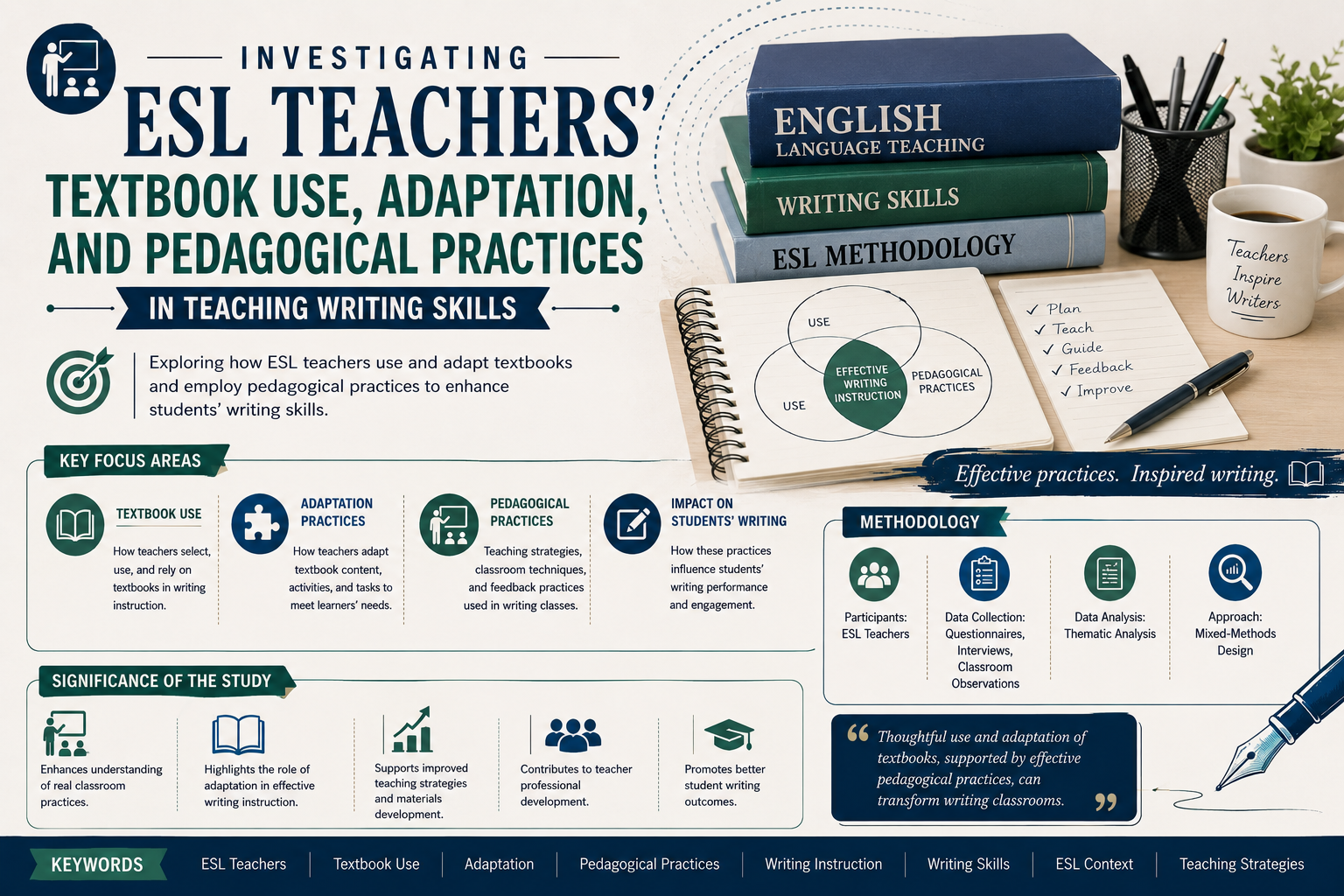
The prescribed textbook remains the single most powerful mediating artifact in English as a Second Language (ESL) classrooms across South Asia, yet comparatively little is known about how teachers actually use it, how far they adapt it, and how those decisions shape the teaching of writing. This study investigated ESL teachers’ textbook use, adaptation practices, and pedagogical approaches to writing instruction in public and private institutions in Punjab, Pakistan. An explanatory sequential mixed-methods design was employed with 60 ESL teachers selected through stratified purposive sampling. Quantitative data were collected through the researcher-developed Textbook Use, Adaptation, and Pedagogical Practices Questionnaire (TUAPQ), a 45-item five-point Likert instrument comprising five subscales, which returned strong internal consistency (α = .93). Qualitative data were generated through semi-structured interviews with 12 purposively selected teachers and non-participant observation of eight writing lessons. Descriptive statistics, independent-samples t tests, one-way ANOVA, Pearson correlations, and multiple regression were computed in SPSS 27, while interview and observation data were analyzed thematically. Findings revealed high textbook reliance (M = 4.02, SD = 0.54) alongside only moderate adaptation (M = 3.31, SD = 0.68), with adaptation confined largely to surface-level addition, simplification, and omission rather than substantive re-design. Writing pedagogy was strongly product-oriented, and feedback practices were dominated by comprehensive error correction. Perceived constraints, textbook reliance, materials-development training, and teaching experience jointly explained 48% of the variance in adaptation practices, F(4, 55) = 12.68, p < .001. Qualitative themes indicated that examination washback and syllabus-completion pressure converted the textbook into a de facto syllabus and narrowed teacher agency. The study argues for materials-adaptation literacy as a core component of ESL teacher education and for assessment reform that legitimizes process-oriented writing instruction.
Downloads
Published
How to Cite
Issue
Section
License
Copyright (c) 2026 Azuba Afzal, Dr. Muhammad Akram

This work is licensed under a Creative Commons Attribution 4.0 International License.