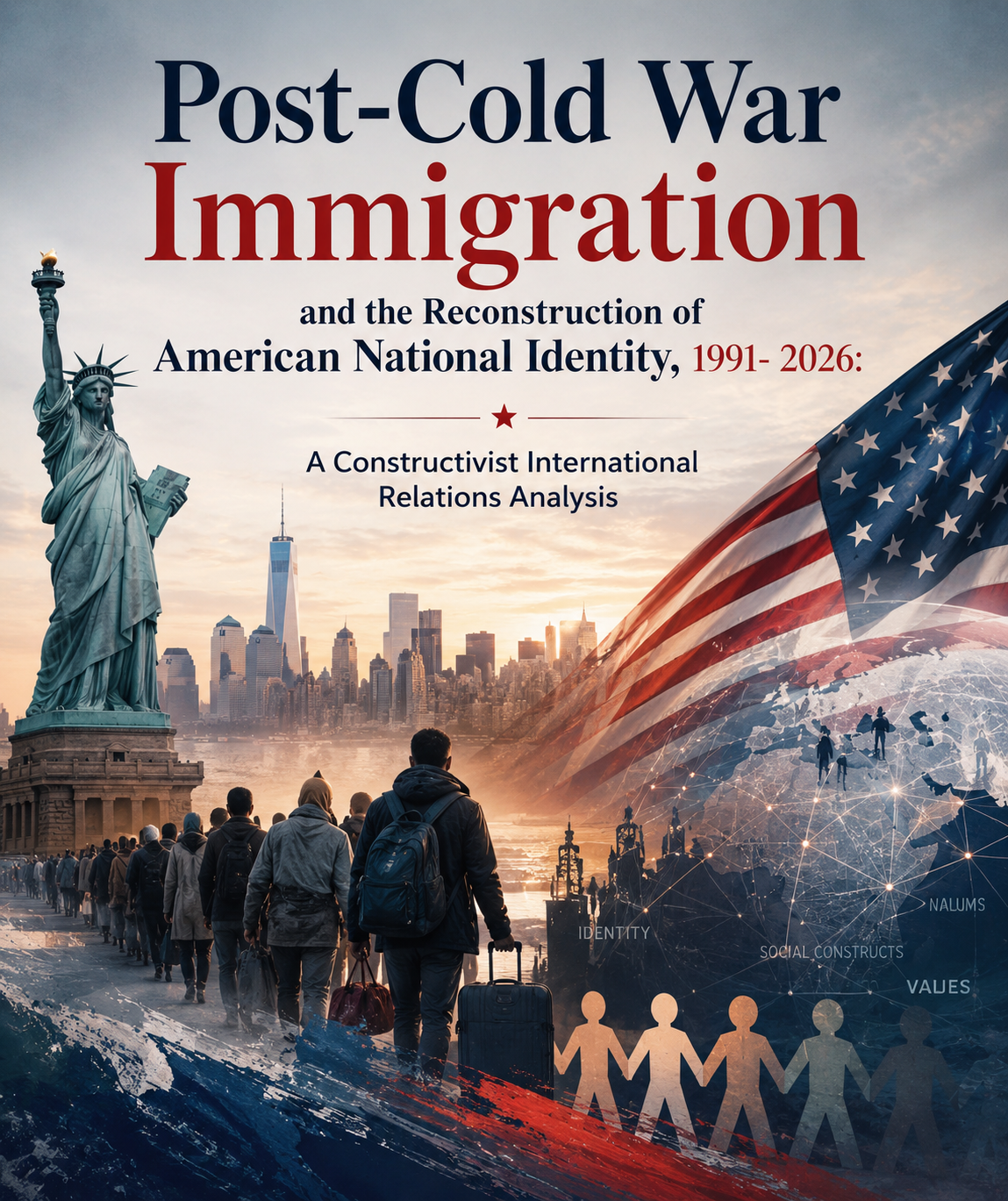
Post-Cold War Immigration and the Reconstruction of American National Identity, 1991- 2026: A Constructivist International Relations Analysis
DOI:
https://doi.org/10.63056/jllsa.2.8.2026.308Keywords:
American national identity, Immigrations, Constructivism, Post Cold-War era, international relationsAbstract
The purpose of this article is to analyze the immigration's role in rebuilding the American national identity in the United States from 1991 to 2026. It understands immigration as an identity construction space in which the law, discourse, institutions, the courts and border practices shape the discourses of citizenship, illegality, asylum, security and belonging. The article is based on the theoretical framework of constructivist International Relations theory and uses a qualitative historical-interpretive research design using structured periodization and process tracing for the post-Cold War era. A short history from 1783 to 1991 sets the longer trajectory of the American immigration identity, and the central argument posits that immigration politics, from the managed openness of the Cold War era, have transformed into securitized boundary making and contested citizenship in the post-Cold War period. The article contends that post-Cold War immigration was as much a challenge to America's national identity as it was an exposure and reproduction of its unresolved contradiction between America as a civic and America as a romanticized notion. A territorial bounded security community and a constitutional nation.
Downloads
Published
How to Cite
Issue
Section
License
Copyright (c) 2026 Dr. Muhammad Ahtasham Jan Butt, Ali Hasnain, Dr. Arfan Latif

This work is licensed under a Creative Commons Attribution 4.0 International License.