A Freudian Psychoanalytical Study of Aster’s Beau is Afraid
DOI:
https://doi.org/10.63056/jllsa.2.7.2026.309Keywords:
Psychoanalysis, Freud, Trauma, Repression, Oedipus Complex, AnxietyAbstract
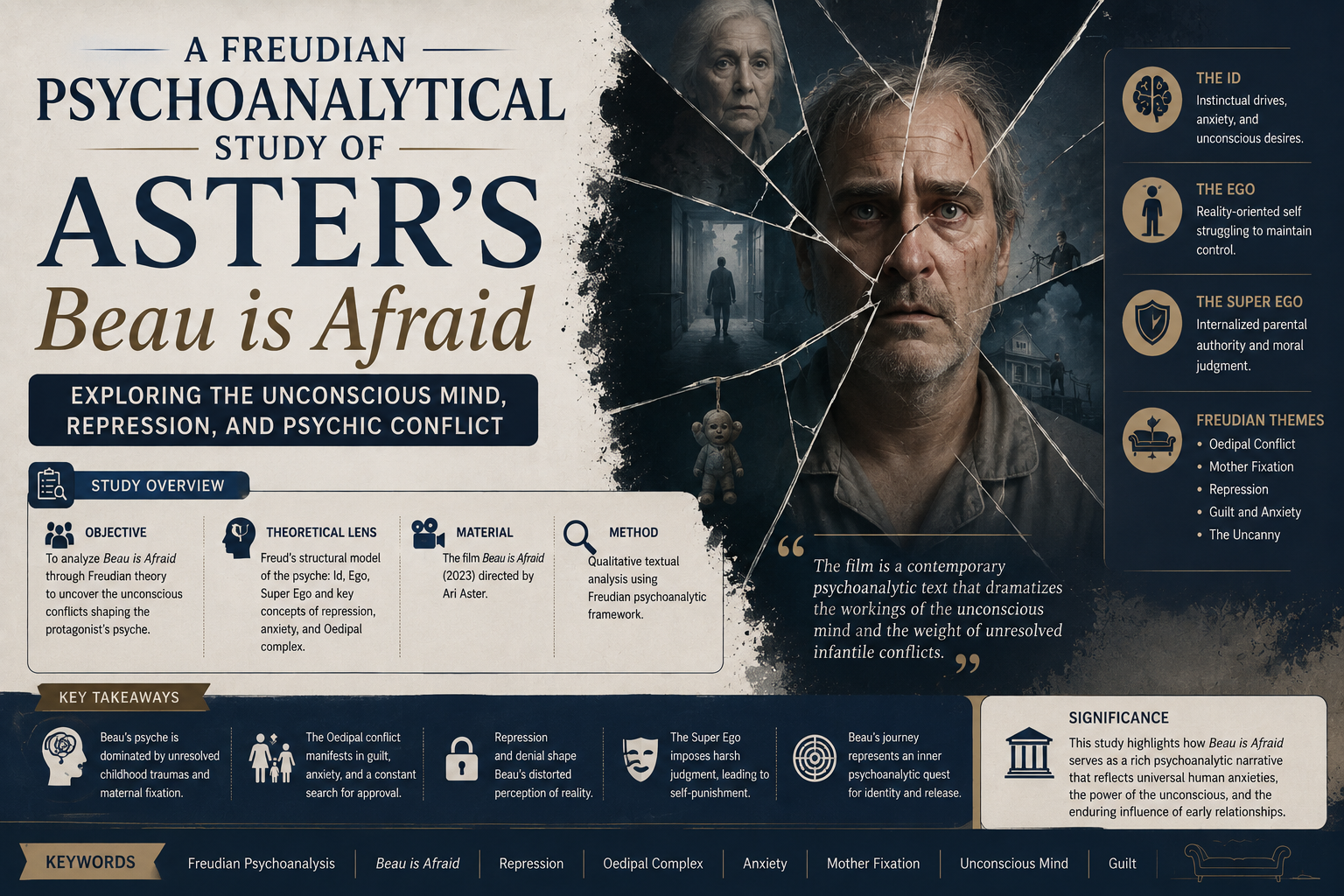
This study offers a Freudian psychoanalytical analysis of Ari Aster's Beau Is Afraid (2023), emphasizing the repressed experiences, fears, unconscious urges, and psychological conflicts that mold Beau Wassermann, the main character. Beau is portrayed in the movie as a very nervous and psychologically troubled person whose sense of reality is constantly shaped by unresolved childhood trauma, anxiety, shame, and mother authority. The study explores the psychological aspects of Beau's character and behavior by looking at the ideas of the unconscious, repression, anxiety, defense mechanisms, neurosis, and the Oedipus complex, mostly based on Sigmund Freud's psychoanalytic theory. The study takes a qualitative approach and interprets specific scenes, dialogues, characters, symbols, and narrative events in the movie using textual and cinematic analysis. Beau's mental condition will also be examined in relation to the film's style, which includes jerky cuts, loud and chaotic noises, and small and tight settings. All of these factors contribute to the film's experience being akin to a visual breakdown. The study will demonstrate how the film's disturbing effect comes from its accurate but disturbing depiction of how childhood trauma and unresolved conflicts can affect one's perception of reality. This demonstrates the applicability of Freud's theories to the current art and media.
Downloads
Published
How to Cite
Issue
Section
License
Copyright (c) 2026 Neha Arif, Dr. Hira Ali, Bakhtawar Tahir

This work is licensed under a Creative Commons Attribution 4.0 International License.