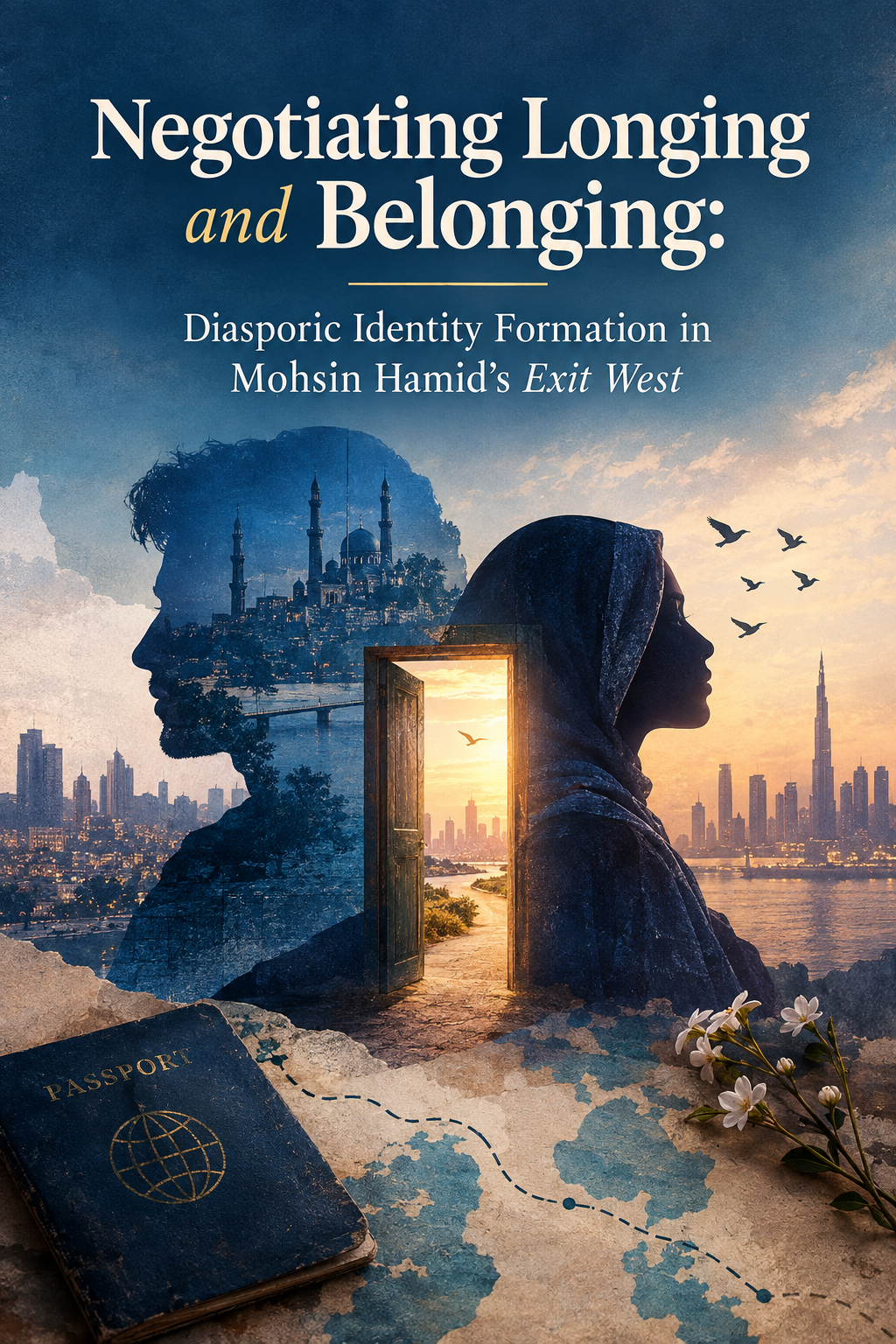
Negotiating Longing and Belonging: Diasporic Identity Formation in Mohsin Hamid's Exit West
DOI:
https://doi.org/10.63056/jllsa.2.9.2026.336Keywords:
Exit West, migration, diaspora, longing, belonging, identity formation, magical realism, hybridity, postcolonial theoryAbstract
This study examines the emotional and psychological dimensions of migration in Mohsin Hamid's Exit West through the theoretical lenses of diaspora and postcolonial studies, with particular emphasis on the interconnected concepts of longing and belonging. While existing scholarship on the novel primarily focuses on migration, globalization, hybridity, liminality, and border politics, relatively limited attention has been devoted to the affective dimensions of diasporic identity formation. Addressing this gap, the study investigates how longing for home and the search for belonging shape the experiences of the novel's protagonists, Saeed and Nadia, as they navigate displacement and cultural transition. Hamid employs magical realism, particularly through the symbolism of mysterious doors, to represent migration as an abrupt and disorienting phenomenon that intensifies feelings of alienation, uncertainty, and identity fragmentation. Using close textual analysis, this study explores representations of home, memory, identity, longing, and belonging within a diasporic framework. The findings demonstrate that diasporic identity emerges through a continuous negotiation between cultural heritage and the challenges of adaptation in transnational spaces. Furthermore, the study argues that Exit West reconceptualizes belonging as a dynamic and evolving process rather than a fixed attachment to a single geographical location.
Downloads
Published
How to Cite
Issue
Section
License
Copyright (c) 2026 Surayya Shaheen, Kifayat Ullah

This work is licensed under a Creative Commons Attribution 4.0 International License.