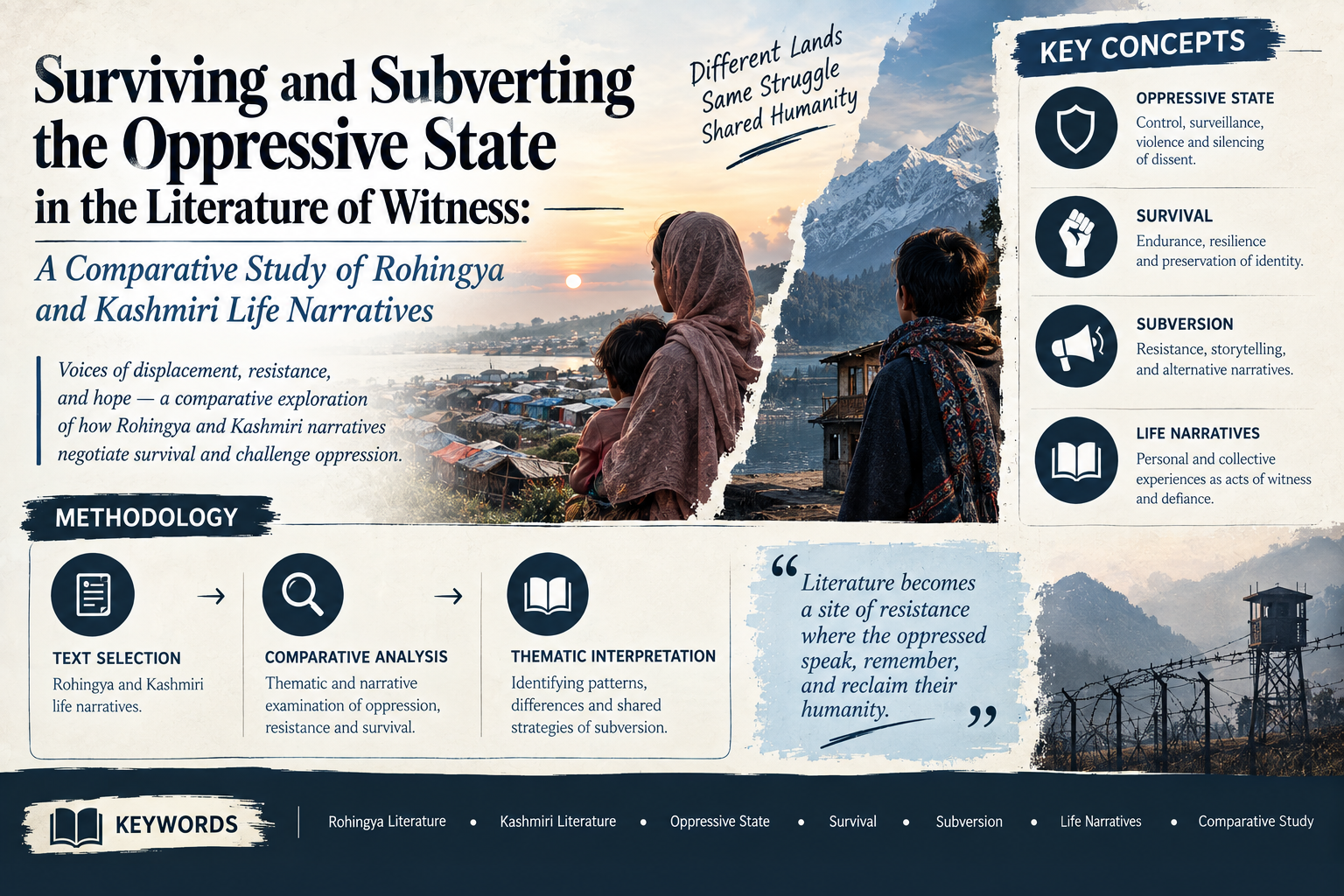
Surviving and Subverting the Oppressive State in the Literature of Witness: A Comparative Study of Rohingya and Kashmiri Life Narratives
DOI:
https://doi.org/10.63056/jllsa.2.9.2026.342Keywords:
Oppressive State, State Apparatuses, Rohingyas, Kashmiris, Subversion, totalitarianism, Literature of Witness, Arendt, Althusser, FoucaultAbstract
Cultural expressions, both oral and written, provide a powerful medium to resist and survive oppression. Drawing on this premise, the study comparatively interprets Rohingya and Kashmiri life narratives, examining how the Myanmar and Indian state, concurrently, employ oppressive and totalitarian apparatuses of power to obliterate identity, disenfranchise, dehumanize, and displace the Rohingyas and Kashmiris in Rakhine and Indian-held Kashmir respectively. Utilizing theorizations of Hannah Arendt, Louis Althusser and Michel Foucault, this research investigates two life narratives: Farah Bashir’s Rumours of Spring (2021) and Habiburahman’s First, They Erased Our Name (2018). The study has found that the two states, Myanmar and India, convergently use systemic and institutionalized stratums of violence and power to marginalize and obfuscate the existence of their two minority communities. Taking these life narratives as embodiments of the ‘Literature of Witness’, this paper suggests that the precarious survival in the besieged territories also posits discursive subversion and resistance to oppression, empowering the two communities to reclaim their collective identity, history, and cultural ethos through the act of writing. This study can contribute meaningfully to ongoing debates in trauma studies, South Asian studies, life writing and the literature of witness’s role in conflict zones.
Downloads
Published
How to Cite
Issue
Section
License
Copyright (c) 2026 Muhammad Afzal Khan Janjua

This work is licensed under a Creative Commons Attribution 4.0 International License.