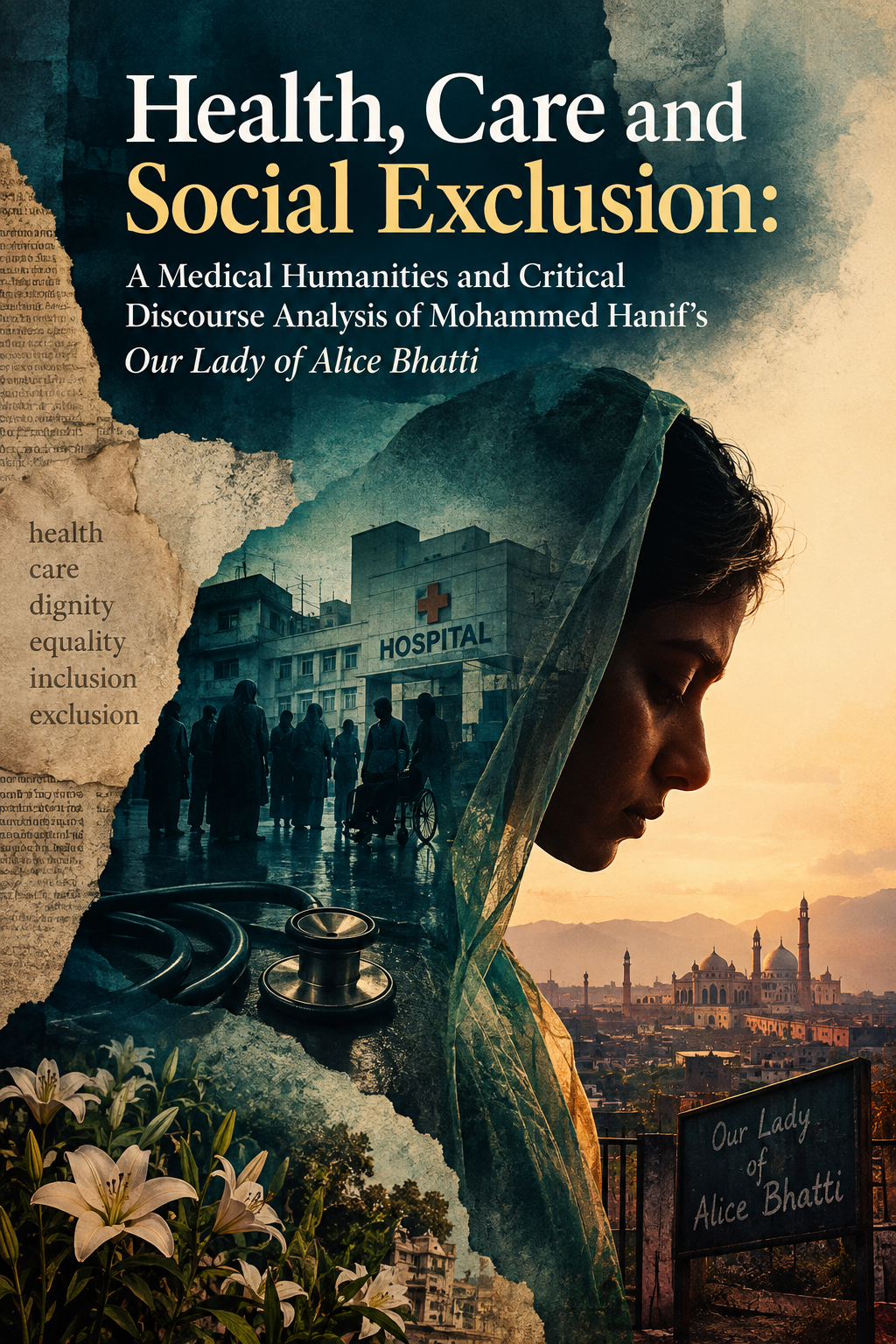
Health, Care and Social Exclusion: A Medical Humanities and Critical Discourse Analysis of Mohammed Hanif’s Our Lady of Alice Bhatti
DOI:
https://doi.org/10.63056/jllsa.2.9.2026.363Keywords:
critical discourse analysis, medical humanities, health inequality, caregiving, social exclusion, healthcare discourse, South Asian fictionAbstract
The current study examines the narratives of health, care and social exclusion in Mohammed Hanif’s Our Lady of Alice Bhatti (2011). The novel brings to the forefront the lived realities of the marginalized populations in Karachi's public healthcare system through the intersections of illness, poverty, gender, religion, institutional violence and inequitable access to healthcare. The study is informed by theoretical frameworks of Social Determinants of Health, Medical Humanities and Critical Discourse Analysis and focuses on how language and narrative maps out health care as a contested social space, in which socio-political power dynamics, discrimination, and structural inequalities recognize and condition illness and narratives of care. The research method is qualitative which uses close reading of selected text to investigate the encoding of institutional practices, moral judgments, and unequal social relations in these choices. The analysis shows that illness in the novel is not only a biomedical phenomenon but also a socially constructed phenomenon, which is influenced by poverty, religious marginalization, gender-based violence, occupational hierarchy, and institutional neglect. The lexical and semantic patterns show that the hospital is a place of healing and exclusion and that vulnerable patients and health care workers are negotiating systemic discrimination and disparities in care access. The study also reveals the use of irony, satire, metaphor, and dialogic interaction by Hanif in criticism of structural violence that is built into the health sector and the social structure. Finally, the study advances interdisciplinary research in the medical humanities by demonstrating how literary analysis can be applied effectively to the study of health inequalities, healthcare practices and social justice in the Global South.
Downloads
Published
How to Cite
Issue
Section
License
Copyright (c) 2026 Dr. Muhammad Ajmal, Dr. Sadia Akram, Dr. Sadia Nazir

This work is licensed under a Creative Commons Attribution 4.0 International License.