Linguistic Scars of Patriarchal Trauma: A Psycholinguistic Analysis of Pakistani Drama Aik Aur Pakeezah
DOI:
https://doi.org/10.63056/jllsa.2.9.2026.368Keywords:
Psycholinguistics, trauma, scars, patriarchy, linguistic narrative, languageAbstract
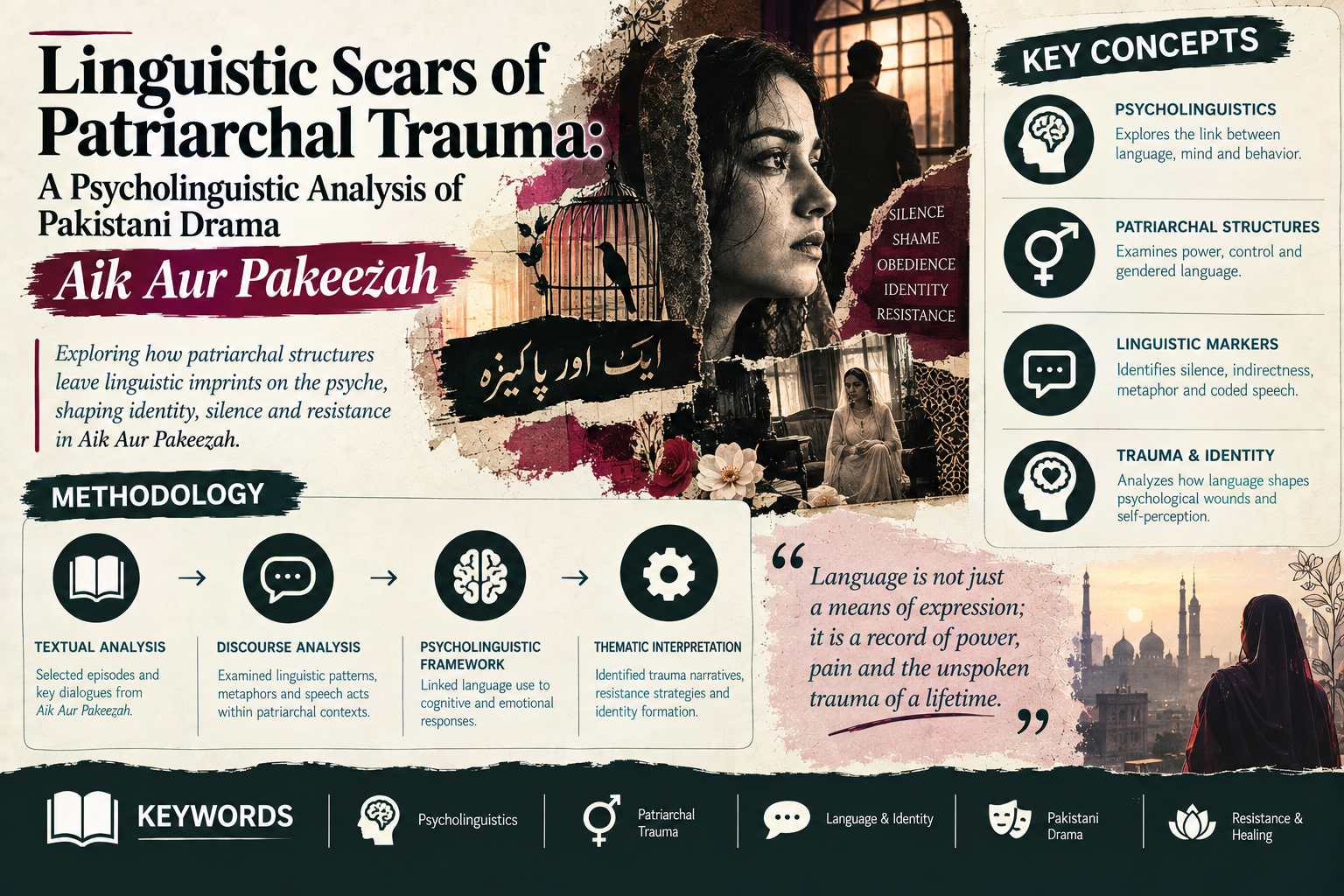
This research aims to analyze the psycholinguistic representation of patriarchal trauma in the Pakistani Drama Aik Aur Pakeezah. Patriarchy provokes traumatizing consequences in many psychological and physical aspects of a woman's life, producing linguistic scars. Patriarchal trauma has devastating impacts on the psychological, moral and linguistic narratives of Pakistani women. Utilizing Cathy Caruth’s Trauma Theory, this study explores how patriarchal trauma leaves linguistic scars and how trauma re-emerges, forcing women to stutter, omit certain words or to speak in a fragmented structure. By using a qualitative approach, transcription of Pakeezah's dialogues selected from purposive sampling of episodes 1-27 is utilized for features such as hesitation, fragmentation and avoidance of certain words, revealing the character's wounded mental as well as linguistic state. The findings demonstrate that patriarchal trauma is reflected through recurring disruptions in Pakeezah’s linguistic expression, particularly through hesitation, fragmented speech, repetition and avoidance that signals the psychological burden of her past traumatic experiences. This study concludes that healing the linguistic scars of patriarchal trauma requires transforming language from a tool of silence and subordination into one of empowerment, agency, and validation.
Downloads
Published
How to Cite
Issue
Section
License
Copyright (c) 2026 Fatima Faisal, Maria Hafeez, Munazza Mazher

This work is licensed under a Creative Commons Attribution 4.0 International License.