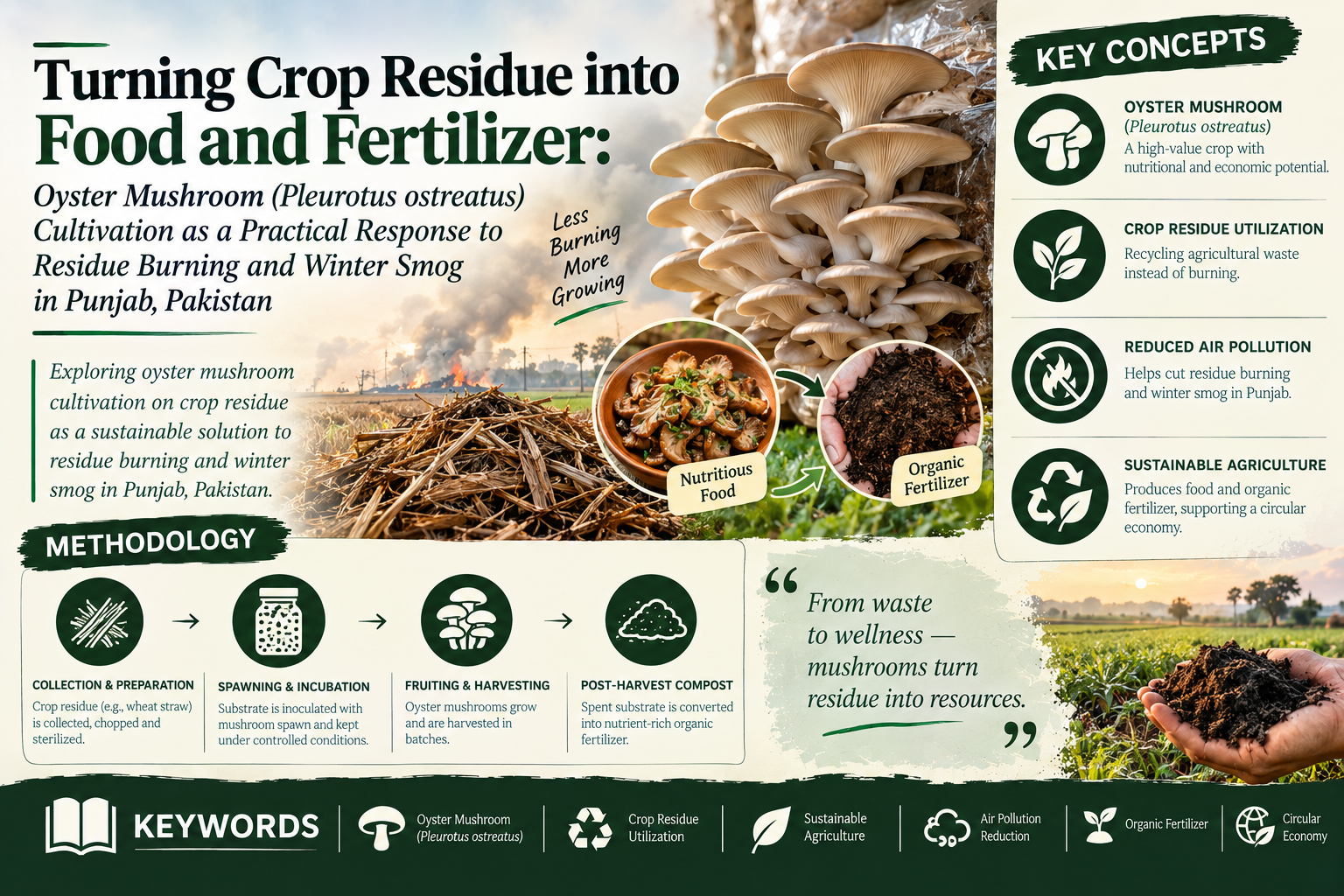
Turning Crop Residue into Food and Fertilizer: Oyster Mushroom (Pleurotus ostreatus) Cultivation as a Practical Response to Residue Burning and Winter Smog in Punjab, Pakistan
DOI:
https://doi.org/10.63056/jllsa.2.9.2026.369Keywords:
oyster mushroom, Pleurotus ostreatus, crop residue burning, smog, Punjab, circular agriculture, spent mushroom substrateAbstract
Every winter, the plains of Punjab are covered by dense smog that closes schools, disrupts air and road transport, and increases respiratory illness. Vehicles, industry, brick kilns, and transboundary air masses all contribute, but open burning of crop residue is a seasonal and avoidable source. This article examines oyster mushroom cultivation as a low-cost way to turn agricultural residue into food, income, and organic soil amendment. It reviews the drivers of residue burning, the biology and nutritional value of Pleurotus species, a practical cultivation protocol suited to Punjab's winter climate, and the economic and environmental benefits. It also states the limits of the approach. Mushroom farming cannot absorb the full volume of residue produced in the province, but it can give farmers a profitable, proven alternative to burning, and it works well as an entry point to wider residue management.
Downloads
Published
How to Cite
Issue
Section
License
Copyright (c) 2026 Farrukh Mahmood, Saba Hisham, Humaira kanwal

This work is licensed under a Creative Commons Attribution 4.0 International License.