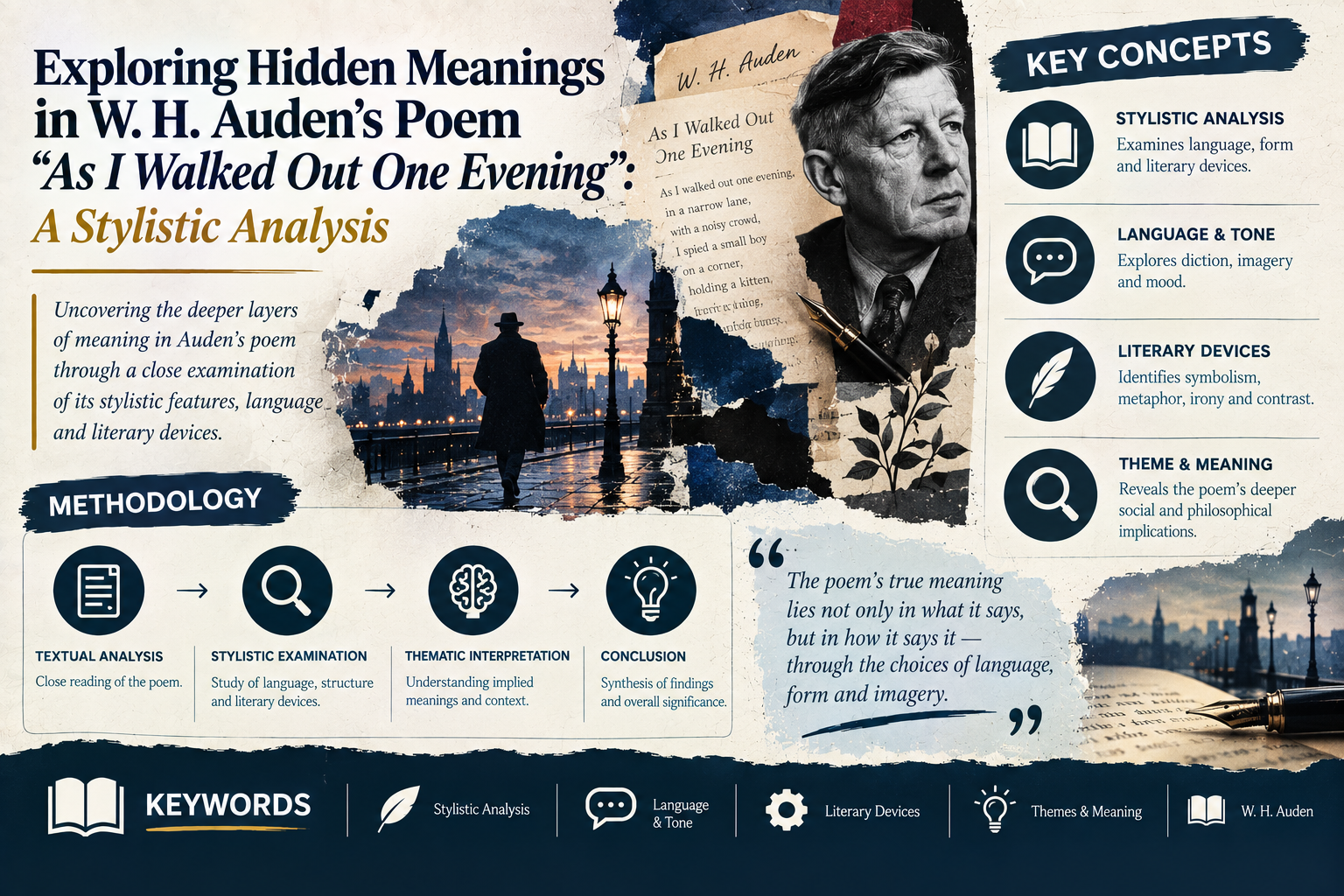
Exploring Hidden meanings in W. H. Auden’s Poem “As I Walked Out One Evening”: A Stylistic Analysis
DOI:
https://doi.org/10.63056/jllsa.2.10.2026.371Keywords:
Style, Stylistics, Foregrounding, Semantic deviation, W.H. AudenAbstract
This qualitative research aims to analyze the poem “As I Walked Out One Evening” by W. H. Auden from a Stylistic point of view. This work intends to uncover the symbolic and implicit meaning of the poem. Moreover, this study uses sematic deviation, a powerful analytical tool in the Foregrounding theory, as a theoretical framework to investigate that how linguistic and stylistics choices contribute to the poem’s in-depth thematic importance. By analyzing the foregrounding technique and stylistic patterns, this study elaborates that how Auden uses unconventional semantics/linguistic structures to convey deep meaning beyond literal interpretations. What’s more is that this research employs both primary and secondary data. The primary data is gathered from the original text of the poem “As I Walked Out One Evening” while secondary data is collected from scholarly articles, books, online websites, and other published sources. Additionally, the findings of this work show the importance of stylistic analysis in literal interpretations as it makes it easier for the common readers to understand the unusual, multifaceted, and symbolic meaning within complex poetic texts.
Downloads
Published
How to Cite
Issue
Section
License
Copyright (c) 2026 Aliya Raees, Muhammad Mehran Khan, Dr. Ihsan Ullah Khan

This work is licensed under a Creative Commons Attribution 4.0 International License.