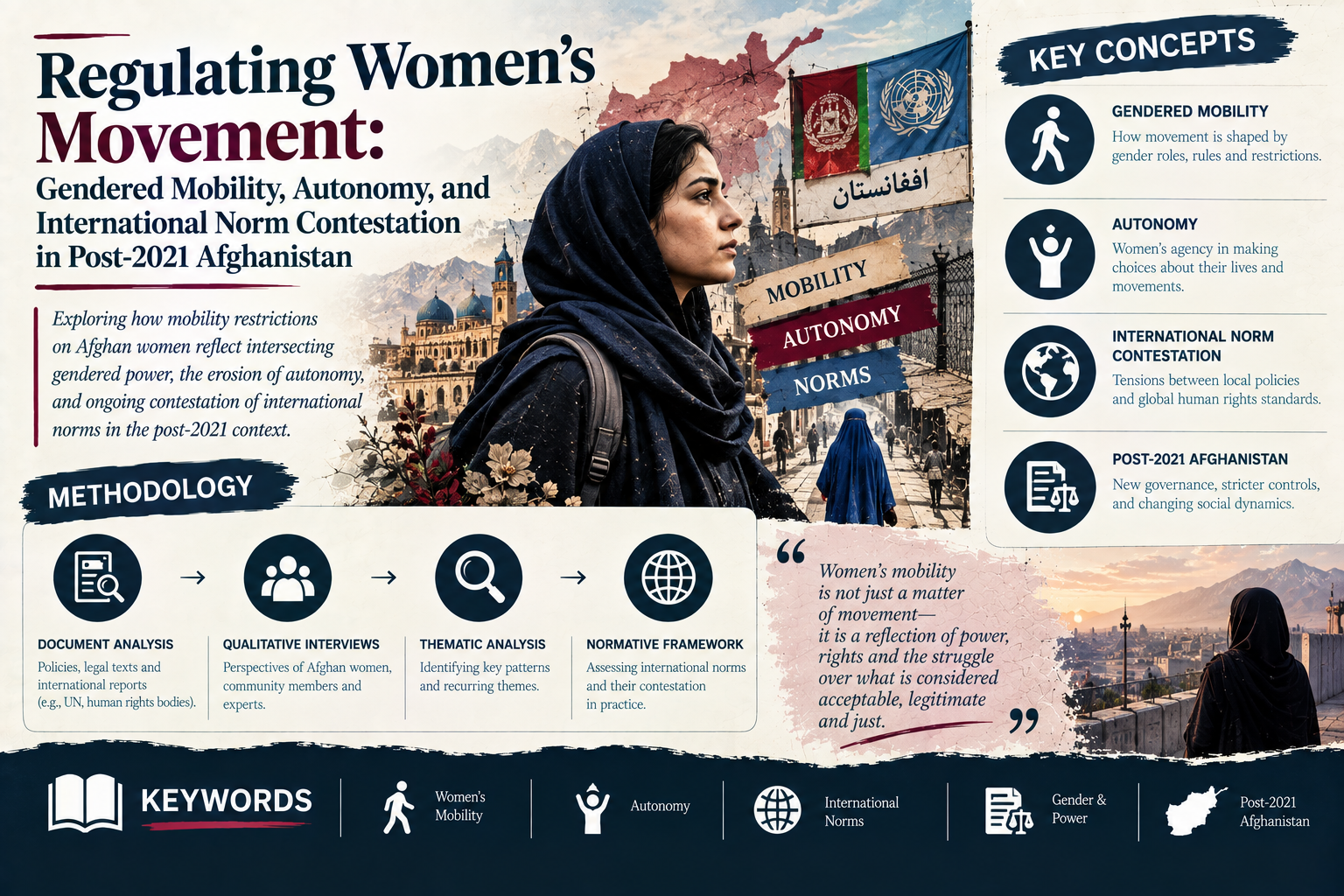
Regulating Women's Movement: Gendered Mobility, Autonomy, and International Norm Contestation in Post-2021 Afghanistan
DOI:
https://doi.org/10.63056/jllsa.2.5.2026.373Keywords:
Afghanistan, Taliban, Afghan women, gendered mobility, mahram, practical autonomy, gender regime, feminist International Relations, institutional exclusion, gender persecution, gender apartheid, women’s rightsAbstract
The Taliban’s return to power in Afghanistan in August 2021 has significantly restricted women’s access to education, employment, healthcare, public space, and freedom of movement. While these restrictions are well documented, less attention has been paid to mobility as a mechanism that connects different forms of gender exclusion. This study examines how regulating women’s movement, especially through mahram requirements and limits on women’s presence in public and institutional spaces, shapes practical autonomy and influences international debates on Taliban governance. The research draws on qualitative analysis of peer-reviewed literature, systematic reviews, United Nations and human rights reports, institutional publications, and relevant international legal materials. Walby’s gender-regime theory provides the main framework for analyzing how gender inequality is reproduced across institutions, while feminist International Relations theory explains how domestic gender regulation gains international political relevance. The findings show that mobility acts as a cross-cutting institutional mechanism, reinforcing restrictions in education, healthcare, employment, and public participation. Male accompaniment requirements make women’s access to institutions dependent on household relationships, economic resources, geography, and institutional approval, which limits the exercise of recognized rights. These effects are understood as constraints on practical autonomy, defined as women’s ability to exercise their rights and participate in institutional life without enforced gendered dependency. At the same time, women’s involvement in alternative education, digital participation, economic activity, and advocacy demonstrates ongoing agencies. The study concludes that gendered mobility is a key analytical link between domestic gender governance and international discussions on human rights, accountability, gender persecution, and the emerging concept of gender apartheid.
Downloads
Published
How to Cite
Issue
Section
License
Copyright (c) 2026 Dr. Humera Ambareen, Raheela Kanwal, Mehik Batool

This work is licensed under a Creative Commons Attribution 4.0 International License.