On Syntactic Architecture of Urdu-Hindi Impersonal Passives in Relativization
DOI:
https://doi.org/10.63056/jllsa.2.10.2026.374Keywords:
Urdu-Hindi, Impersonal Passive, Locality, Acceptability Judgment Task, Relative clauseAbstract
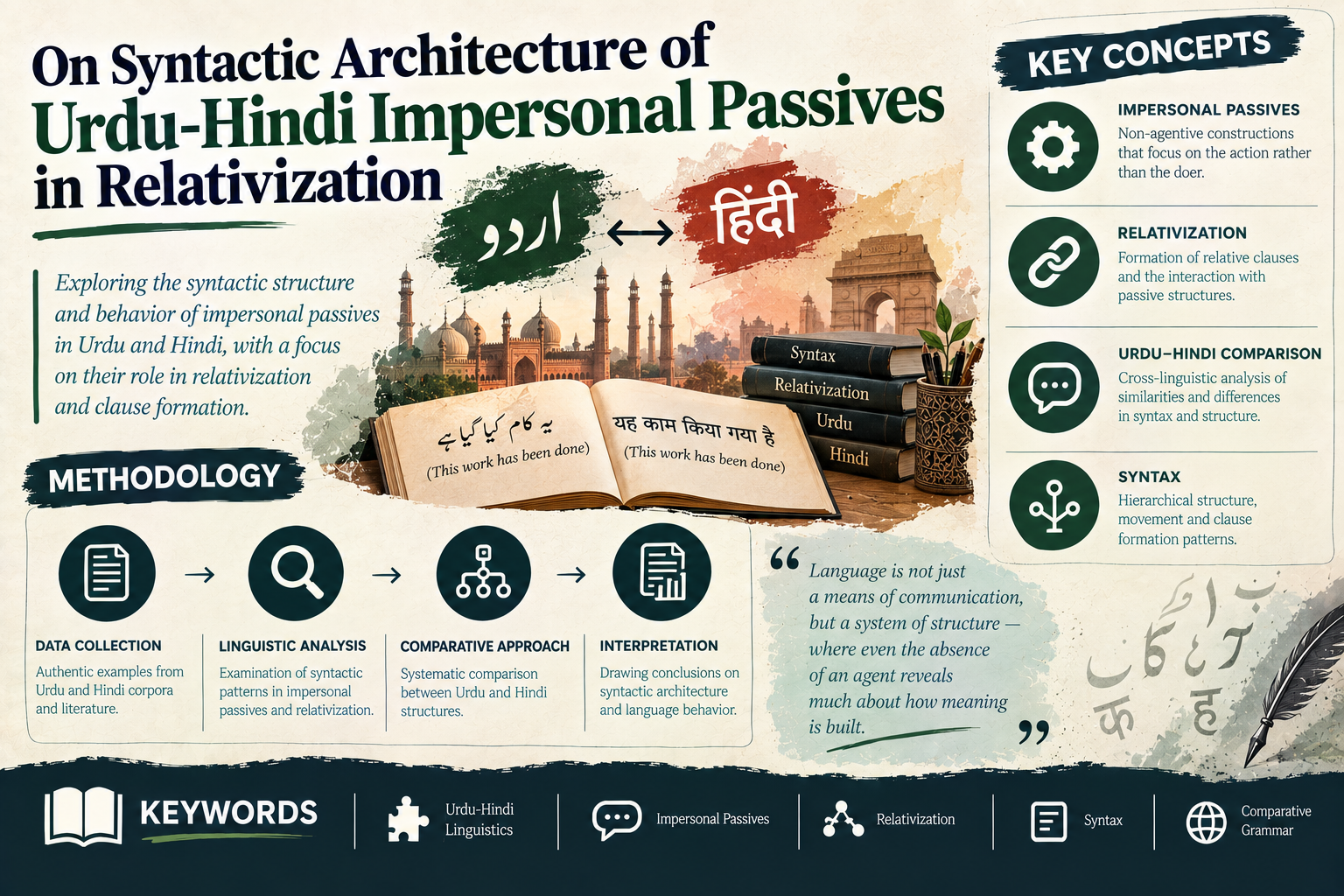
This study investigates the syntax of impersonal passive within Urdu-Hindi relative clauses, proposing a unified theoretical model that integrates Cyclic Agree and Voice Projection with a raising-based analysis of relativization. Urdu-Hindi exhibits distinct complex predicate architectures across ergative, unergative, and accusative verb types, establishing quintessential testing conditions for locality and case interplay. To get empirical evidence, an Acceptability Judgement Task (N=40) was transacted utilizing 7-Point Likert scale across six conditions controlling argument shift and morphological case marking. A repeated-measures analysis of variance (RM-ANOVA) demonstrated a statistically significant main effect for postpositional marking, , where overt case-marking via -ko provided a uniform, surface level boost to sentence naturalness ( points). Crucially, the association between shifting and case-marking was non-significant, , demonstrating that -ko fails to mitigate or repair the ungrammaticality caused by constituent splitting. Post-hoc pairwise comparison confirmed that sub-extraction systematically violates strict locality and phase-based constituent integrity constraints. Collectively, these empirical findings demonstrate that morphological case-marking functions as an additive surface-level facilitator rather than a structural reparative mechanism capable of overriding narrow-syntactic movement constraints.
Downloads
Published
How to Cite
Issue
Section
License
Copyright (c) 2026 Naila Kanwal Dar, Qaisar Jabbar, Asad Ali

This work is licensed under a Creative Commons Attribution 4.0 International License.