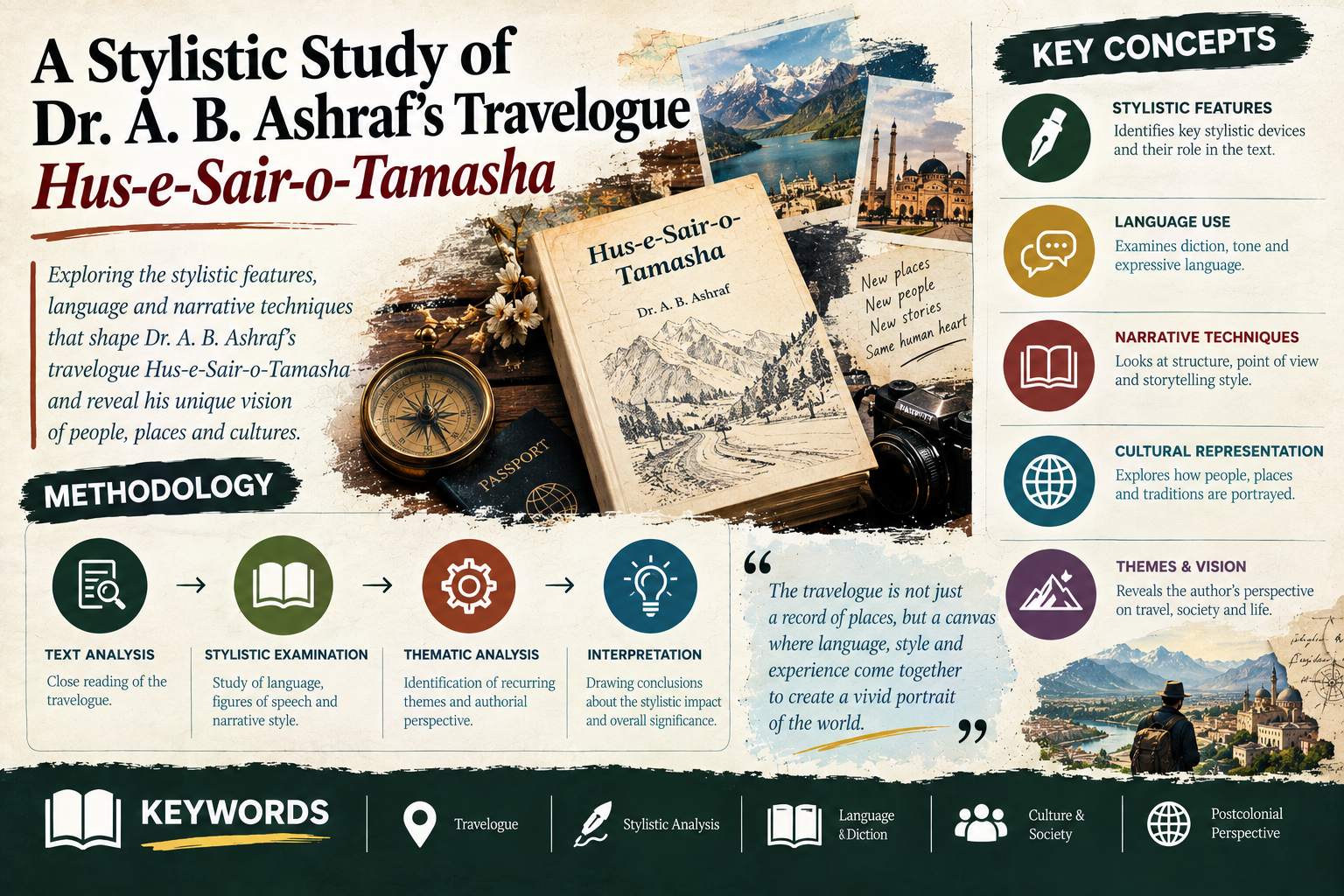
A Stylistic Study of Dr. A. B. Ashraf’s Travelogue Hus-e-Sair-o-Tamasha
DOI:
https://doi.org/10.63056/jllsa.2.6.2026.378Keywords:
Wanderlust and Sightseeing, Scenic Description, Historical Awareness, Cultural Study, Social Analysis, Satire and Humor, Comparative Study, Western Society, Eastern Society, Social Values, Human Thought, Cultural ObservationsAbstract
This study examines the travelogue Hus-e-Sair-o-Tamasha by Dr. A. B. Ashraf from a research and critical perspective. The study focuses on the writer’s observations of Turkey, Australia, Germany, Belgium, France, Italy, Hungary, Bulgaria, Romania, and other European regions. It highlights the major characteristics of his travel writing, including simplicity, fluency, spontaneity, vivid description, historical awareness, humor, romantic sensibility, and social criticism. Dr. A. B. Ashraf does not restrict his narrative to geographical and recreational experiences; rather, he explores the history, culture, architecture, public facilities, cleanliness, transportation, lifestyle, economic conditions, religious practices, and social values of different societies. His comparative observations of Eastern and Western cultures reveal both the strengths and weaknesses of these societies. The study also examines his criticism of social hypocrisy, superstition, sectarianism, moral contradictions, and economic inequality, alongside his appreciation of discipline, hard work, cleanliness, education, and human freedom. His emphasis on humanity, tolerance, mutual respect, and peaceful coexistence gives the travelogue a distinctive intellectual dimension. Overall, Hus-e-Sair-o-Tamasha emerges as more than a record of travel; it is a literary work combining geography, history, culture, society, economics, aesthetics, and human experience.
Downloads
Published
How to Cite
Issue
Section
License
Copyright (c) 2026 Arooj Fatima, Dr. Imtiaz Hussain Baloch, Nida Saeed

This work is licensed under a Creative Commons Attribution 4.0 International License.