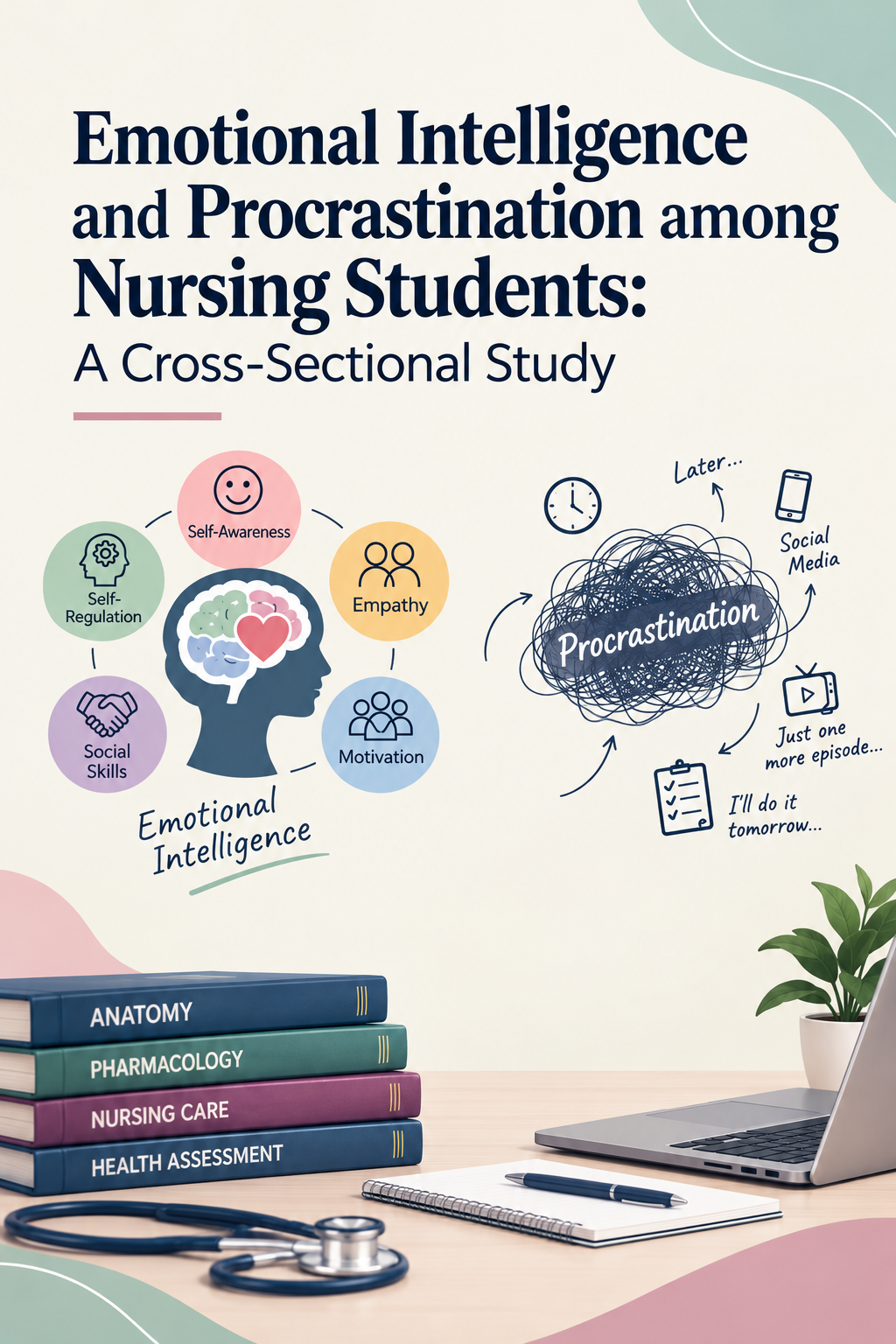
Emotional Intelligence and Procrastination among Nursing Students: A Cross-Sectional Study
DOI:
https://doi.org/10.63056/jllsa.2.10.2026.384Keywords:
Emotional intelligence, Procrastination, Emotion regulation, Nursing students, Academic delayAbstract
This study examined the relationship how emotional intelligence and academic procrastination are related in nursing students. A cross-sectional design and convenience sampling was used. Three hundred female nursing students aged 18 to 30 were chosen from nursing colleges in Faisalabad, Pakistan. They filled out the Schutte Self‑Report Emotional Intelligence Test (SSEIT) and the General Procrastination Scale (GPS). The data analyzed with SPSS 27 using Pearson product moment-correlation, multiple linear regression. Emotional Intelligence and its subscales—managing others’ emotions, managing own emotions, perception of emotions and utilization of emotions were all positively linked to each other. Each part was negatively linked to procrastination. Emotional Intelligence as a whole predicted procrastination (β = ‑0.26) and explained 7 % of the changes. In the regression only managing own emotions had a strong negative effect on procrastination (β = ‑0.51); the other parts did not matter much. Emotional Intelligence fell as students moved to years but procrastination stayed about the same. Birth order, marks percentage or work experience did not change these patterns. The results show that the ability to manage one’s emotions is the emotional intelligence part that matters most for procrastination. Emotional skills may weaken as training goes on. Adding emotional intelligence training to nursing programs could help.
Downloads
Published
How to Cite
Issue
Section
License
Copyright (c) 2026 Bismah Shahid, Maha Nasir, Umama Maqbool, Sumaira Akhter, Eman Fatima

This work is licensed under a Creative Commons Attribution 4.0 International License.