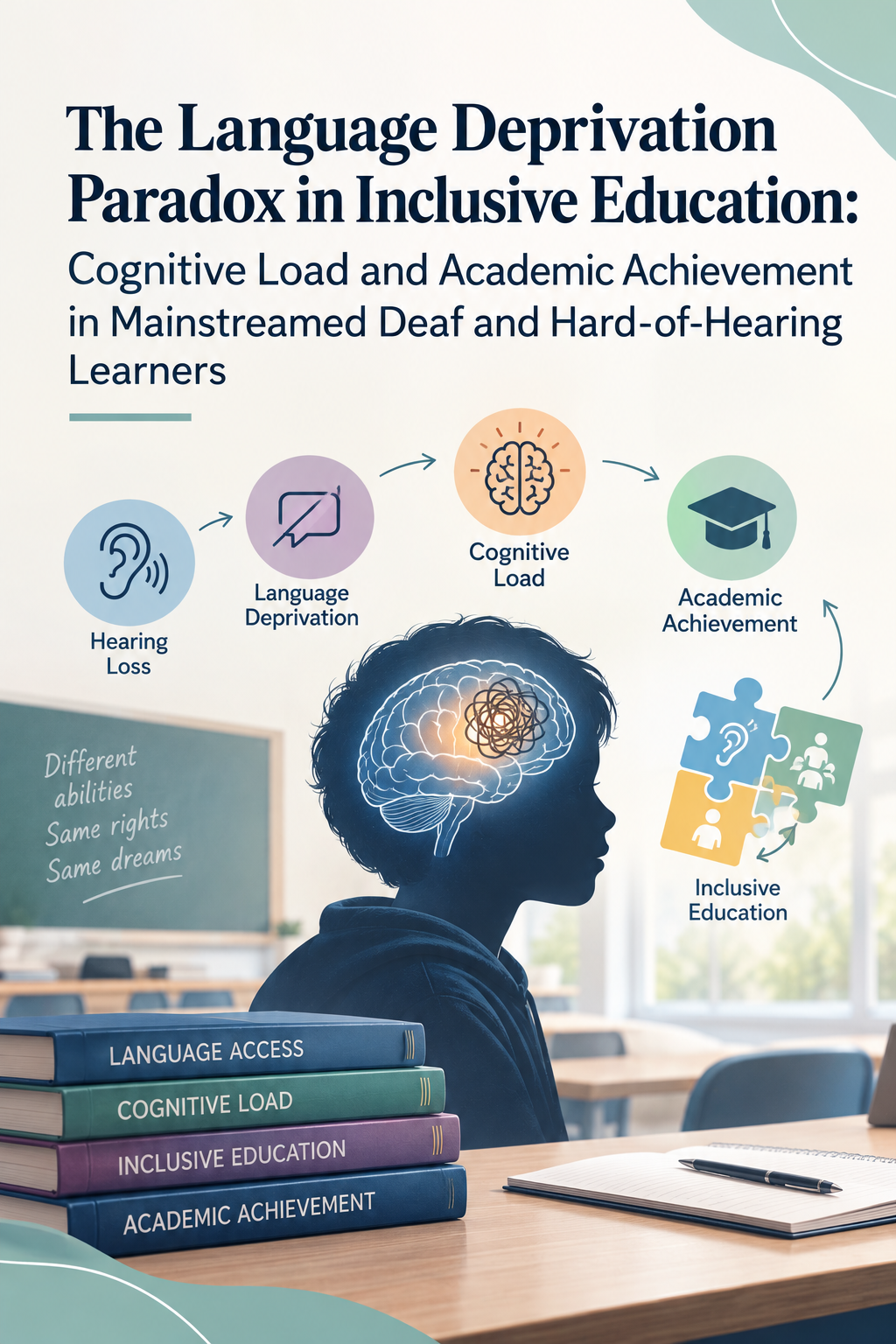
The Language Deprivation Paradox in Inclusive Education: Cognitive Load and Academic Achievement in Mainstreamed Deaf and Hard-of-Hearing Learners
DOI:
https://doi.org/10.63056/jllsa.2.10.2026.385Keywords:
Language Deprivation, Cognitive Load, Academic Achievement, Deaf and Hard-of-Hearing Learners, Inclusive Education, Language Access, Educational Development, Academic LearningAbstract
The present study examined the language deprivation paradox in inclusive education by investigating the relationship among language deprivation, cognitive load, and academic achievement among deaf and hard-of-hearing learners in Punjab, Pakistan. The study focused on understanding how limited access to accessible language may influence learners’ cognitive processing demands and academic development within educational settings. A quantitative research design was used, and data were collected from 180 deaf and hard-of-hearing learners selected through purposive sampling. A structured self-administered questionnaire was developed specifically for the present study to measure language deprivation, cognitive load, and academic achievement. The questionnaire was administered online through Google Forms, and the completed responses were initially organized and coded in Microsoft Excel before being transferred to IBM SPSS Statistics for statistical analysis. Descriptive statistics and reliability analysis were used to examine the study variables, while Pearson Product-Moment Correlation and Multiple Linear Regression were applied to examine the principal relationships and predictive effects among the study variables, while One-Way Analysis of Variance was conducted as an additional exploratory analysis. The findings indicated a significant positive relationship between language deprivation and cognitive load, whereas academic achievement was significantly negatively associated with cognitive load. Multiple regression analysis further showed that language deprivation significantly and positively predicted cognitive load, while academic achievement significantly and negatively predicted cognitive load. An additional exploratory analysis indicated significant differences in academic achievement across different levels of language deprivation. Overall, the findings highlight the interconnected roles of language access, cognitive demands, and academic achievement among deaf and hard-of-hearing learners.
Downloads
Published
How to Cite
Issue
Section
License
Copyright (c) 2026 Muhammad Adeel Alam

This work is licensed under a Creative Commons Attribution 4.0 International License.