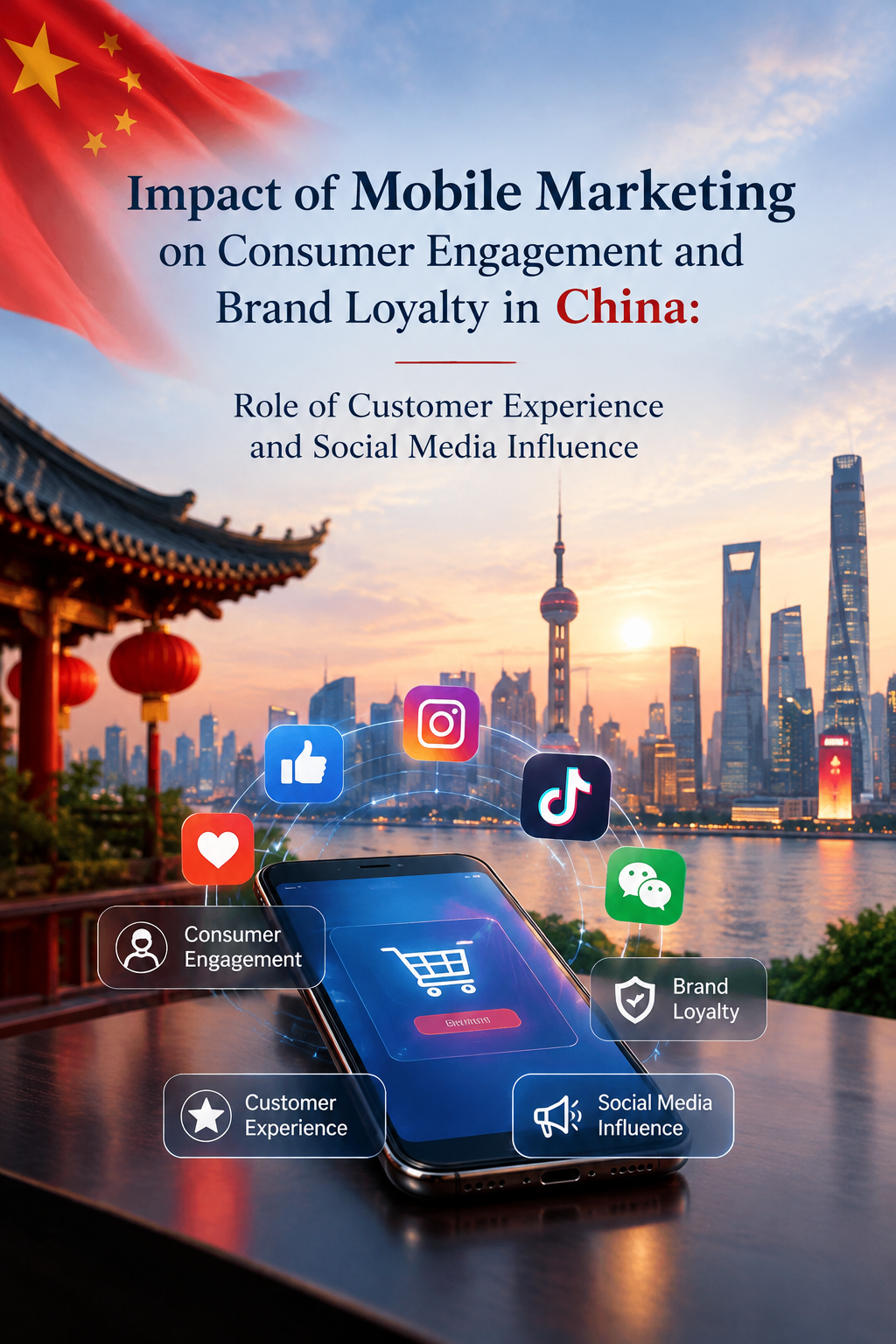
Impact of Mobile Marketing on Consumer Engagement and Brand Loyalty in China: Role of Customer Experience and Social Media Influence
DOI:
https://doi.org/10.63056/jllsa.2.10.2026.390Keywords:
Mobile marketing, consumer engagement, brand loyalty, customer experience, social media influenceAbstract
The present study examines how mobile marketing impacts consumer engagement and brand loyalty in China's post-2020 mobile ecosystem, a period characterised by enforcement of the Personal Information Protection Law (PIPL), the rise of Key Opinion Consumer (KOC) influence over Key Opinion Leader (KOL) channels, and the maturation of live commerce as a dominant retail format. A qualitative multiple case study design (Yin, 2018) is employed, examining three strategically selected brands (Luckin Coffee, Li-Ning, and Starbucks China) representing digital-native, domestic heritage, and foreign premium archetypes. Data are drawn from audited annual reports, industry intelligence reports, expert media commentary, and business school teaching cases, and analysed through a two-phase thematic analysis combining deductive coding against four theoretical frameworks with inductive coding for emergent themes. The findings confirm that mobile marketing positively drives consumer engagement and brand loyalty across all three cases, with active formats (gamified rewards, live commerce participation, and social gifting) consistently outperforming passive formats. Customer experience mediates mobile marketing-loyalty relationships in all three cases, but hedonic customer experience produces more durable loyalty than functional customer experience under competitive price pressure. Social media influence moderates effectiveness through three distinct mechanisms, namely organic product amplification (Luckin Coffee), macro-cultural amplification (Li-Ning), and designed social proof (Starbucks China), corresponding to compliance, identification, and internalization in Kelman's (1958) social influence theory. The study extends Oliver's (1999) four-stage loyalty model by introducing source-contingent loyalty progression, in which the durability of loyalty depends on the type of customer experience and the mechanism of social media influence rather than on mobile marketing investment intensity alone. The findings advance scholarly understanding of mobile marketing effectiveness in a non-Western, mobile-first digital economy and offer actionable strategic guidance for brands seeking durable customer relationships in China's competitive marketplace.
Downloads
Published
How to Cite
Issue
Section
License
Copyright (c) 2026 Muhammad Musa Maqsood

This work is licensed under a Creative Commons Attribution 4.0 International License.